Export and Import Payments: How Furniture Manufacturers Can Avoid Foreign Currency Penalties

Practical guide prepared by the law firm Honcharuk & Partners for UAFM members: furniture exports and imports of fittings and equipment during wartime.
You have shipped furniture to a buyer in Poland, but the payment has still not arrived. Or you have made an advance payment for a machine from Italy, but the equipment has yet to be delivered. The Ukrainian tax authorities consider such situations a violation of foreign currency settlement deadlines and may impose penalties that can eventually equal the value of the transaction.
Many business owners assume that the war automatically exempts them from such penalties. In reality, this is not the case. You can protect your business, but you need proper documentation, and it is important to prepare it without delay.
How Much Time Do You Have?
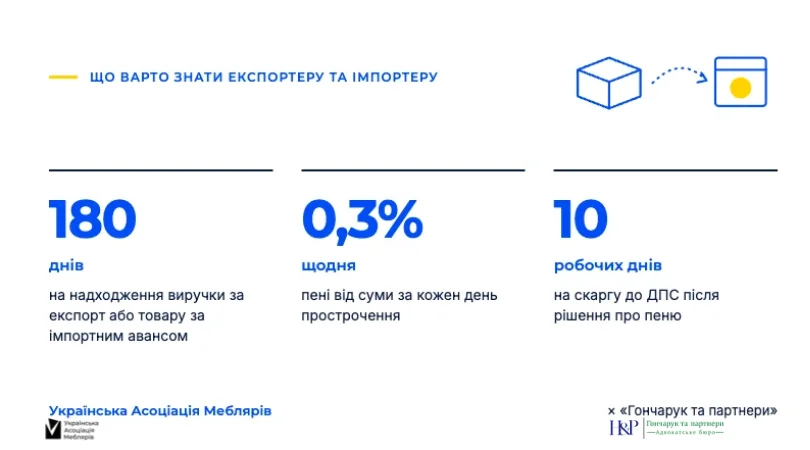
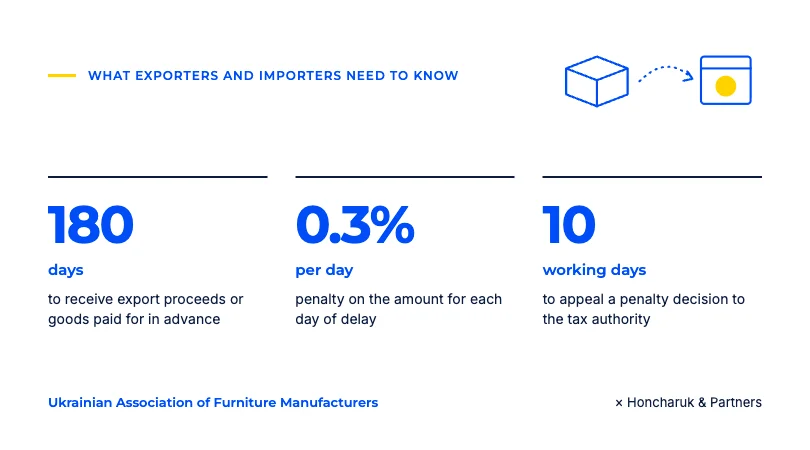
Exports. Payment for exported furniture must be credited to your account at a Ukrainian bank within 180 days from the date of customs clearance.
Imports. If you have made an advance payment to a foreign supplier for furniture fittings, wood-based panels, varnishes, or equipment, the goods must be delivered within 180 days from the date of payment.
This deadline is established by the National Bank of Ukraine and remains in effect during martial law. A contract may specify a shorter period, but not a longer one.
How Much Does a Delay Cost?
The penalty amounts to 0.3% of the outstanding amount for each day of delay.
For example, suppose a buyer owes you EUR 40,000 and the 180-day settlement period has already expired. Starting from the following day, a penalty equivalent to EUR 120 accrues daily (calculated in Ukrainian hryvnias at the NBU exchange rate).
After approximately 11 months, the accumulated penalty may equal the outstanding debt. The total penalty cannot exceed the amount owed, but even this limit represents a significant financial burden.
The penalty is assessed by the Ukrainian tax authorities during a company audit. Banks report overdue foreign trade transactions to the tax authorities, so businesses should not assume that such delays will go unnoticed.


How This Applies to Furniture Manufacturing
Penalties may arise even when neither party has deliberately breached the contract. For example, you make an advance payment for a CNC machining center, but the manufacturer needs seven months to produce it. The 180-day period expires before the equipment is even shipped, and penalties are calculated on the entire advance payment.
That is why, during contract negotiations, it is worth agreeing that most of the payment will be made once the equipment is ready or shipped. If the supplier insists on a substantial advance payment, arrange an extension of the settlement deadline in advance (the procedure is explained below).
Another common situation involves complaints about defective goods. A shipment of furniture fronts arrives in Germany damaged, and the buyer withholds 10% of the payment. You consider this a discount for defective products, but the tax authorities see it as outstanding export revenue. To ensure that the debt is also reduced in the official documentation, formalize the discount or return of goods in a document signed by both parties.
Sometimes, an EU dealer sells your furniture slowly and pays you only after selling it. In this situation, keeping track of deadlines is essential: you must take action before the 180-day period expires.
Why Simply Referring to the War Is Not Enough
This is clearly illustrated by two cases considered by the Supreme Court of Ukraine. Our law firm did not participate in either case, and the parties involved were not our clients.
A Case the Exporter Lost
An agricultural trading company from Kharkiv sold products to a buyer in Slovakia, who failed to pay. The company had force majeure certificates issued by the Chamber of Commerce and Industry, while the original contracts had been destroyed in a missile strike on a grain elevator.
The tax authorities imposed penalties exceeding UAH 21.5 million. The courts of first instance and appeal ruled in favor of the company, but in 2025, the Supreme Court upheld the penalties.
The Court highlighted several important points.
The certificates referred to the war in general rather than explaining why the buyer had failed to pay under those specific contracts. The company continued signing new agreements and shipping goods during the war, indicating that the war had not prevented it from conducting business.
The Court also did not accept the destruction of the original contracts as sufficient grounds for force majeure, because the company failed to explain why it had not filed a lawsuit against the buyer even without those documents.
Furthermore, tax relief measures introduced during the COVID-19 pandemic and martial law do not apply to foreign currency settlement penalties, which are governed by separate legislation.
If your EU buyer has not paid for a shipment of kitchens while you continue supplying products to other customers, simply referring to the war will not protect you from penalties.
A Case the Importer Won
A Kyiv-based retail chain ordered equipment, including design and installation services, from an Italian company and made advance payments.
After February 24, 2022, Italian specialists could no longer travel safely to Ukraine. On March 7 and 14, the parties signed supplementary agreements suspending performance of the contract for the duration of hostilities.
The Italian company eventually refunded the advance payment, but after the applicable deadline. The Ukrainian tax authorities imposed penalties of UAH 8.2 million. However, courts at all three levels overturned the penalties.
In this case, the company had promptly documented the suspension of the contract and identified the specific reason: the contractors could not safely reach the installation site.
The Chamber of Commerce and Industry's force majeure certificate covered the relevant period and the specific contractual work. Although the company obtained the certificate after the tax audit, the Court still accepted it because the suspension had been documented back in March 2022.
Some original documents had also been destroyed, but the company prepared an official record of their loss and requested duplicates from its counterparty.
The same principle applies to a furniture manufacturer whose foreign supplier cannot deliver and install a production line because its installation engineers cannot travel to Ukraine. The contract should be suspended immediately through a supplementary agreement explicitly stating this reason.
In the first case, the company had only general documentation referring to the war. In the second, the suspension of a specific contract was documented when the circumstances arose.
The law expressly provides that when contract performance is suspended due to force majeure, the settlement deadline is suspended and penalties do not accrue. This rule applies to both exports and imports.
What You Can Do Before the Deadline Expires
The Ministry of Economy of Ukraine may extend the settlement deadline for a specific transaction. The relevant conclusion is issued free of charge, and a decision is made within 10 working days. However, the application must be submitted before the 180-day period expires.
If a buyer simply fails to pay, you may initiate legal proceedings before a court or international arbitration tribunal.
The settlement deadline is suspended from the date the claim is accepted for consideration. If you win, penalties are payable only for the period preceding that date. If you lose, penalties are calculated for the entire period.
Therefore, filing a lawsuit makes sense only when you have sufficient evidence to substantiate the debt.
Checklist for Furniture Manufacturers
1. Include a force majeure clause in every international contract. Specify the right to suspend performance, notification deadlines, and the documents required to confirm force majeure circumstances.
2. Purchasing equipment with a long production lead time? Link the main payment to shipment or arrange an extension of the settlement deadline in advance.
3. If payment or delivery is delayed, act immediately. Within the same week, document the suspension of contractual performance through a supplementary agreement or formal letter, clearly stating the reason.
4. Obtain supporting force majeure documentation. Request a certificate from the Chamber of Commerce and Industry or a competent authority in your counterparty's country relating to the specific contract. Collect evidence showing exactly how the circumstances prevented performance.
5. Document discounts and returns properly. Any discount for defective goods or return of products should be confirmed by a document signed by both parties.
6. Keep a settlement deadline calendar. Track 180 days from customs clearance for exports and from advance payment for imports. One month before the deadline, decide whether to extend the period, file a lawsuit, or suspend the contract.
7. Remember that the war itself does not automatically exempt you from penalties. Neither general references to the war nor wartime tax relief measures automatically eliminate foreign currency settlement penalties.
8. Received a tax decision imposing penalties? An administrative appeal to the State Tax Service of Ukraine must be submitted within 10 working days of receiving the decision.
Bonus Guide for Furniture Manufacturers
“Business Fragmentation Through Individual Entrepreneurs: Where Is the Line?” (November 2026)
This practical guide explains how to assess your company's business model involving individual entrepreneurs (FOPs), identify potential risks from the tax authorities' perspective, and understand your business rights if a tax audit has already begun.
To receive the guide, please contact Honcharuk & Partners using the contact details below.
About the Authors
This material was prepared by the attorneys of Honcharuk & Partners.
Our law firm handles disputes with tax authorities concerning foreign currency settlement deadlines and penalties and reviews international trade contracts before they are signed.
Legal consultations for furniture manufacturers:
+38 (067) 243 33 64
+38 (095) 560 39 77
[email protected]
Sources: Law of Ukraine “On Currency and Currency Operations”; Resolution of the Board of the National Bank of Ukraine on the operation of the banking system during martial law; Supreme Court rulings issued in 2025; review of the case law of the Administrative Cassation Court concerning the tax consequences of force majeure (November 2026). Our law firm did not participate in the cases discussed.
This material is provided for informational purposes only and does not constitute legal advice. The legal information reflects the legislation in force as of the publication date.