

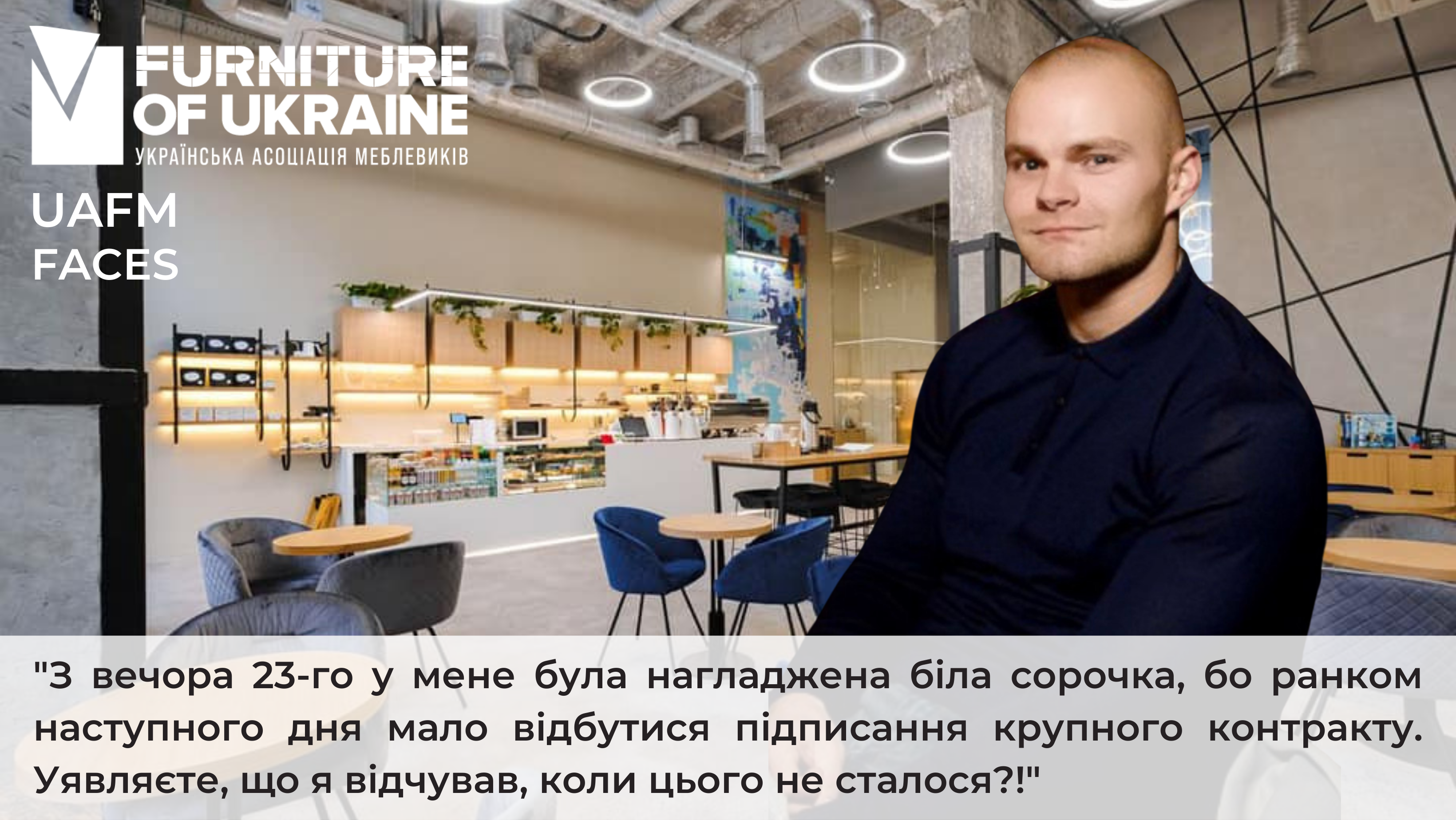
UAFM in the faces: Dmytro Yushchenko told why the Horeca Furniture company, which implemented dozens of large projects for powerful investors, has now reformatted its client priorities
The beginning of the war was psychological stress for every Ukrainian. To the head of the capital company “Horeca Furniture” Dmytro Yushchenko, last year’s terrible morning of February 24 dealt an unpleasant blow – not only, like most, by the very fact of the start of the war.
– Since the evening of the 23rd, I had an ironed white shirt, because the next morning an unusual event for our company was supposed to happen: the signing of a large contract for the implementation of a large-scale project. For an amount that was commensurate with the company’s annual turnover. Can you imagine how I felt when that didn’t happen?! I experienced this feeling again when, two months later, I returned to Kyiv, entered the apartment, and saw that white, ironed white shirt…
Of course, such a huge lost business profit could not but depress the entrepreneur, the head of the company, but, as they say, it still did not manage to knock him out of the saddle. Neither the management nor his numerous team. Among other things, obligations to clients remained unfulfilled – unfinished projects started before the war, and unfinished objects. Some of them, perhaps, even now, says Mr. Dmytro, would have been “on pause” if not for the efforts of the managers, who in April, when the company was ready to resume operations, called all customers, assuring them that, despite all the existing difficulties of wartime, nevertheless, it is worth finishing what was started, that the company has not lost its ability to work as it has always worked and is ready to continue to prove it. And despite the fact that it was necessary to adjust the price parameters of the contracts already agreed upon before the war due to the fact that the dollar exchange rate has changed, the prices of materials and components, especially imported ones, have increased. Clients were forced to recognize the objectivity of such price adjustments. Moreover, some projects were already paid by the customers for eighty percent and ready for the same amount.
They persistently fought for projects that were not yet at the approval stage at the beginning of the war. Of these, not all could be brought to signing, some will probably remain “frozen” until the end of the war.
But it was not only unfulfilled obligations to clients that mobilized the team headed by Dmytro Yushchenko to resume operations when hordes of occupiers were pushed out of the Kyiv region. The company, which was entrusted with the implementation of their large-scale and often quite complex projects by world-renowned brands, had a sufficient margin of strength not to bend before the adversities of wartime.
– Apparently, as in almost all of our furniture stores, the number of new orders at your company decreased last year for objective reasons. What often prevents potential clients from starting new projects and how do you still manage to get them in such a situation?
– The most common deterrent factor is the uncertainty of the near future. In addition, Internet networks disorient and even intimidate people with a stream of contradictory information, populist forecasts, and pseudo-expert assessments of prospects. They are scared by a new large-scale offensive of the enemy, then by an invasion of Belarus, then by a nuclear threat.
But there are also many companies and private investors who can be called either brave or optimists. We are counting on them. I will casually say that understanding the complexity of the situation in which Ukrainian businessmen-manufacturers found themselves, and having an idea of how and how it can affect us specifically, we changed our priorities in the search for clients in the spring, so to speak, betting on small projects, for corporate customers working in small and medium-sized businesses. After all, as practice shows, it is now much more difficult for large companies to stay afloat, and now they are not ready for those large-scale renewal projects, large-scale development steps, which they demonstrated before the war and which we counted on as the general contractor of those projects. Such reformatting of client priorities, as the summary of last year, showed, justifies itself. The company only asked for thirty percent. Of course, this is a shame for us, but nevertheless, it is still the level that allows us not only to prove the viability of the company, and the ability to work with profit, but also to keep the team, providing them with work.
