

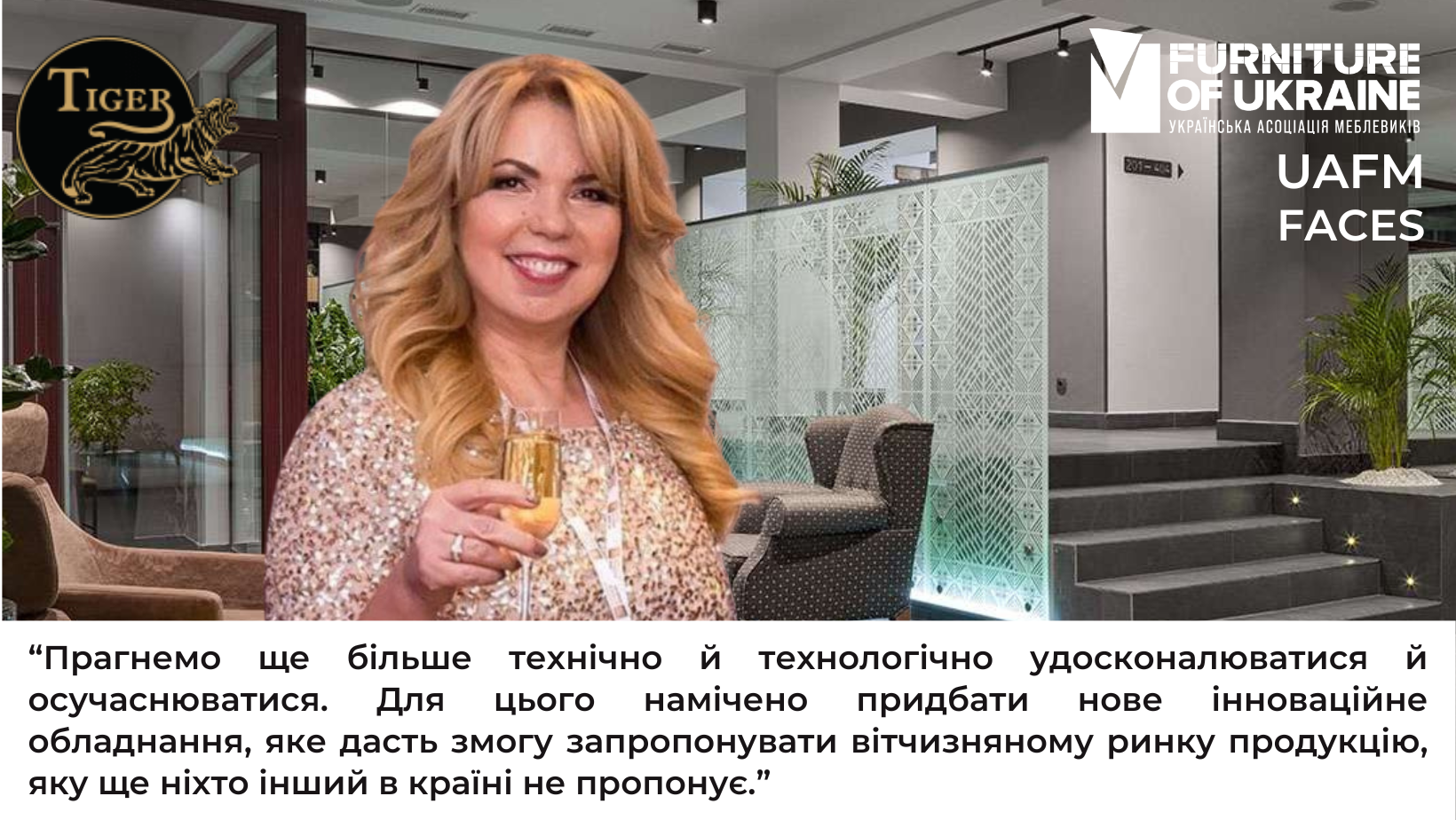
UAFM in Faces: Victoria Moroz, the owner of the “Tiger” company, spoke about how innovative production remains the main component of the company’s development.
The capital company “Tiger” is one of the few in our furniture community that does not directly manufacture furniture. It creates modern high-tech decors that, combined with furniture and other attributes, form a holistic interior ensemble. “Tiger” is a leading domestic manufacturer of exclusive decorative items, mainly from glass – both interior and exterior: stair railings, panels, mosaics, stained glass windows, decorative triplex. The company is capable of providing services to furniture manufacturers when they need to decorate their products. Most often, furniture manufacturers resort to decorating furniture facades. And not just glass ones.
The company boldly combines the latest industrial printing technologies with unique developments of its creative team, with the exquisite intuition of talented designers, to create both unique exclusive products and high-level decorative collections with excellent functionality and aesthetics.
When the company was founded 16 years ago, ultraviolet dominated the sphere of activity in which it decided to specialize. But as soon as UV printing began to give way to more progressive and versatile nanotechnologies, “Tiger” immediately “armed” itself with them as well. Promptly introducing technical and technological innovations in the field of decorative printing into its production, quickly responding to market demands and trends – this became the company’s habitual need, an important component of its development. The current difficult period for the domestic business and economy of a country at war was no exception. “Tiger” plans to take a significant innovative step in its development this year as well, which will be discussed further.
Meanwhile, we asked the company’s owner, Victoria Moroz, what the two years of war were like for “Tiger” and whether there was a difference between them.
– They were definitely difficult, as I’m sure they were for all our colleagues in the Association and for Ukrainian producers in general. The war and the market crisis it caused still do not allow us to reach the pre-war level of production and sales, although this winter – despite the fact that a market activity slump is traditionally characteristic for this period – adds optimism. We have been and continue to receive orders quite intensively.
And if we are to compare the two difficult war years, last year was still more favorable for the company. In the energy sense, that is, without prolonged power outages.
– But almost all producers critically dependent on electricity adapted quite quickly to blackouts by purchasing generators for autonomous power supply of their needs back then.
– Yes, but for us, autonomously generated electricity cannot be a lifesaver. The specifics of modern nanoprinting equipment are such that it can only operate from the mains. Some parameters of autonomously generated electricity are different, which makes it unsuitable for our equipment. So when there were power outages in ’22, the company’s printing work stopped completely.
– Nanotechnology printing is, of course, more advanced compared to ultraviolet printing. How exactly did it contribute to the company’s development?
– It allowed the company to become more versatile. To move from fulfilling individual orders and creating separate decorative elements to comprehensively decorating interiors of large facilities. If I were to confirm this with examples of specific projects currently in progress, I would name the Lviv business center “Dominanta”, whose interior decoration we are just completing, a hotel in Pushcha-Vodytsia, and also the “Bartolomeo” residential complex in Dnipro.
Glass, which is, figuratively speaking, already in “Tiger’s” DNA, was and remains the main material that serves as the basis for decorative printing. But nanotechnologies equally allow for high-quality image application on the surfaces of other materials – metal, ceramics, plastics, wood and composite materials. Again, working with such a range of materials also contributes to us being commissioned for comprehensive decoration projects.
– Speaking of wood, the material that most members of our Association work with, since they are mostly furniture manufacturers, which wood species are most suitable for nanoprint decoration?
– Actually, all of them. But I would especially highlight ash with its beautiful texture, which nanoprinting does not make invisible.
– Do you have any foreign orders?
– We always did, but now we have to refuse most complex projects, because, as you know, our installers cannot travel abroad. But I wouldn’t say that export deliveries have completely stopped either. We send complete products that do not require installation abroad. For example, we recently sent a batch of lamps to Barcelona for one of the hotels there. There were similar deliveries to the African continent as well.
– The war is ongoing, and business is just as difficult, but every ambitious company, every creative entrepreneur finds an opportunity, even in such conditions, for progress, even if not significant, in the development of their company. Is “Tiger” one of those? Do you have plans of this kind for the current year?
– We do. We strive to further technically and technologically improve and modernize. For this purpose, we plan to acquire new innovative equipment that will allow us to offer the domestic market products that no one else in the country offers yet.
– Well, I wish you success, may what is planned come to fruition.
