

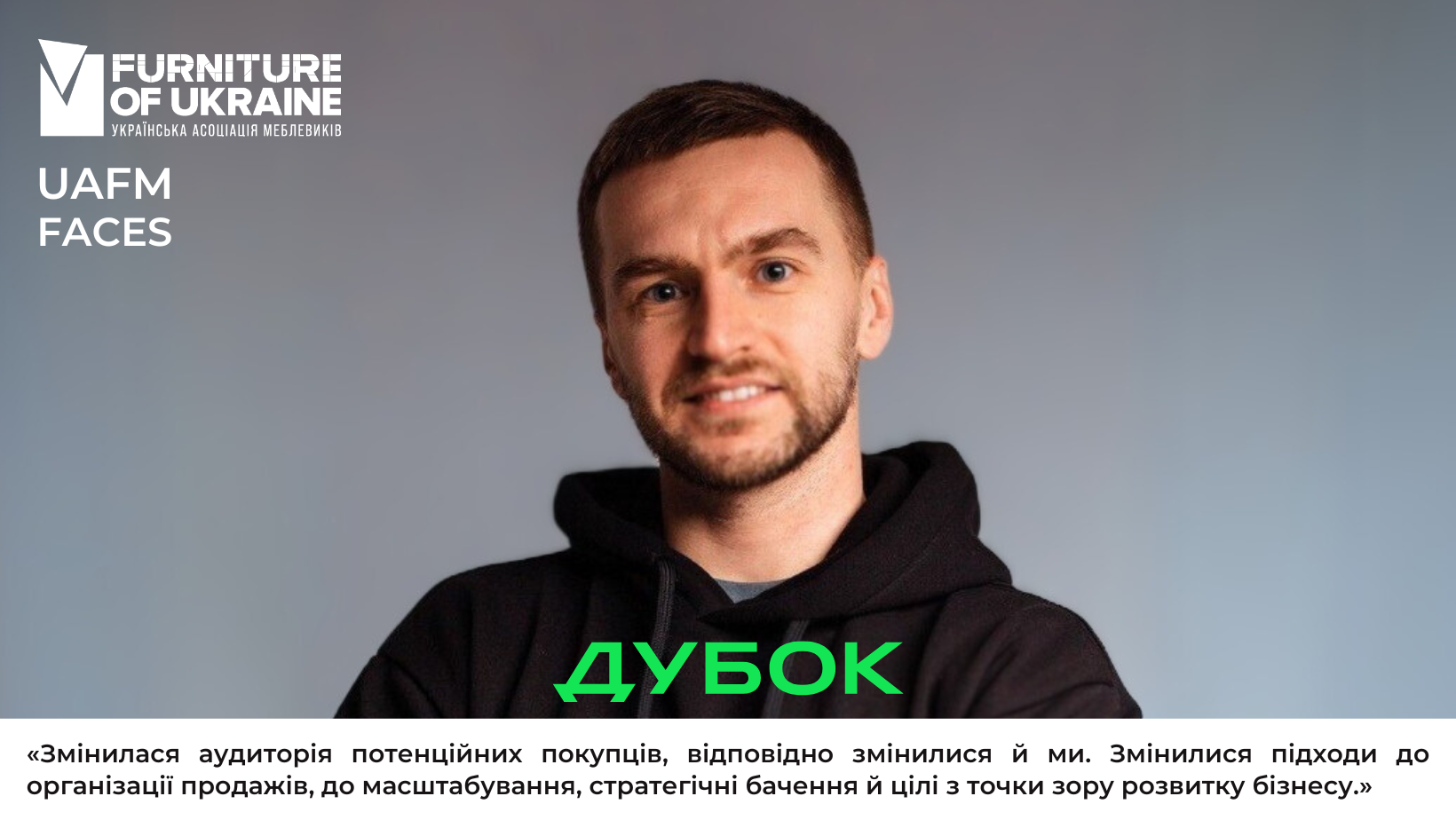
UAFM in Faces: a story by Anton Yumaiev, Marketing Director at Dubok
The stagnation of the domestic furniture market, caused by the beginning of the full-scale invasion, has equally affected both furniture manufacturers and their retail partners — furniture retailers. The dependency is direct: the fewer products sold, the fewer produced. Both sides began actively adapting to the new challenging circumstances. Three years later, statistics show that most companies — some more successfully than others — have adapted.
We spoke with Anton Yumaiev, Marketing Director of “Dubok”, to find out how this adaptation took place within the company.
— The target audience has changed — and we have changed accordingly. Our approaches to sales, scaling, and business development strategy and goals have also shifted.
First of all, we decided to focus on developing our business in Europe, since that market is more stable and predictable than our domestic one. That said, the Ukrainian market is no longer as unstable as it was during the first year of the war. Despite the continuing challenges, it remains a priority for us. The foreign direction is our experiment, which started in startup format right after the full-scale invasion. It is developing in parallel with our efforts to strengthen positions in the domestic market.
— How far have you progressed with your international expansion?
— Some things are already up and running; others are in active development. For example, we’ve opened our first showroom in Prague. We’re also setting up online sales in the Czech Republic, and another online store will soon launch in Slovakia.
— What can be done to improve service in Ukrainian furniture retail?
— For us, it’s important that the fairly high level of customer service we had before the full-scale war has been maintained even in these tougher conditions.
Of course, there’s always room for improvement, and furniture retailers could offer a wider range of services and move to a higher level — but is the customer ready to pay for that? We clearly understand that our segment is currently not ready. So it’s important to maintain a balance between what we can offer and what our customers can afford.
It’s also important to consider that the level of service largely depends on the price segment of the furniture sold by a given retailer. For instance, we focus on the mid and slightly lower price segments. Customers in this category don’t expect the kind of in-depth service a premium client might. For example, services like a personal account manager guiding the customer from order placement to final installation.
— Your company can fairly be called a socially responsible furniture retailer. That’s backed by the fact that your team actively participates in reforestation and urban greening efforts — planting thousands of trees every year. Are you still doing that during the war?
— Let’s just say — we’ve resumed it. At the start of the full-scale invasion, we focused on helping the army, supporting displaced people, and caring for our staff. But in time, we returned to tree planting. A recent example: in April, we responded to an initiative by the Lviv City Council and helped green the Sykhiv district by planting maple and cherry blossom trees.
— So this year, you’ll be working on more than just international expansion?
— Yes, we have other plans — and they’re quite ambitious. We aim to scale our retail network, update our product line, and expand our assortment, including through private collections. This will allow us to offer our potential customers the exact products they need.
