

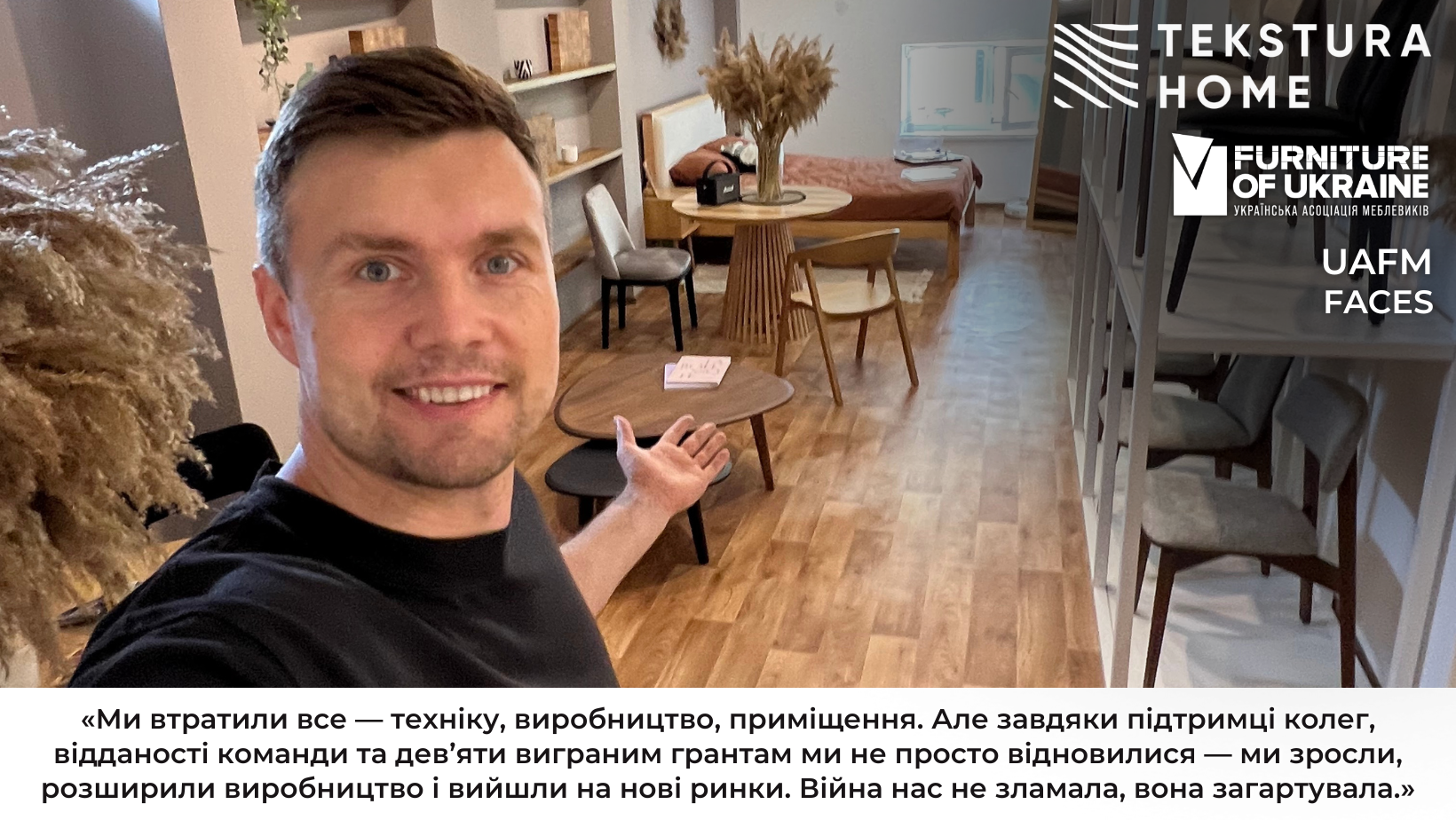
UAFM in Faces: the story of Anton Molchanov, Owner of Tekstura Home
We feel deep sympathy, but also immense respect and admiration for those members of our furniture community — the companies that, despite suffering greatly due to the war, managed to rise again, sometimes from scratch, and continue doing what they do best. This story is about one of them.
“Tekstura Home” used to have its production facilities in Luhansk and Kharkiv regions. “Used to,” because now they are gone. The company is now operating in the Lviv region.
Relocated? Not quite — it can’t really be called a relocation. All of the company’s production capacity, machinery, and equipment were left behind. Some were destroyed by shelling, some looted during the occupation, and the rest cannot be transported out. Due to the proximity to the frontline, no transporters are willing to go there.
And yet — the company resumed operations! How?
According to owner Anton Molchanov, it was thanks to the help of colleagues — local furniture makers from Lviv. The company that extended a helping hand had seen a drop in production volumes due to the war, which freed up personnel and equipment. Molchanov proposed a partnership: he would use their resources to restart his own production based on their “foundation.” They reached an agreement. It’s essentially an outsourcing partnership: “Tekstura Home” pays an agreed percentage of profit for using the partner’s staff, equipment, and premises.
— So you had enough space and equipment to resume production. But what about people? Labor shortages, especially qualified ones, are an issue across the country.
— Some of our previous team — mostly managers — stayed with us. But they’re scattered across Ukraine and beyond — Kyiv, Odesa, Ternopil, Khmelnytskyi, Poltava, Kolomyia. One is even in Spain. So they work remotely. But we had to form a new production team from scratch. And like many others today, we started offering positions traditionally held by men — to women.
As for equipment, to meet the needs of our production and to become more self-reliant, we’re still buying new machines. We use our own reinvested funds, but mainly grants — we’ve won nine grants during this time.
And all this while the new equipment we purchased before the war, in anticipation of scaling up, remains unpacked and inaccessible. We’ve already written it off.
— Have you restored your pre-war product range?
— As for furniture — mostly yes. Some outdated models were replaced with new designs, as we’ve done periodically before. But at our new location, we launched an entirely new line — textile production. We now make bed linens for adults and children, baby blankets and “sleeping cocoons,” duvets, pillows, and even toys. The textile line is diverse. We also make mattresses. And in this line, we are now completely independent from our hosting partners.
This textile production also helped expand our furniture offerings. Now we produce not only beds but also sofas — fully soft furniture.
— What are your plans for this year?
— Export. We already have occasional international sales, but that’s not enough. We need to make exports consistent. We’re starting with an English-language website. Eventually, we’ll begin participating in exhibitions — something essential for long-term export success. You understand that in our current situation — given what the company went through at the start of the war — such large-scale projects take time to realize.
