

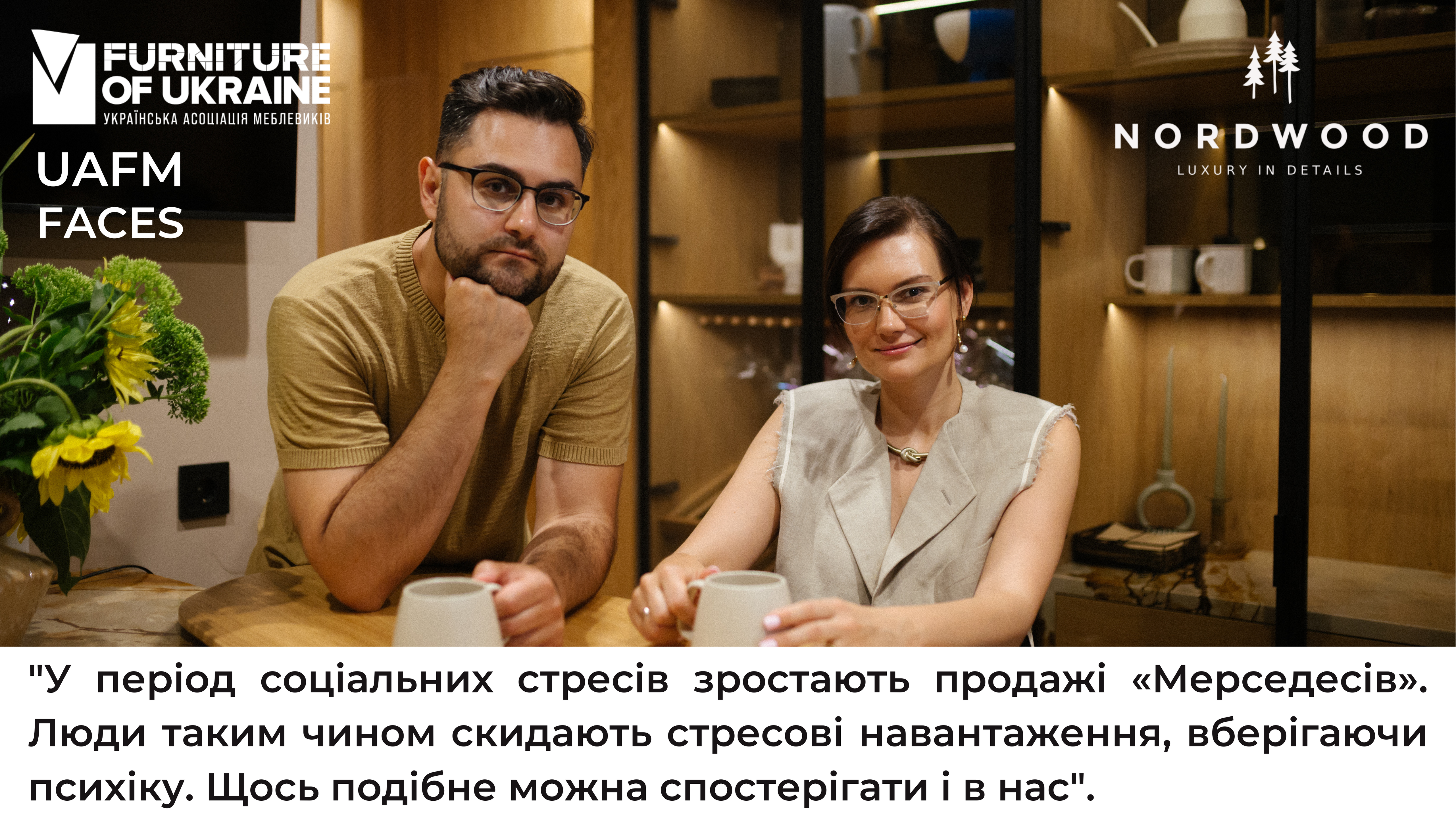
UAFМ in the faces: Nordwood company, as its founders have revealed, has been able to implement two new directions in its development over the past one and a half years.
Conversations with the couple Inna Osadcha and Vitaliy Mali about how their company “Nordwood” is faring in the current conditions had to be rescheduled twice. Busy people: they had to visit several sites, and oversee the progress of comprehensive residential design projects for clients, which is, in fact, the specialization of “Nordwood” since its inception. In the work the company successfully performs, every project detail demands meticulous attention, both during the factory production stage and when the interior is being created directly on-site.
– Well, so the company is doing well? – We ask, hoping that its leaders’ daily business hustle and bustle will confirm this assumption.
– And indeed, there’s no reason to complain, – Mrs. Inna confirms. – Of course, it’s not the same order volume as in better times, and the stability of their inflow is not the same, but we’re pleased with the current conditions. We’re also pleased that the domestic market is showing increasing resilience every month, which, honestly, we had little hope for at the beginning of the war.
If we go back to last year, when the countdown to the national disaster began, the owners ‘locked’ the company – meaning its physical dimensions (production facilities, office) until the summer, just like thousands of Kyiv residents secured their families in the western part of the country. But they were concerned about the company’s future as much as they were about their families, given the new adverse realities. Indeed, considering the state of the domestic market, which was fighting for survival under the capital’s walls, the company’s prospects shifted towards the Western direction. They started looking for their place in foreign markets. And they were somewhat successful. Designers who found themselves in European countries and were not sitting idle helped them, especially those with whom they had joint projects before the war. They also contacted others. These designers, now located outside Ukraine, became ambassadors of Ukrainian furniture. They convince potential foreign clients not to be afraid to deal with Ukrainian furniture even in war conditions. They also suggested joining their projects abroad. And when Inna and Vitaliy returned to Kyiv, work for their company was already in progress. Thus, the war forced “Nordwood” to open a new – export – chapter in its history.
Returning to the present, the domestic market, whose survival concerns were fortunately not realized, remains more generous in orders than the foreign market for now. But there is also progress in the western direction, which remains promising for the company. Several potential foreign projects are currently in the calculation and approval stage – for clients from Spain, England, and Germany. A project for a Polish client is already in progress.
– Interestingly, has the war in any way affected the preferences and requests of Ukrainian clients, considering the projects that have been ordered for you in the last one and a half years?
– We work as we have always worked with projects in the ‘medium-plus’ and premium price segments. Clients still seek interior exclusivity and do not require simplified approaches and solutions when developing projects. But the war factor is present in their decisions, albeit in a unique way: they seem to challenge it. They say, ‘You haven’t broken us, and we will continue to live as we’re used to and as we want.
– There’s a paradoxical fact that’s been proven, – Vitaliy adds, joining the conversation, – during periods of social stress, sales of ‘Mercedes’ cars increase. People use this as a way to relieve stress and preserve their mental well-being. We can observe something similar happening here now.
– Regarding the theme of exclusivity and the individuality of the projects you develop according to your clients’ requests. On your Facebook page, you showcased and talked in detail about a recently completed turnkey residential design project. Its exclusivity was achieved, in part, by incorporating Japandi elements into the interior. Inna, could you explain what this style variation is?
– I’m directly involved in the design of this project, so I’m happy to share some of its unique features. Japandi is one of them. It’s essentially a designer’s mix of elements from Japanese and Scandinavian styles. From the Japanese side, there’s an emphasis on natural materials (for example, combining wood and fabric in furniture facades), and from the Scandinavian side, a tendency towards the simplicity of minimalism. In essence, I didn’t invent anything entirely new here. Mixing different styles in interior design projects – not just two but several – has long been a common designer practice. In practice, there’s no such thing as a purely one-style interior. A certain style is typically predominant, but it’s always complemented with elements of other styles to make the project more individualized. Of course, this needs to be done subtly, and skillfully, without violating aesthetic norms.
During three months of forced downtime, the couple didn’t stop their creative work for the future of the company. They updated their website, and Inna even created her own designer page. They developed several basic multi-style models of soft furniture, kitchen furniture projects, and bathroom furniture, which wasn’t practised in the company before, as all furniture was previously designed exclusively to meet the needs of each project. During the war, the need for basic models emerged, primarily with an eye on the company’s potential participation in foreign projects, where ready-made furniture designs could be used, making project execution easier and more efficient. Of course, having basic models also enables retail sales of such furniture.”
