

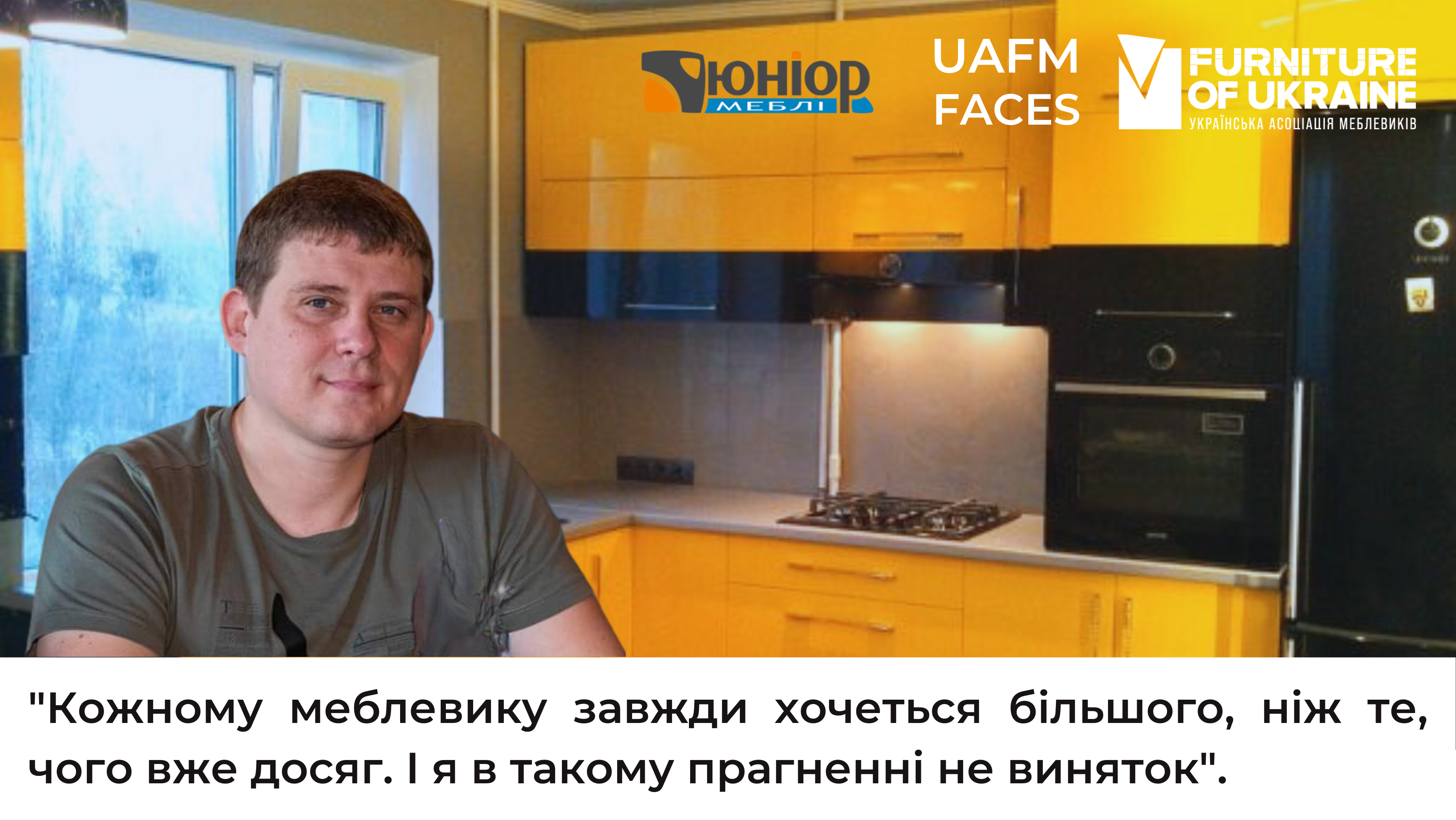
UAFM in the faces: What can be achieved not just by resisting difficulties, but, on the contrary, by acting more persistently and creatively despite them? This is the story told by the owner of the company “TK Aktiv” Evgen Kisarets
“The need teaches you to eat dumplings,” says folk wisdom. In other words, it forces you to do things you haven’t done before. This proverb came to mind after a conversation with Evgen Kisarets, the owner of the Zhytomyr company “TK Aktiv,” whose products are known in the domestic furniture market under the brand “Junior Mebel.”
The hardship that engulfed the country in February of last year – although it did not cause the company’s ruin, which unfortunately some UAFM colleagues could not avoid, and although it did not force it to relocate, still put it on the brink of survival. This was largely because some major clients, especially retail chains, whose facilities the company furnished under long-term contracts, terminated pre-war agreements because they were in distress. Until summer, the factory did not operate in its usual mode, barely staying afloat by fulfilling occasional small orders. And when there were none, Evgen recalls that to keep the team employed and able to pay the workers something, they had to engage in cleaning premises, territories, etc.
When the government and international funds began offering grant loans on favourable terms to support small and medium-sized businesses, to prevent the economy from collapsing, Evgen Kisarets immediately seized the opportunity to help his company in the difficult situation it found itself in. Luckily, the company received the funds.
– And what were they spent on?
– On a fundamental modernization of production. Administrative and managerial optimization in the company happened on its own – as the staff was reduced, characteristic of wartime conditions: someone secured their families abroad, someone went to defend the country, and someone decided to look for a better job.
For me, as the owner and manager of the company, it became obvious that in the circumstances that have arisen and in the perspective outlined by the current situation, continuing to work as we have been working means stopping furniture development and improvement. We’ve already, so to speak, mastered the art of fulfilling tender orders, the implementation of which is no longer particularly challenging in terms of technology and technique. We receive technical tasks and ready drawings from clients, which we adapt slightly to our production conditions, and then, as they say, it’s a matter of technique.
But every furniture maker always wants more than what has already been achieved. And I am no exception in this aspiration. I also want not only to produce furniture for tender orders invented by others but also to create them myself. To have my design studio for this purpose, the opportunity to produce not only custom-made furniture but also competitive serial furniture of our design. However, staying at the former level of development, it was pointless to hope to realise such ambitious plans.
– How far have you progressed on this path of modernization?
– We purchased the necessary high-performance equipment, including numerical control. Currently, new machines are in the final stages of installation and adjustment, with operators undergoing relevant training. We expanded production areas by adding an extension to the main building.
– As an entrepreneur, you could not fail to notice that the war and its consequences, including a weakened domestic market, forced many furniture companies that sold their products only on the domestic market to hastily reorient to exports. And those whose exports were already established began to seek opportunities for its expansion and growth. And this trend is continuing. Is your company not aloof from this process?
– Our company is one of those whose furniture business was built with a focus on the domestic market. If we had continued to feel one hundred per cent confident in it, perhaps export prospects for us would have been distant for a long time. But now we have started to bring them closer. The initiated process of modernizing production will be, among other things, the first important step in this direction.
Raising production to a higher technical and technological level will not be a 100% guarantee of the possibility of export deliveries. Preparation for this should be comprehensive. This includes gaining relevant knowledge. For this purpose, this summer I completed a theoretical and practical course “Export School,” jointly organized by the Department of Economic Development of the Zhytomyr City Council, the City Development Agency, and the Entrepreneurship Development Fund with international financial support.
– How did the company end last year, and how is the current one going?
– Last year, parallel to the dynamic process of modernization we initiated, from autumn onwards, we noticeably began to increase production volumes in the usual format of fulfilling tender orders. And by the end of the year, we reached a monthly indicator at about 80% of the pre-war level. This was because there was a significant increase in the market demand for office furniture. The reason for this was the relocation processes that were characteristic of the previous year. Not only companies and firms but also educational institutions, regional administrative institutions, etc., were relocating to safer regions. To arrange in a new place, in new conditions, they needed either new or additional furniture.
Part of this year was forcedly unsuccessful for the company in terms of production. And here’s why. The phase of production modernization arrived, which, if not stopping, significantly slowed down the production process. Installing new equipment involved either dismantling the old one or adapting it to the new one. Performing these works required a temporary suspension of the production process, which did not become critical for the company. Moreover, production started to operate so intensively that today we have monthly indicators even better than those before the war.
