

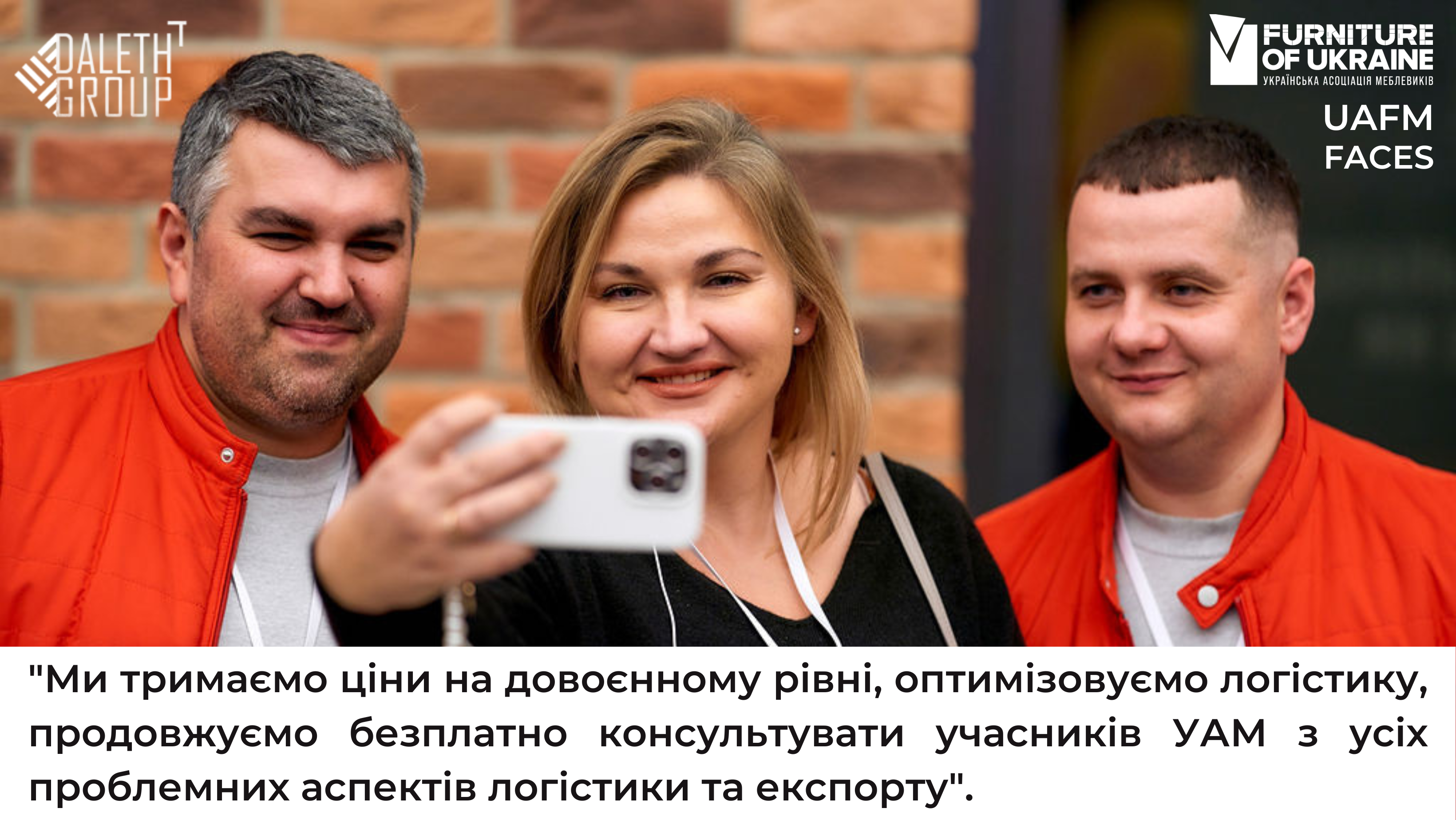
UAFM in the faces: Logistics service provider, “DALETH BROK” continues a close collaboration with the Ukrainian Association of Furniture Manufacturers, catering to the logistical needs of industry exporters.
Among non-profile members, “DALETH BROK” holds a special position within UAFM. As a service provider specializing in offering a complete range of transport, logistics, customs, and financial services, the company supports international trade. The company’s experts excel in optimizing cargo delivery routes in terms of both cost-effectiveness and safety. With extensive experience in customs clearance and international logistics, they can propose unconventional approaches to handling client orders, involving both customs clearance at domestic customs offices and entry points in Ukraine, along with the delivery of goods from various parts of the world through different transportation modes. The comprehensive service provision and expertise in customs and international trade laws enable “DALETH BROK” to meet the evolving needs of its clients.
Continuously evolving and enhancing its competencies, the “Daleth Group” (which includes “DALETH BROK”) offers numerous logistic and customs brokerage solutions for services in Ukraine and European Union countries. The company consistently provides logistics, warehousing, port, and customs brokerage services in EU countries.
– How has the war, which has been tormenting the country for almost two years, affected the company’s activities and its overall well-being, so to speak? – we asked Marina Ponomarenko, the Operations Director.
– The war has undoubtedly impacted the volume and nature of the logistic services we provide to our clients, but our service provision has not ceased. They have transformed, with some becoming less relevant and others, on the contrary, gaining significance.
We are also ready to offer furniture companies an analysis of their logistic and technological schemes for further improvement by developing optimal export strategies and export management. We can handle procurement for clients abroad, including all necessary customs and transportation issues. Conversely, we can manage purchases in Ukraine for their foreign partners. We develop and offer furniture makers a set of insurance services.
This year, “Daleth Group” expanded logistic possibilities for its clients by joining the international Common Transit System – NCTS. Being one of the first in the country, it obtained authorization for the application of transit simplification – “use of a common guarantee.” This allows us to process transit declarations T1 for our clients under a common guarantee in 36 countries in Europe and the world, saving time and money for Ukrainian exporters. NCTS also enables customs services in participating countries to exchange customs data, ensuring proper control over transit goods, preventing fraud, and enhancing the efficiency of human resources utilization.
Having a transit declaration T1 is essential for importing goods into the EU territory and for crossing it in transit mode. Much depends on the correct completion of the document for its legal force. Errors in the transit declaration can lead not only to customs refusal to process the shipment but also to administrative or criminal punishment. Our highly qualified staff avoids any mistakes in the documentation process.
Surprisingly, the war has not narrowed but, on the contrary, expanded the geographical presence of our company, both in Ukraine and abroad, by forcing some employees to change their place of residence to secure their families. Now, working remotely, they continue to represent the company in more regions of the country and more EU countries. Working in an “online” format has not hindered productivity or quality; in fact, it has contributed to deepening the digitalization processes within the company, which began before the war and accelerated during its conditions.
– The recent introduction of electronic queues at border crossings aims to accelerate and simplify border and customs procedures.
– Yes, but at the initial stage of the practical implementation of this mechanism, some misunderstandings and complaints led to the opposite effect – slowing down the border-crossing process. However, ideally, when all participants fully adapt to this innovation, the benefits will be realized.
– How has export-import logistics become more complicated?
– The inability to use our ports for transporting goods by sea and the necessity to rely on foreign ports added concerns. For exporting clients, this significantly increased logistical expenses. Many had to establish new overland transportation routes because the previous ones, for example, through Belarus to Baltic countries, were closed. However, for us as a service provider, redirecting routes was not problematic. We quickly and skillfully adapted to clients’ new routing needs. Through us, they experienced no delays or other issues, as always.
– Another unexpected logistic problem arose – congestion. What is happening at the border with Poland, which likely affects your clients who get stuck there for a long time, is it also a concern for you?
– Of course, we are not indifferent to all the logistic troubles our clients face. Regarding those who got stuck in the congestion at the border with Poland, it is clear that it is not our fault, and unfortunately, there is no effective solution in such a situation. We can only recommend alternative routes, but the collapse at the Ukrainian-Polish border reduced the capacity at other crossing points due to the increased load caused by many trucks taking detours.
Our clients undoubtedly suffer more significant losses from prolonged delays of export shipments at the borders. Still, we also suffer economically: three times fewer new contracts are concluded because potential clients, considering the situation at the Polish border, are hesitant to arrange new export shipments.
– Perhaps what we are currently observing in the field of road transport has redirected exporters to “Ukrzaliznytsia”?
– No, we do not notice such a trend. Railway transportation, with its difficulties and long delivery times, has always lagged behind the mobility of road transport. And even the current congestion issues at the border did not change this established priority.
– Logistics for domestic exporters-importers has undoubtedly become more expensive during the war, not only due to forced redirection to longer routes. Fuel prices have risen. Have your brokerage services also become more expensive?
– No, we fundamentally maintain prices at pre-war levels. Although they were somewhat higher than the market average even before the war due to the high efficiency of our brokerage services. Quite often, we optimize clients’ logistics to such an extent that they receive significant economic benefits. That’s why they value us. Moreover, considering our long and close relationship with UAFM, we continue to provide free advice to furniture makers on all problematic aspects of logistics and export. Due to the war, their issues have increased, so there is never a week without our experts providing comprehensive advice within our competence.
“DalethGroup”: always by your side!
Detailed information about services:
Instagram:
https://instagram.com/dalethgroup?igshid=NmJveXY4djR6ZnB5&utm_source=qr
Facebook:
facebook.com/dalethgroup
Telegram channel:
https://t.me/smartlogisticsnet
IT-logistics platform for business efficiency Smart Way Global Logistics:
Download the mobile app #SmartWayGlobal Driver or Smart Way Global Customers:
