

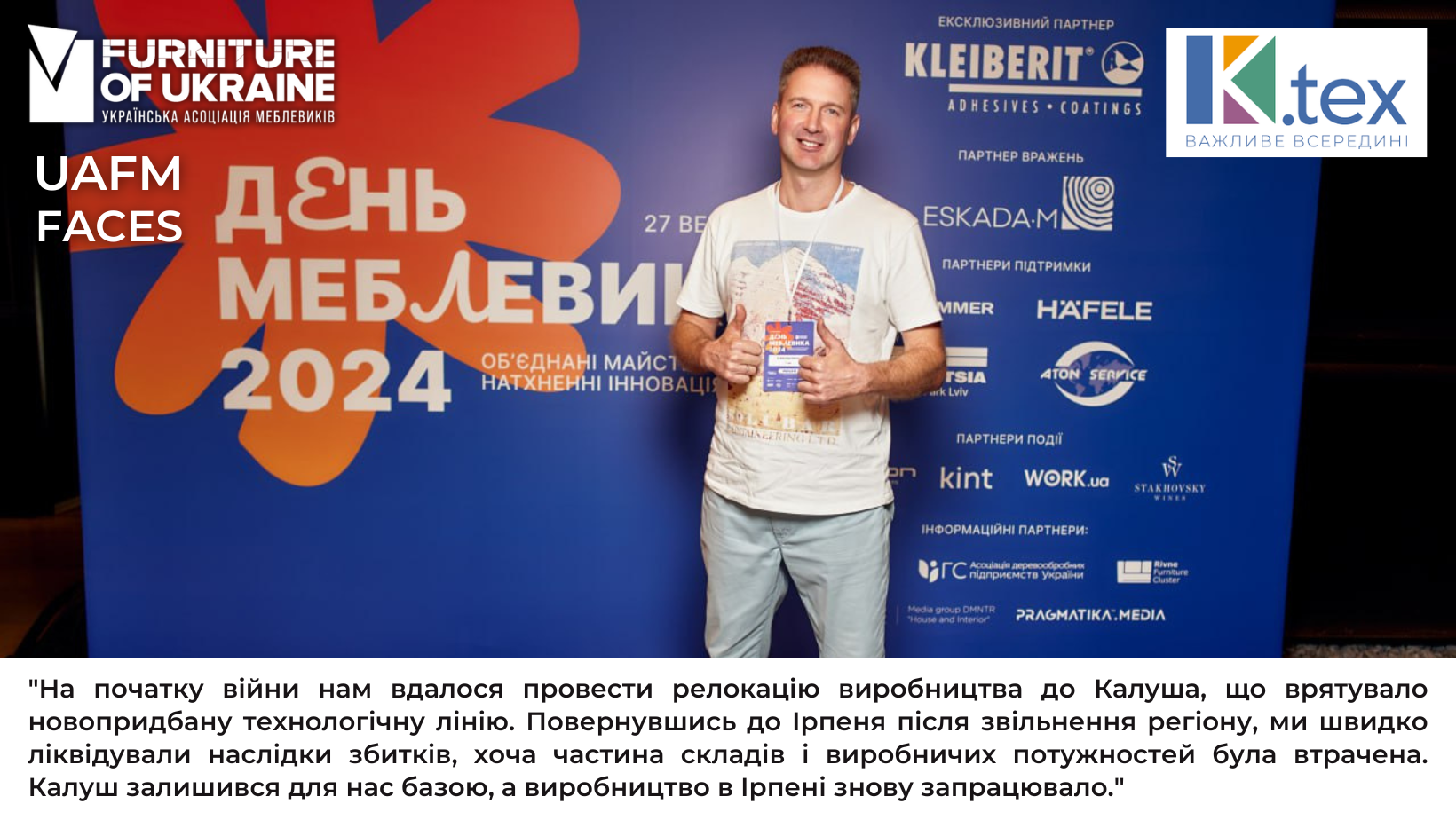
UAFM in faces: a conversation with Vyacheslav Voitko, sales and marketing director of К.tex.
The company К.tex, located in Irpin, is one of the few members of the UAFM community that does not specialize in furniture production but rather in supplying nonwoven materials for furniture manufacturers. It stands out among suppliers by not dealing in wood or fittings but by directly producing and providing materials primarily used in soft furniture production.
The company has three main production areas related to the furniture sector: fillers, thermal felt, and quilting services, facilitated by modern sewing equipment. Additionally, К.tex manufactures insulation for clothing, which has remained the core business since its founding and includes several proprietary brands. When the furniture-related business reached its potential, the company joined the industry’s furniture community.
This potential grew significantly with the launch of the Reproject in Irpin, aimed at recycling textile waste from sewing industries, including soft furniture and mattress production. This initiative completed the cycle: К.tex receives essential raw resources from them, while furniture factories obtain needed fillers and other nonwoven materials from К.tex.
Nonwoven materials, such as felt, thermal felt, and fillers produced by К.tex, are of high quality thanks to the use of modern equipment. The capacity and functionality of a German production line, purchased before the war, allow the company to not only scale production but also expand its product range.
– What materials do you use to produce fillers and felt?
– Thanks to several production lines at К.tex, each one is adapted to a specific type of fiber—some lines work with synthetic fibers, others with natural or mixed fibers. We can also produce our materials from both virgin and recycled fibers.
– What is the principal difference between materials made from virgin or recycled fibers?
– To summarize, materials from virgin fibers are more stable in their properties (density) and durability. Meanwhile, materials from recycled fibers are cheaper, and there is a trend toward using recycled fibers, which will soon become a required standard.
– What’s the correct term: “recycled textile fibers” or “reclaimed fibers”? What’s the difference?
-This is more of a question for our fiber suppliers, but in my understanding, the mechanics are the same, though the end product differs. When you’re not just recycling textiles but reclaiming fiber, you focus more on maximizing efficient and quality use of available raw material. In Europe, the term “fiber-to-fiber recycling” is common, where fabric scraps are effectively broken down and returned through several processes back into fabric.
Our main supplier is now our partner company, «Re:inventex». Their task is to find quality raw materials and supply us with quality fiber; from there, we do our work.
– Do your nonwoven materials have any demand among cabinet furniture manufacturers?
– Yes, sometimes they are used as sound-absorbing elements. There’s a particular need for sound insulation among office furniture manufacturers to ensure comfortable working conditions, thereby increasing office workers’ productivity. Some companies even request our help with soundproofing entire rooms. We have close partnerships with several such companies and produce specialized sound-absorbing materials upon their request.
– Irpin suffered significant damage early in the war when it was occupied by uninvited guests. Did your production suffer any damage?
– We managed to relocate. Fortunately, the newly acquired production line hadn’t yet been delivered to Irpin and was still in Kalush, in western Ukraine, so we decided to move there. Unfortunately, what was left in Irpin was not preserved: warehouses with products burned down, and some production facilities were partially damaged. When the enemy was driven out of the capital region, we returned to Irpin and quickly repaired the damage. However, we didn’t fully leave Kalush—the production line acquired before the war remains there as the base for our production branch.
Our production materials also include hemp. From hemp fibers, we create thermally bonded fabric, which can be used as an alternative to coconut coir in mattress production, and hemp fillers, which can serve as an alternative to synthetic fillings. Currently, we buy this raw material in the Sumy and Cherkasy regions, and in the future, we look forward to sourcing from our partner, Ma’Rijany, which aims to become Europe’s largest producer of hemp fiber.
– What will the company focus on in the near future?
– We’ll be developing a new area for us—non-combustible nonwoven materials, especially made from hemp. Their production is a complex process with many technological nuances.
Overall, nonwoven materials represent a whole universe. There are numerous types that may interest us for future product line expansion.
