

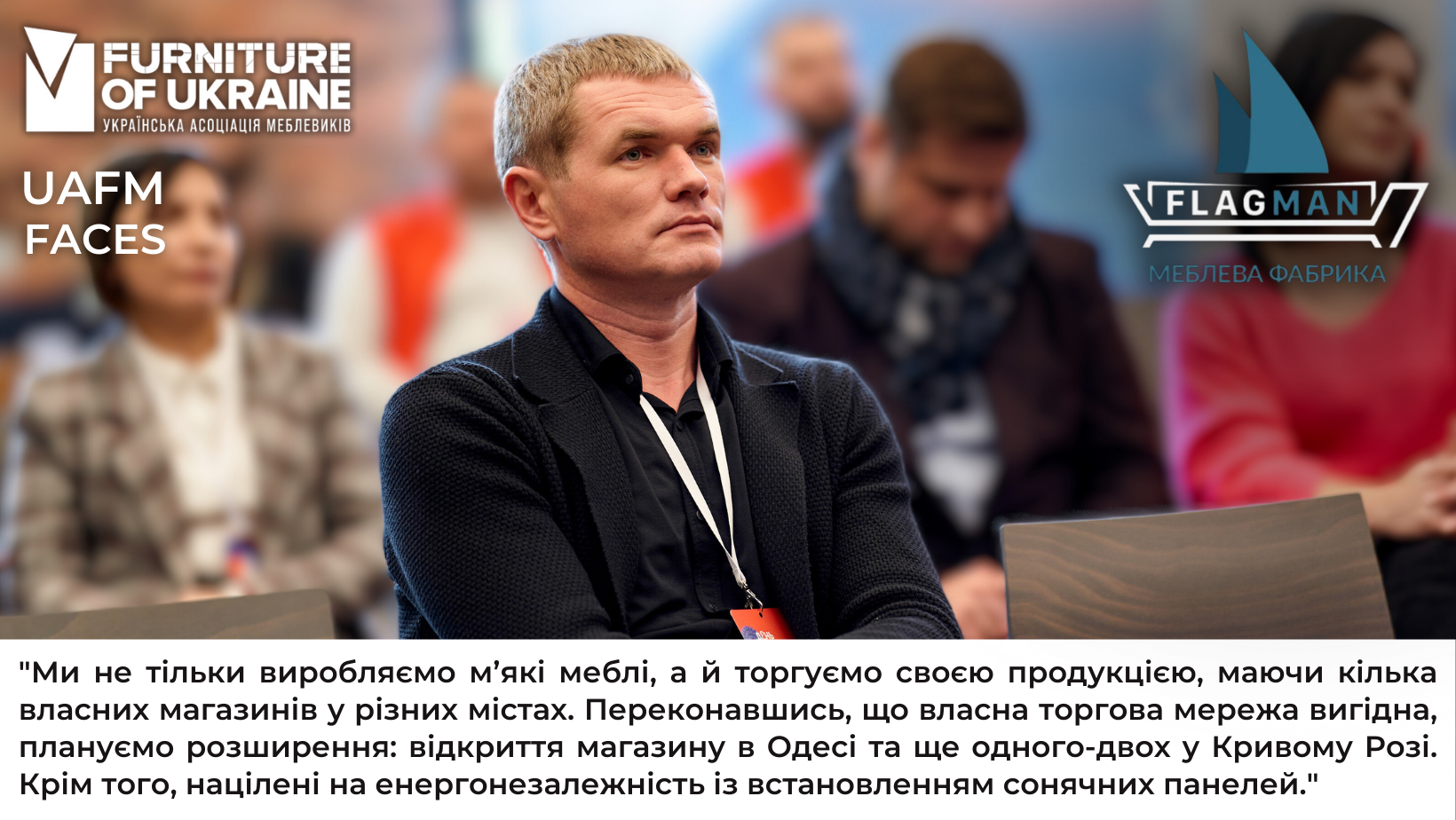
UAFM in Faces: the story of Ihor Semenov, owner of the company “MykolaivMebli”.
Ihor Semenov’s company “MykolaivMebli” suffered from the war more than most of his colleagues in the furniture industry, whose troubles were mainly limited to a decrease in the number of orders and production volumes, as well as reduced profitability. An enemy shell landed on the territory of his factory, collapsing the wall of one of the premises, damaging finished products with shrapnel, and injuring several soldiers stationed there at the time. Fortunately, there was no fire. However, the “wounds” inflicted on the company have long been “healed,” so we spoke with its owner more about the present. About the fact that the factory is now fully operational: producing goods, paying taxes, and making some modest steps in its development.
Naturally, we could not avoid the topic of staffing difficulties, which came up first in the conversation, as they remain one of the most pressing issues not only for our furniture industry but for the entire economy of a warring country.
– To put it simply, – says Mr. Ihor, – half of our former pre-war team is gone, and the remaining half has been partly renewed, which essentially ensures the furniture production’s operability. To a significant extent, due to incomplete staffing and interruptions in electricity supply, the usual schedule and rhythm of the factory have been disrupted, preventing full stability.
Speaking about recent staffing additions, he notes, – We hired a furniture upholsterer who is of retirement age and therefore not subject to mobilization. Previously, we offered a job to a discharged serviceman, but he didn’t last long with us without psychological rehabilitation.
I know some companies are assigning women to certain production operations traditionally done by men, but for us, it turned out the opposite: we hired a man as a seamster for our sewing department, which is usually a purely female space.
– An unusual case, indeed, considering there shouldn’t be issues finding female workers.
– Not necessarily. Finding an experienced seamstress for soft furniture manufacturers has always been difficult. Even experienced ones who are used to working with lightweight fabrics may struggle with heavy furniture textiles. The sewing equipment is also different. A couple of years ago, we hired a so-called knitwear seamstress, but she couldn’t handle the work.
– Are you continuing to update your assortment with new furniture models, or is that difficult in the current circumstances?
– We currently don’t see the feasibility of introducing entirely new models into production. Instead, we are focused on updating existing models by making certain changes. For example, this includes replacing solid wood parts in sofa frames with chipboard components; where possible, replacing 50mm boards with 30mm ones, replacing wooden slats with spring blocks in some models, and so on. We’ve also improved cutting programs to reduce material waste.
There are two reasons for these replacements. One is to reduce the cost of the product, and the other is the shortage of previously used components. For example, we used to source spring blocks from a manufacturer in Donbas, but when the war began, we had to find another supplier. The new supplier’s spring block specifications are different, so we had to make changes to existing models to adapt them to the 1920 block size, which is always available in the new supplier’s warehouse program.
– For furniture companies that were not export-oriented before the war, the need to establish overseas sales has become a priority.
– It has become an obvious need for our company as well, but under the current martial law conditions, we physically cannot fully take on exports. However, we are not putting this topic on the back burner. That’s why we joined UAFM during the first year of the war and, with the Association’s assistance, participated in the international Poznań exhibition. This allowed us to gain insight into the subject, establish contacts with colleagues who already have export experience, as well as those who are just beginning, like us. It’s clear that entering foreign markets is a long and painstaking process: finding clients, negotiating, agreeing on contract terms without the opportunity to meet potential clients in person, developing a special export furniture line, and so on. So, we had to take a pause on this ‘long-term’ topic, especially since the company is facing much more urgent current needs, the most critical being staffing, as we’ve already discussed. Without preserving the team, not only will exports remain out of reach, but production will stop altogether—this is clear.
– What tasks is the company setting for itself in the coming year?
– In addition to manufacturing soft furniture, we also sell our products, operating several of our own stores in different cities. We’ve learned from experience that having our own retail network is beneficial in every way. In this part of the business, we plan to expand further by opening a new flagship store in Odesa and one or two stores in Kryvyi Rih.
As for production, we are specifically focused on purchasing a CNC machine, which is an urgent need. We also have plans to make the company energy-independent, which involves acquiring the necessary equipment. This is not just about generators but about installing solar panels.
– Well, then we wish you success in implementing your plans!
