

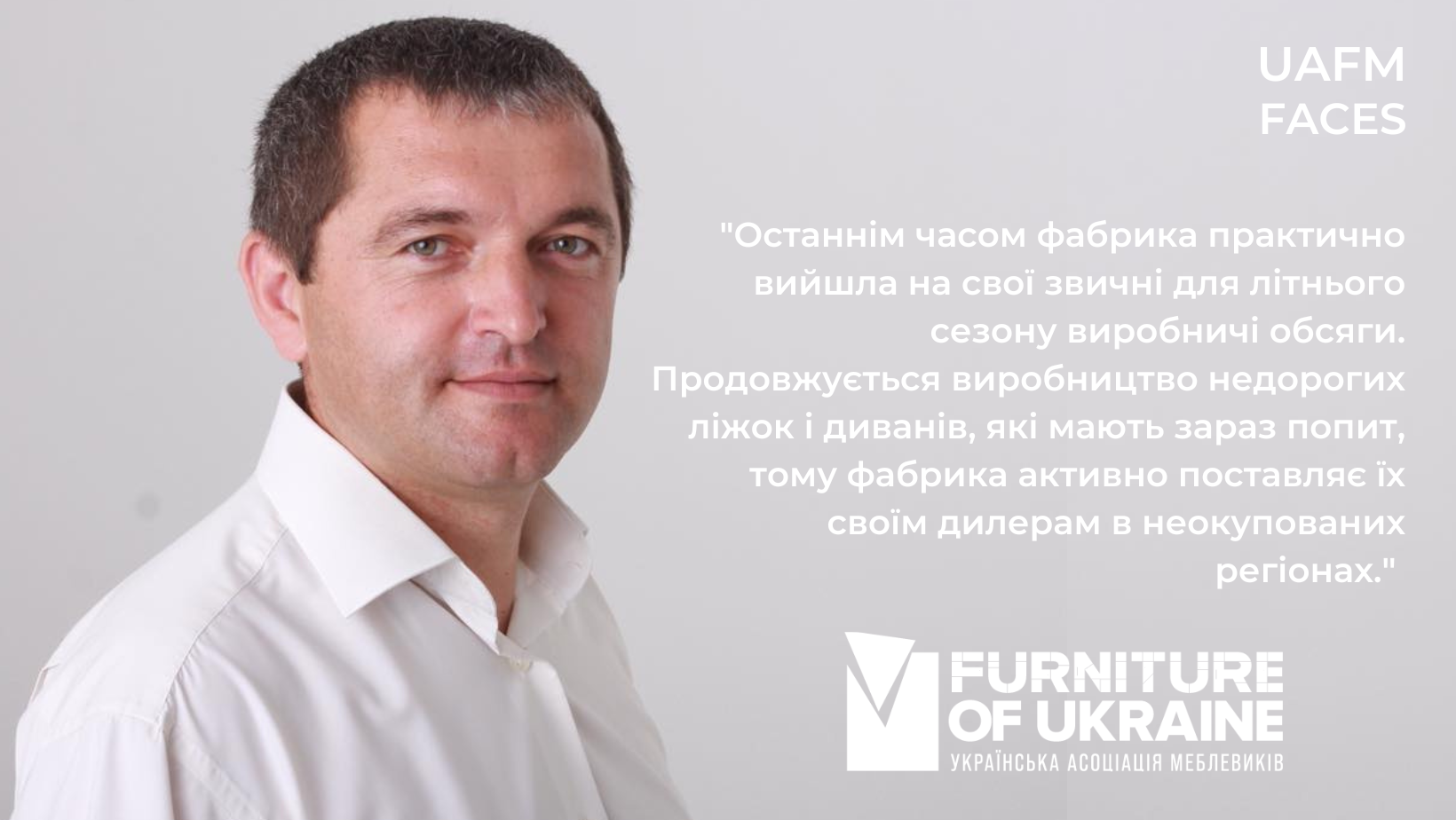
UAFM in faces: about how a furniture factory “Elegant” responded to the needs of wartime, says commercial director Volodymyr Halynyak
The private enterprise “Husiatyn furniture factory “Elegant” is located in the Ternopil region, so it is far from the front, and, thank God, it is not terrified by regular rocket fire, like the people of Kharkiv or Mykolaiv. But all the same, the war did not bypass the Husiat furniture makers either. And not only because several workers are mobilized. The war forced the enterprise to do something that a few months ago could not have occurred to even a person with a wild imagination: for example, to manufacture weapons – the so-called “Molotov cocktails” or sewing bulletproof vests. However, in order, Volodymyr Halynyak, the commercial director of the factory, told about the company’s work during the war.
It took several days for the management of the factory and its workers to find their way, how to live and what to do in the terrible situation that vile russia created for Ukraine. In fact, everything is simple: whoever did not pick up a weapon, that’s why you have to work, and do your usual business. That’s why the factory workers started working on it. They immediately put aside the furniture business and concentrated on sewing blankets and pillows. This product is from their usual factory range. And yet it was unusual: these things were sewn not for sale, as before, but as charitable volunteer assistance to those people who had to flee from the war to safer regions. And it was not delivered to trading points, but delivered to points of reception of things needed for refugees, as well as to the local military commissariat – already for the needs of the army. And that was only the beginning of the great volunteer care that the “Elegant” furniture factory took upon itself, becoming almost the largest collective volunteer in the region.
They sewed, of course, from their own material resources. The remnants of fabrics, foam rubber, etc., which in peacetime would hardly find commercial use, were also used, but war, as you know, is indiscriminate in everything. They used materials from their own stocks for the production of other free items for wartime needs, which will be discussed further. And what they didn’t have – they didn’t need furniture production – they bought it additionally with their own funds. Bottles for flammable mixture were probably an additional purchase – we thought first of all – but Mr Volodymyr denied it: his own bottles too. And he explained that the co-owners of the factory are also engaged in winemaking in parallel, that is, bottles from that farm. As a result, during the second week of volunteer work, three thousand bottles of “cocktail” were produced for the needs of territorial defence.
Another volunteer product, far from furniture, was the production of barricading road devices – stretch marks of the type common for wartime “hedgehogs”. Again, from the metal of our own reserves.
But in order to sew “plate socks” (that’s the name of the item of protective ammunition of a soldier, better known as a bulletproof vest), we had to buy not only the basic materials – bulletproof insert plates and special fabric, but also a special sewing machine for it. This was the third volunteer project, and it began to be implemented in the third week of the war. In order to preserve the lives of soldiers at the front, Husiat furniture makers sewed 3,800 “plate toes”, completing this work at the end of June.
Two weeks later, they started their usual work – furniture making. But again, for making what wartime needed. At a specific time, they established the production of simple single beds, equipped with a mattress (so-called “student”) for furnishing the housing of the same “internally displaced persons”, expressing themselves in the official language. These models were as cheap as possible, with a minimal markup for the manufacturer. That is, even in this – directly furniture project – there was still a certain volunteer component.
Recently, the factory has practically reached its usual production volumes for the summer season. The production of inexpensive beds and sofas, which are currently in demand, continues, so the factory actively supplies them to its dealers in unoccupied regions. Somewhat – due to the war and the volunteer distractions caused by it manufacturing products that are not characteristic of its specifics – it lags behind in the development of new models to update its furniture product line. Usually, it is customary to do this at the beginning of the year, in the spring, when production tension traditionally decreases. This year, we have to deal with it only now, when earlier at this time we were already dealing with the new catalogue. The delay is also caused by the fact that we had to reorient ourselves to new suppliers. This applies to some upholstery fabrics, and transformation mechanisms. Finding new ones, and concluding contracts with them also takes some time.
