

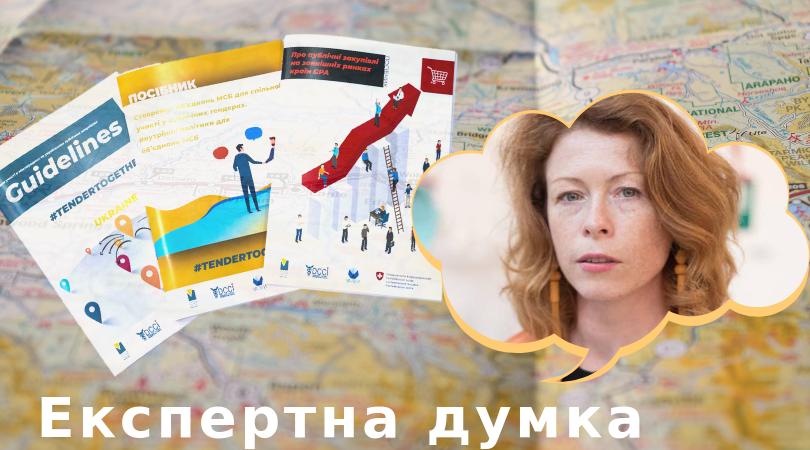
Heading “Expert opinion”
About the benefits, explaining the possibility of joint participation of representatives of SMEs in public tenders, many UAFM members already know, and who – no, they can easily familiarize themselves with them on the Association website: https://uafm.com.ua/…/doslidzhennya – meblevo … / tender-together /.
We decided not to limit ourselves only to their preparation (and they were created by authoritative experts in this field), but also to further popularize the subject of joint participation of representatives of SMEs in public tenders and to encourage this profitable business in every way. In particular, due to the additional comments of the authors of these manuals.
She was the first to comment on her manual “Creating SMEs for joint participation in public tenders. Domestic policies for SMEs associate Julia Strikovska, lawyer.
EU directives for tenders are favorable,
than the requirements of Ukrainian legislation
How can small and medium-sized businesses (SMEs) combine their financial, industrial, professional efforts in order to successfully participate in public procurement (tenders) in Ukraine and EU countries?
It is clear that by joining small enterprises can compete more effectively in tenders, meet even very demanding qualification criteria for tenders and provide attractive conditions for buyers for purchasing goods, works, services both in our country and in the EU countries. That is, the opportunity to expand the market for the sale of goods and the supply of works or services to EU countries in the field of public procurement.
This issue was studied by me in the framework of the project Tendertogether, analyzed the legislation of Ukraine and the EU on the creation of groups of companies and combining opportunities under subcontracts, and also studied the practical experience of this matter.
The corresponding manual was created, which contains the basic models of associations that comply with the laws of Ukraine and the EU and must be tested in practice. Such models, both in Ukraine and in the EU countries, include: a) the creation of a group of companies – a consortium;
b) participation in the tender of several companies that combine their efforts on the basis of subcontracts.
The manual also describes in detail from the point of view of the law the general features and differences between the application of a particular model of association in Ukraine and in the EU countries. For example, Ukrainian legislation requires participants to unite, to participate in a tender in the form of a certain legal entity – a consortium, while EU legislation offers companies in such cases to conclude an agreement on a consortium (in the English consortium – association) in an arbitrary form, assuming that its registration as a separate legal entity is possible only in certain cases established by the legislation of the country of the tender or the conditions of the tender.
Draft documents have been added to the manual (in Ukrainian or English, respectively), which will help to create a consortium or establish legal relations with contractors. For example, the constituent documents of the consortium, the agreement on the consortium for tenders in the EU, the contract with the contractor, letters of subcontractors and the like. It also proposed policies that promote the establishment of transparent, equal and good relations between participants, unite, namely, policies about virtue and conformity, about communication, about managing contractual activities, about excluding a participant from the consortium.
In general, it can be said that the main difference between the EU legislation and Ukraine in terms of participation in tenders is that the main purpose of the EU tender directives is to establish a flexible, barrier-free, participatory mechanism that only defines the conditions for a transparent and competitive participation in tenders of EU countries. The legislation of Ukraine establishes more specific requirements whenever possible for those or other subjects, including those that are united, to participate in tenders. Therefore, the task of the Ukrainian legislation is to further harmonize the national public procurement rules with the EU legislation.
The management also considers some other legal aspects of the passage of participants, are combined, qualification criteria, as well as issues of concentration and fair competition, the execution of contracts, appeals against the results of tenders and the like.
The “Expert Opinion” rubric was founded within the framework of a grant project with the support of the Swiss Cooperation Office in Ukraine, the project name: “Increasing the level of cooperation and trust with joint participation in international and national government procurement” – TENDER TOGETHER, which is implemented by the Ukrainian Association of Furniture Makers in partnership with the Украинская Ассоциация Визуальной Индустрии УАВИ and Донецька торгово-промислова палата.
