

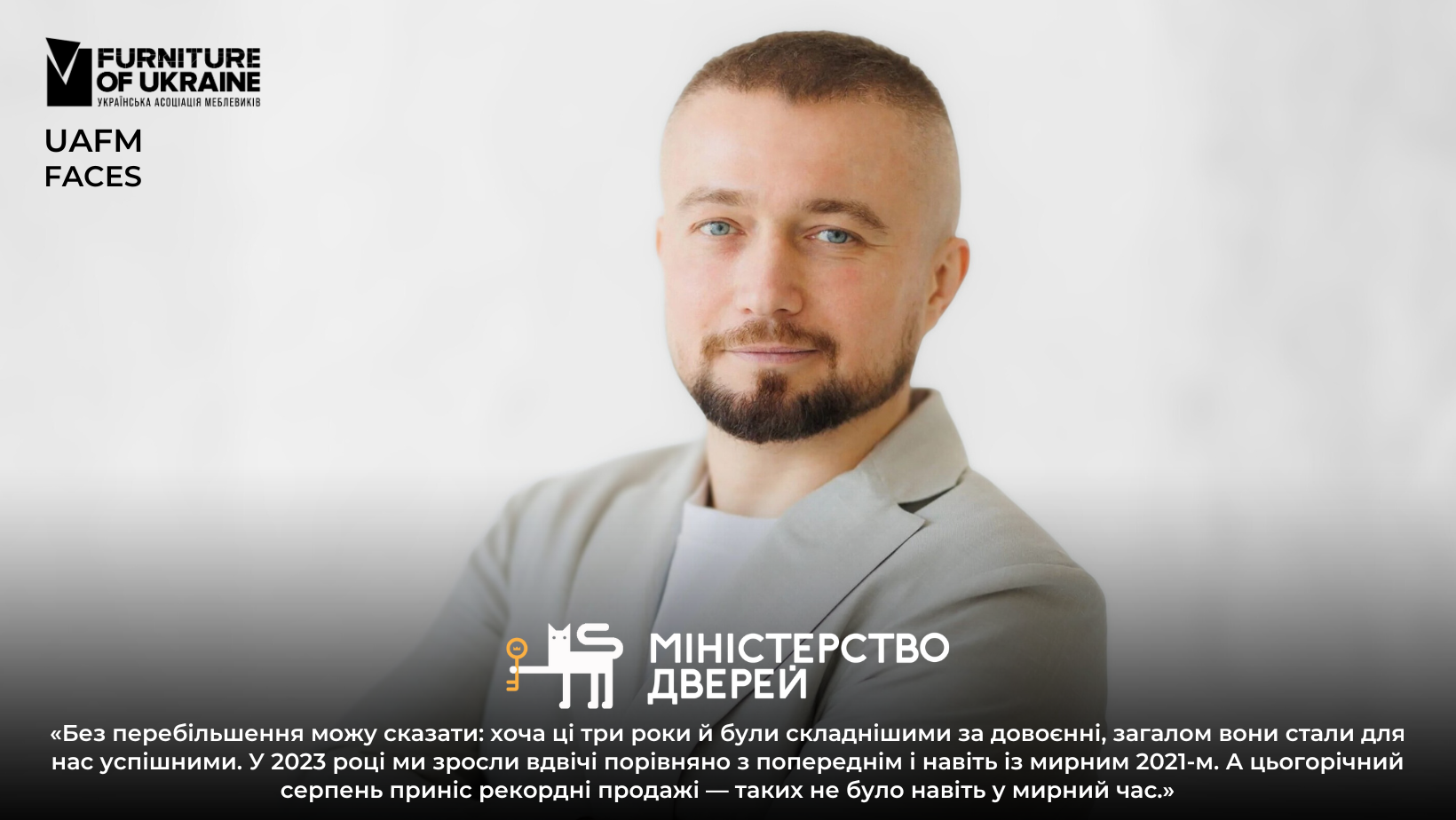
UAFM in Faces: a story by Serhii Panchenko, Development Director of the company Ministry of Doors.
Traditional door production belongs to carpentry, which is very close to traditional furniture making since both deal with wood. However, modern door and furniture manufacturers have long ceased to rely solely on wood — they also use metal, glass, and plastics. Some doors and furniture pieces are made entirely of metal. This similarity, along with the fact that both furniture makers and door manufacturers often share the same customer, is what brings them together under the Ukrainian Association of Furniture Manufacturers. One of these companies is LLC “TBK Yekaterynoslavska Dverna Artil”, which produces premium-class metal entrance doors under the well-known brand Ministry of Doors.
We asked Development Director Serhii Panchenko how such a strong domestic manufacturer and exporter based in Dnipro is managing under today’s conditions.
For Yekaterynoslavska Dverna Artil, both intensive production and intensive sales are so natural that even on that grim February Wednesday in 2022, when the first enemy missiles struck Ukrainian cities, the company continued selling doors. Later, of course, the usual rhythm of life and work was disrupted.
Since defending the country is primarily a man’s duty, it was to be expected that “Artil’s” men would also be needed at the front. And indeed, just a few days later, about a quarter of a hundred employees donned military uniforms. As a result, the two-shift production became a single-shift operation.
While for most manufacturing companies it only became clear by the third year of the war that the shortage of personnel could threaten their survival, the management of “Artil” immediately took steps that most entrepreneurs are only now starting to consider — preparing replacements for conscripted workers, primarily by training women. Within a month, the production lines were ready to offer even welding jobs to women. As in any modern facility where welding is a significant part of the process, the Dnipro-based company uses robotic welders, yet manual welding remains essential.
This timely personnel strategy allowed the company to maintain its leadership in the industry even during wartime — ensuring stable supplies and a diverse product range. And although the company received the status of a critical infrastructure enterprise a year ago, women’s contribution remains indispensable.
— How did you prepare the production so that women could work as welders?
— The welding process itself isn’t difficult for women — the welding gun isn’t heavy, and it’s quite manageable to create a quality weld. What is hard for them is moving large metal parts or welded structures. We addressed this by mechanizing and automating the movement of metal components and assemblies.
— What have these three years of war been like for the company?
— Without exaggeration, I can say that although they were harder than the pre-war years, overall, they were quite successful.
The first year of the war, as for everyone, was the hardest. But the following year, we doubled our growth compared to the previous one and even exceeded our 2021 (peacetime) results by about 60–70%. Last year, the increase compared to 2023 was minor. This year has been relatively stable: no downturns, though the market hasn’t shown growth either. Social sentiment — and consequently, consumer demand — has stabilized. People have accepted that the war won’t end soon but also believe there will be no collapse of Ukraine.
The final results of this year will be known early next year, but I can already say they’ll surpass last year’s modest growth. Largely thanks to record sales in August — higher than in any peacetime month over the past decade. We also expect a good result from the fall season, which is traditionally the strongest for sales.
— How do you explain that surge the company achieved in 2023? Was it due to reconstruction after the destruction across Ukraine?
— That was only one of the contributing factors. Another was that some competitors located near the frontlines had to suspend operations for a long time. Meanwhile, I remember that as early as March 20, we were shipping door batches to Epicenter stores in Uman, Zhytomyr, and further west. By May, distributors had also resumed sales.
Another factor was demand from internally displaced people settling in new places. Wives of soldiers, who had to take care of everything at home and were now receiving their husbands’ military salaries — money they hadn’t had before — began renovating their homes. Others also returned to renovation plans postponed in 2022. There was also an emotional aspect: people were inspired by the successes of the Armed Forces of Ukraine, who liberated much of the Kharkiv region and freed Kherson.
Exports also increased significantly, as the countries we supply to stopped importing doors from Russia and Belarus. The main competitors that remain are Turkey and China.
