

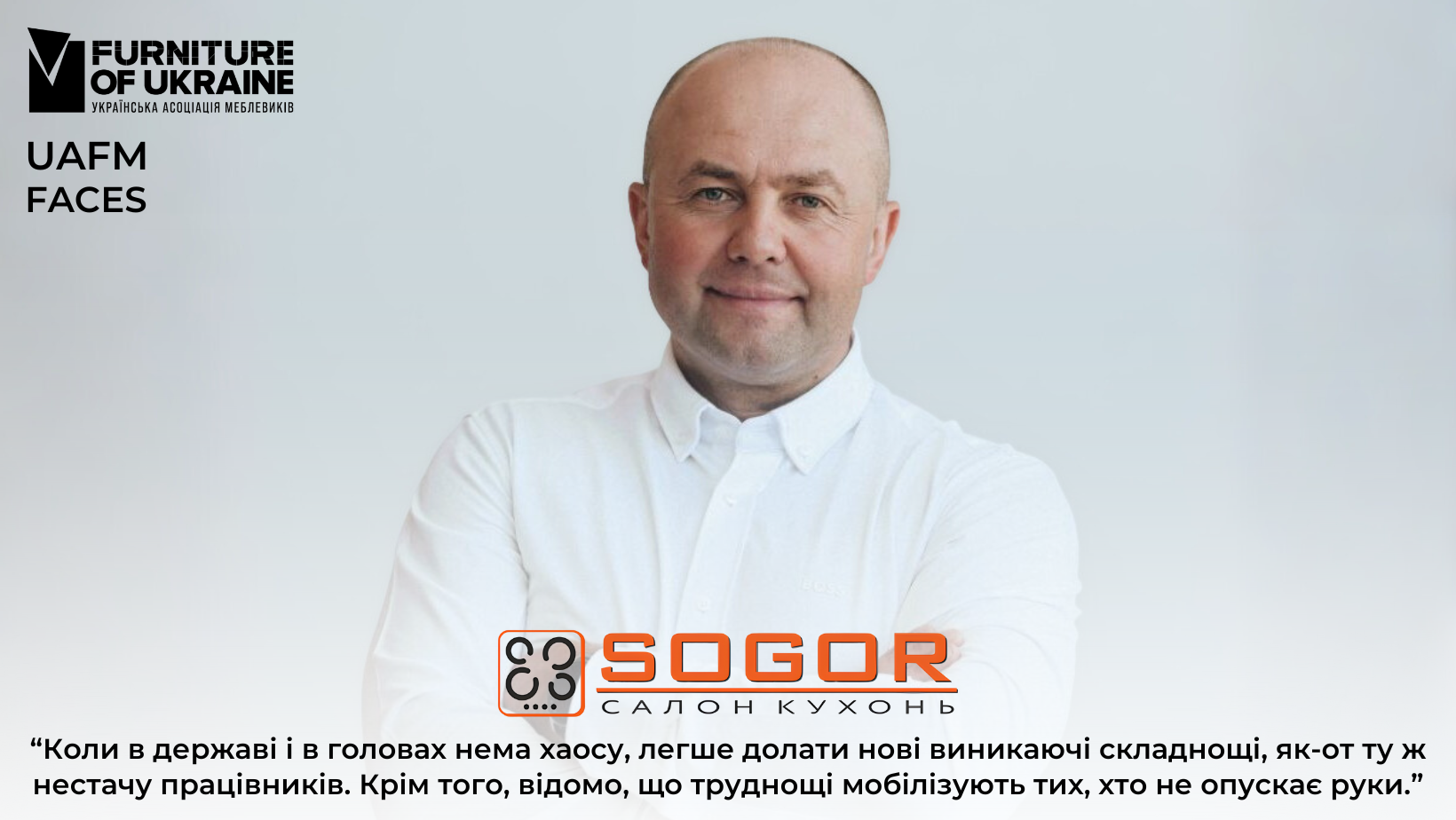
UAFM in Faces: A story from Andrii Uhryn, owner of the company “SOGOR”
The Lviv-based furniture company SOGOR, though positioning itself as a kitchen salon, has long gone beyond the production of furniture for a single functional purpose. In this regard, it has universal capabilities and can manufacture almost all types of case furniture — not only for home use but also for the HoReCa segment. At one time, the company even produced furniture for schools and kindergartens.
Still, as Andrii Uhryn noted, kitchens remain a top priority. Although the company has largely adapted to working under wartime crisis conditions, things have not become easier — one set of challenges has simply been replaced by another. If at the beginning of the war the main problem was sales, now the company’s development is constrained by a shortage of workers. It has so far managed to preserve its core team of professionals — the foundation of its stability — though its number has decreased during the war. Finding equally qualified replacements on today’s labor market is nearly impossible. The company sometimes hires young employees even with certain physical limitations, and even such recruitment is considered a big success.
The same shortage of personnel also slows down export growth. SOGOR is an export-oriented company, which is logical — few furniture manufacturers in western Ukraine fail to use the region’s logistical advantages for European exports. Especially now, when the domestic market has not regained (and likely will not regain, while the war lasts) its former purchasing power. In this area, the labor shortage is even more acute — due to the restriction on men of conscription age leaving the country. It is extremely difficult to find, for each foreign project and each country separately, someone permitted to cross the border to install furniture delivered from Ukraine. Entrusting such a responsible task to external contractors abroad is risky.
As Mr. Uhryn clarified, the company was lucky to find a skilled worker in Budapest, where it is now completing a private project. Yet such case-by-case solutions complicate export development, which is crucial under current conditions.
— The experience your company has in producing furniture for various functions apparently allows you to take on comprehensive furnishing projects — what’s called “turnkey” solutions.
— That’s right. We produce both single-function furniture — for kitchens, bathrooms, hallways — and full-home furnishing. Such projects have clear advantages, though they are more complex to execute.
— Furniture for schools and kindergartens has disappeared from your portfolio. Why? Has demand for it decreased during the war?
— Manufacturing such furniture has become unprofitable, so we stopped participating in relevant tenders. Usually, such contracts involve large wholesale batches, and our current capacity — again, primarily due to the shortage of workers — does not allow us to deliver such volumes on time at the tender price.
— Such a wide range of furniture products requires the company to be largely self-sufficient. Are there any processing operations you still outsource to partners?
— Yes, we handle all the main furniture materials ourselves. We subcontract glasswork to a nearby partner company that helps us with this. We can also process stone, but sometimes we turn to partners when we’re overloaded and risk missing delivery deadlines.
— As an expert who has been in the industry for a long time, how would you describe the current state of Ukraine’s furniture market? Has it remained the same throughout the three years of war, or is there some improvement?
— There’s definitely movement toward improvement, albeit slow. The first year — not only for our sector but for many others — was chaotic: the market collapsed, entrepreneurs were disoriented, teams lost stability, and prices soared. It’s easier now in the sense that both the economy and private business have adapted to the prolonged crisis caused by the war. Companies are finding ways not only to survive but to grow gradually. When there is no chaos in the state and in people’s minds, it’s easier to overcome new challenges — such as the shortage of workers. Moreover, difficulties motivate those who don’t give up. With each year of war, the number of orders and, accordingly, profits increase.
— It’s interesting: how do kitchens ordered by Ukrainians differ from those preferred by foreign clients? Are there major differences?
— Kitchen projects for foreign clients typically feature a higher level of comfort and functionality, thanks to richer and more diverse fittings and components.
— Abroad, there’s a growing trend toward mini or smart kitchens, especially among young families living in small rented apartments. Do you receive such orders?
— In Europe, this niche has been taken over by IKEA, and competing with such a powerful player is hardly feasible for Ukrainian manufacturers. The appeal of smart kitchens lies in their lower price and simplified functionality. We’re traditionalists — we don’t work in the mass market. Our price range is mid to mid-plus.
— What are the company’s future plans?
— Despite all the challenges, we must continue expanding exports in various geographical directions, not limiting ourselves to Europe. In early 2022, we already had a major overseas order, but due to the war, our American partners unfortunately suspended cooperation — they were wary of potential risks.
