

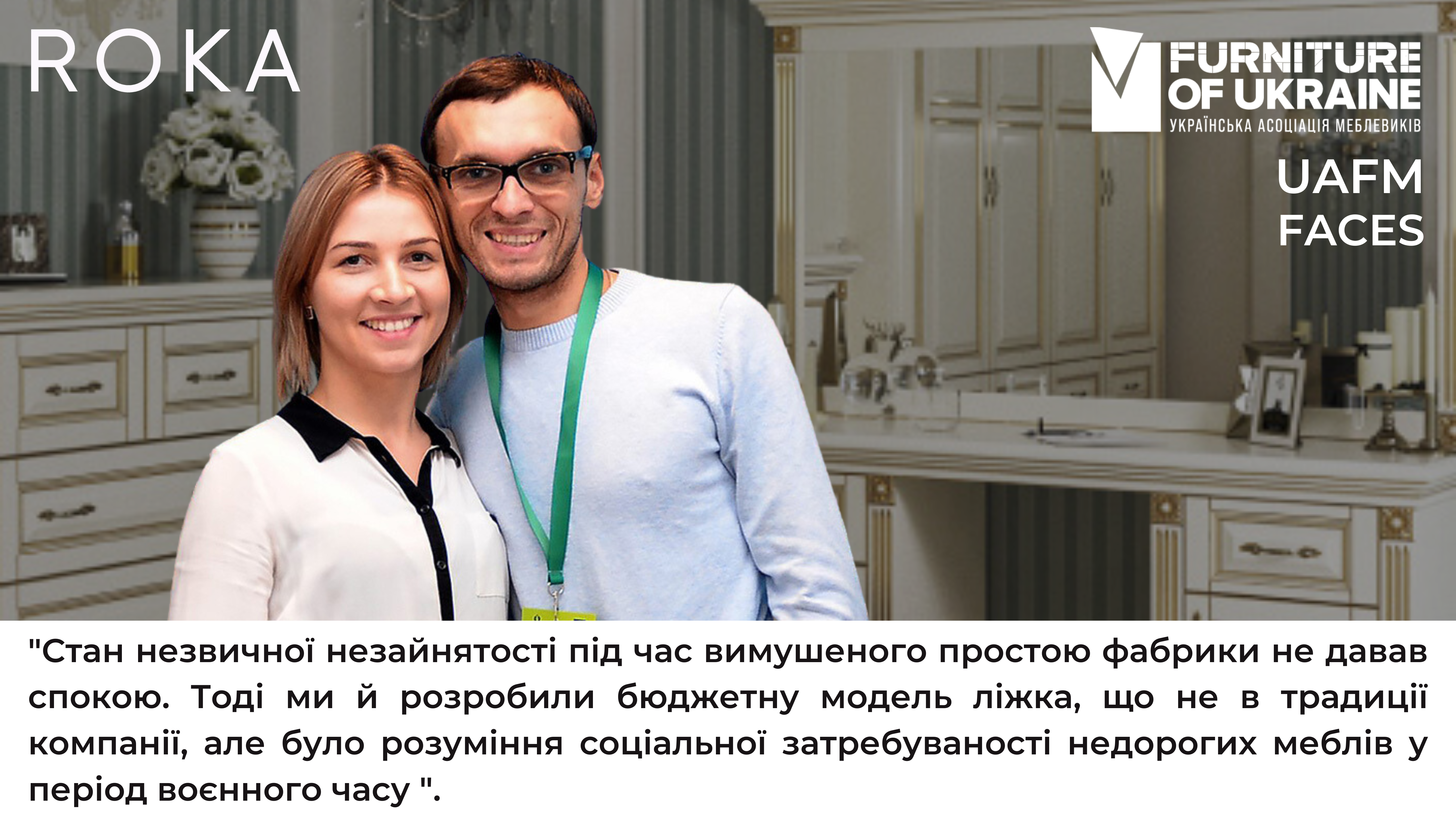
UAFM in Faces: Co-owner of the “ROKA” company, Vladyslav Kask, shares steps taken in furniture business development despite the complex realities of the present time.
Vladyslav Kask is engaged in furniture manufacturing in Cherkasy by vocation and profession. He graduated from Lviv Forestry and Wood Technology University. His wife, Katerina, is also motivated in the furniture business. She holds a diploma from the Kharkiv Academy of Design and Arts, showcasing her design skills. In 2013, the couple founded the furniture company “ROKA” naming it after the combination of the first syllables of Katerina’s maiden name and the beginning of Vladyslav’s surname. Over the decade of its existence and development, the company has become a reputable player in the domestic furniture market, feeling confident and promising within it. The previous year was meant to be another step for its strengthening and growth. However, it will remain one of the most challenging milestones in its history. Needless to say.
With the onset of the war, the factory remained idle longer than anticipated. This was due to the fact that they do not sell furniture directly to end customers but practice a dealership form of product distribution. However, their dealers across Ukraine, including the occupied territories and conflict zones, suddenly ceased trading because, like all Ukrainians, they were shocked by the events unfolding in the country. As trade gradually recovered, “ROKA” began production, accepting the loss of some dealers for an indefinite period. Thus, it became challenging to reach pre-war levels of production and sales. Nevertheless, our successes on the front lines, the reclaiming of enemy-occupied territories, and the dedication of the team yielded results for the company, which were hard to anticipate just a few months prior. In just six months, they reached 70% of the pre-war production level. The first orders during the wartime period came from western regions, indicating a gradual recovery of the furniture market.
– The state of unusual idleness during the forced factory downtime, – Vladyslav explains, – was unsettling for my wife and me, as we were used to being involved in business from early morning till late evening daily. So, we developed a budget bed model, which was unconventional for the company that typically specializes in solid wood furniture in the mid-range plus price segment. However, we understood the social demand for affordable furniture during wartime. Additionally, we had leftover semi-finished materials that could be used to produce such beds. Indeed, there was a swift demand for these kinds of furniture, mainly from volunteer organizations catering to the needs of displaced refugees. The company didn’t generate profits from this, but it managed to sustain the workforce during the initial stages of recovery, which was crucial at the time. Later, a commercial version of the budget bed model was designed and remains part of our product range because the demand hasn’t diminished.
– So, did the company shift towards producing budget products?
– No, it didn’t shift. We stayed with our customary manufacturing positions, producing furniture in the mid-range plus price segment. The production of budget beds was a temporary deviation from our strategic course. Now we continue to strengthen our brand within the traditional pricing parameters for the company. Moving to a lower price range isn’t advantageous in technological terms; it would require reconfiguring production, which is economically impractical.
– Were there any developments for your main product line as well?
– Expanding the product range is challenging for the company at present. Not in a creative sense, but technically and in terms of personnel. It would mean increasing the factory’s production capacity and expanding the workforce, which isn’t feasible in the current situation. So, we focused on optimization: simplifying the technological process and reducing the cost of existing models. For instance, we standardized furniture components to use across various models without compromising each model’s uniqueness. By reducing the variety of furniture components, we optimized the production process. This was something we hadn’t had the time or necessity for in peacetime.
Additionally, we analyze which models and collections have lower demand, identify the reasons, and address them, primarily by improving product quality through material substitutions.
– Such production optimization signifies real progress in the company’s development, which is a feat achieved by only a few manufacturers during these challenging times. This year should be even more favourable for this.
– We’ve managed to achieve something significant for the company this year as well. We secured a small grant to acquire a press for veneer application, which now allows us not to depend on subcontractors for this operation. At least for now, when production isn’t overwhelmed with orders.
– What are the main obstacles that currently challenge the company the most?
– The first challenge is not the overall reduction in the number of orders, but the instability of their arrival: work might be absent today, and tomorrow we might need to work double shifts. This irregularity unsettles the team and destabilizes the company. Another problem is the human resource issue, although our workforce is small. However, precisely in a small team, the absence of even one employee is keenly felt and jeopardizes the entire factory’s operation. This is the situation we find ourselves in, hoping for improvement as our victory approaches.
