

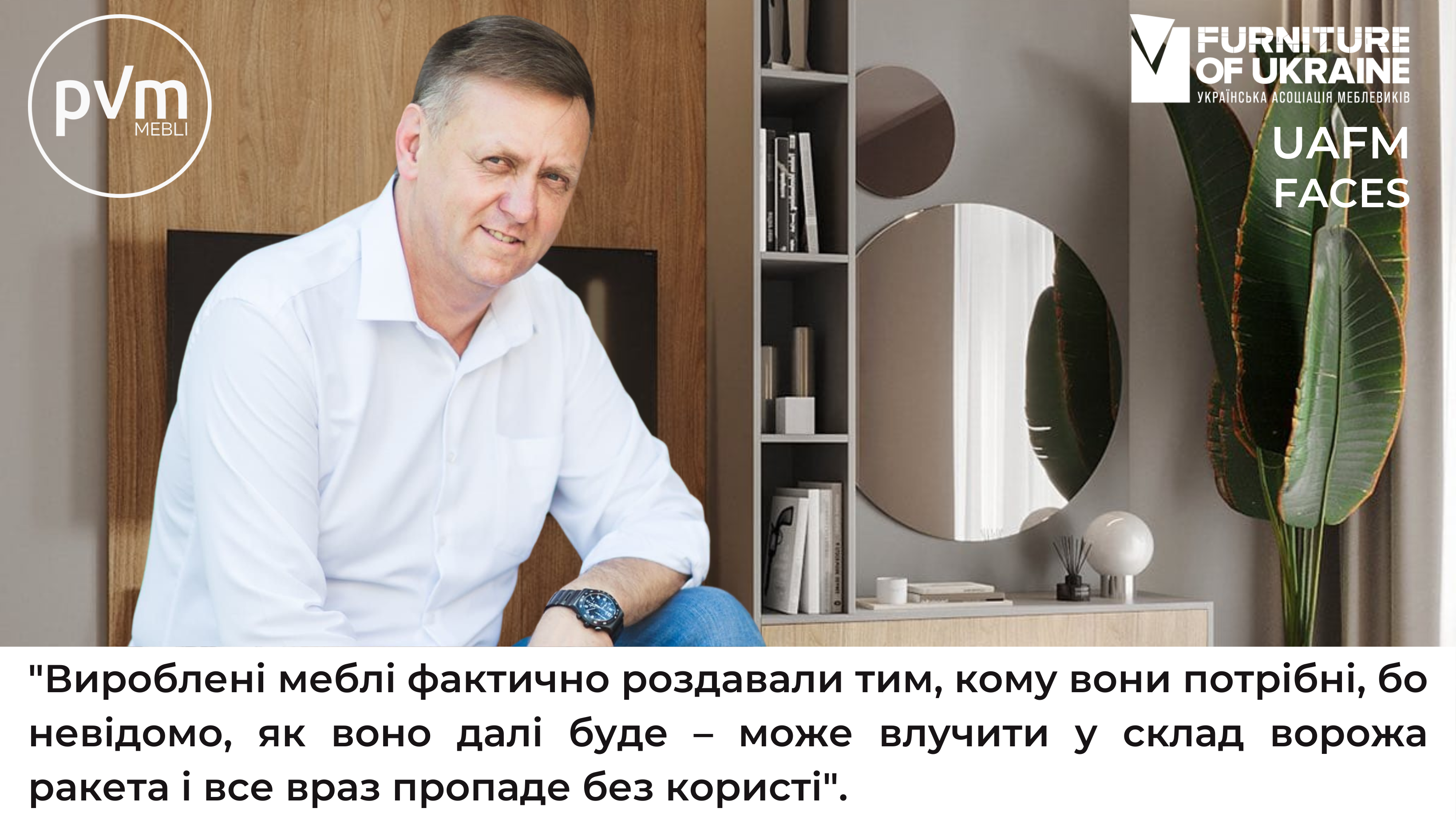
UAFM in the faces: during the war, the concept of “charitable furniture-making” emerged. For almost two years, it became the essence of the activity for the company “Mebli PVM”.
The owner of the capital’s factory, “Mebli PVM“, Vitaliy Prykhodko, personally addressed potential clients on the company’s website:
“We offer a wide range of quality furniture for everyday use at affordable prices. Today is a challenging time for many, especially financially. Therefore, we strive to provide our customers with quality products that can fit into a modest budget. And our furniture is everything you may need at home, from wardrobes to kitchens. We offer special discounts that can be helpful for you.”
Further conversation with Vitaliy Mykhailovych revealed that the appeals mentioned in the excerpt from his address were more than just a marketing tactic. The civic and humane, Christian position of a Ukrainian entrepreneur should be present in everyone during times of national distress, ready to help those in need.
– In the first critical weeks of the war, our company, like the majority of domestic private businesses, supported the defenders as much as possible to give a worthy response to the enemy. We contributed everything we could to support the territorial defence. All our transport and most of our employees were involved in delivering humanitarian aid. No one thought about any gain from it, understanding that if the enemy is not stopped, we will lose everything.
When the enemy was driven out of Kyiv, former clients from the heavily affected areas of Bucha and Irpin reached out. Some requested furniture repairs damaged during the occupation, while others asked to dismantle and transport miraculously undamaged furniture from their ruined homes. Some had nothing left at all. My guys delivering humanitarian aid returned one day and said a family was living in a barn with nowhere to sleep. We immediately made beds for them and transported them. How could I refuse or demand payment from people in such situations? I provided transportation to employees to help people, and they didn’t argue, even if I could only pay them a symbolic amount of five hundred hryvnias for the work.
The company could afford to pay employees at least the minimum for a living when production resumed. We produced simple, non-profitable beds, stools, and tables for soldiers’ bunkers and civilians who were left with nothing. At that time, my thinking was: even if it’s not perfect, we need to put into production all the material reserves accumulated before the war and distribute the manufactured furniture to those who need it because the future is uncertain. A hostile missile could hit the warehouse, and everything would be lost in an instant. We gave three beds and a wardrobe to a young family with three children from our store at one of the markets. “Take them right from the showcase. So that the children don’t sleep on the ground.” When you make furniture for such needs, it is done quickly and in the most straightforward way—no designer frills. You use the materials that are available and the paints and varnishes that you have. People who have experienced hardship appreciate this simplicity.
– How long did the company sustain itself through this charitable furniture-making?
– We managed to rely on pre-war material reserves for almost the entire past year. Gradually, paid orders started coming in, but we didn’t push for them too much. Clients still asked for discounts. Human nature is such that if you make one pricing concession, people want more. We took orders with at least some margin calculation. Later, we were able to handle a mini-series. That’s how we managed to stay afloat in the market, and that’s how we’re holding on now. By this fall, we even managed to settle our debts.
– Where did you get the resources for that?
– It was all for the same reason – to have the ability to help people. We managed to secure interest-free credit cards from two banks. I used these cards to buy groceries, fuel, and send supplies to the front. The factory was barely surviving, but we didn’t stop supporting the army. We continue doing that even now. We recently sent a specially purchased generator to the front lines. We send wheels for vehicles and batteries. Power banks are in high demand there now.
– Through social media, you started actively promoting your wardrobes. Why focus on them?
– Because they turned out to be in high demand in the current market. We developed several wardrobe mini-series and hit the market trend with this feature. We offer them at good prices and decent quality, thanks to the use of quality fittings. Modern design also attracts buyers. They are showcased in our stores with various facade options. Again, we agree to have a small margin but not compromise on quality and not scare away our target audience of potential buyers with high prices.
