

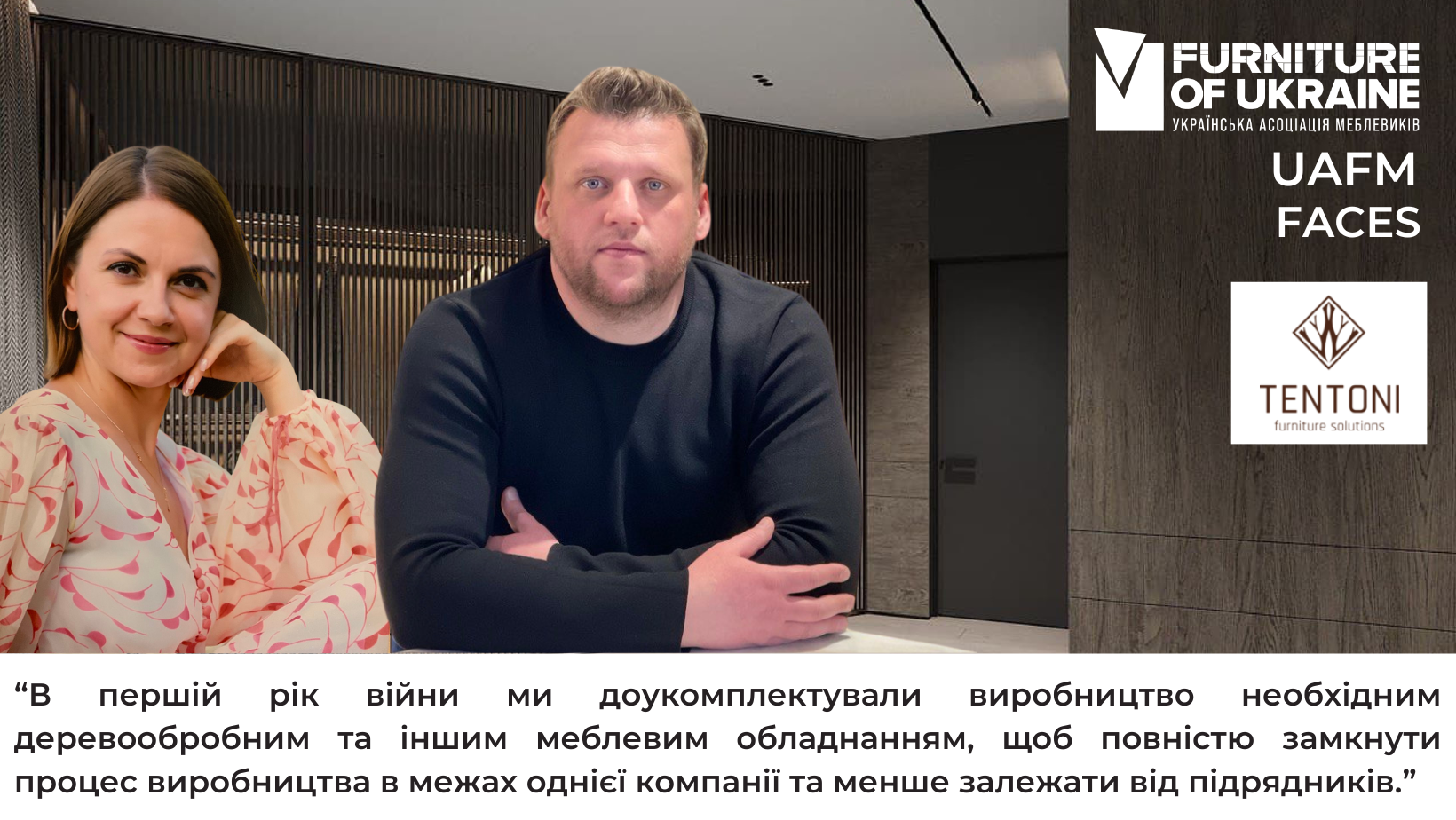
UAFM in faces: in the conditions of martial law, every complex project that furniture makers have to implement is a challenge for each company. The company “TENTONI” is no exception, as its co-owner Iryna Novikova shared.
Many domestic producers – and furniture makers are no exception – were forced by the war, which collapsed the domestic market, especially in the beginning, to rapidly seek foreign opportunities to sell their products. Some started looking for such opportunities from scratch, while others, who already had export experience, expanded their export horizons in every possible way.
The capital company “TENTONI”, which is a family business of the spouses Iryna and Serhiy Novikov, began the implementation of its first foreign turnkey project virtually in the first weeks of the war. Just as it would have started it even if there was no war: because everything was already ready for this.
– Perhaps the start of the war in Ukraine was not perceived indifferently by your customer. Didn’t it make him wary, didn’t it scare him with the risk of being left with nothing? Didn’t he want to terminate the contract? – these were the questions we started the conversation with Mrs. Iryna.
– Of course, the customer understood that he was taking a risk. At the beginning of the full-scale invasion, European banks recommended their clients to refuse transferring currency to Ukraine, assigning the highest degree of risk to such operations. But neither the foreign client nor us had a plan ‘B’, so to speak, to act differently. Agreements had already been reached regarding the delivery and installation deadlines, and refusal from the contract meant postponing the project for three or more months, which the client could not afford.
And we, despite the most intense phase of the war, were ready to fulfill our obligations. And within the agreed timeframes, because the team was still almost complete. Therefore, the client still made a risky advance payment, and we purchased the necessary materials and components.
And the client’s company did not let us down. Neither with the timeframes for manufacturing the entire agreed volume of products, nor with their quality, nor in terms of logistics and installation. Although at every stage we had to overcome certain obstacles caused by the martial law in which the country found itself. This also enriched us with image capital, which helped us get further orders.
– The implementation of complex projects involves the use of various materials – glass, metal, stone, plastic, and, accordingly, working with them. Is the company universal in this sense or does it resort to subcontractors?
– The core specialization of the company is woodworking and case furniture. Therefore, on a partnership basis, when implementing complex orders, we work with manufacturers of upholstered furniture, metalworkers, processors of artificial stone, etc.
– Each custom project is individual, and therefore always differs in some way from previous ones. In the conditions of war, has the level of individuality of orders increased or, on the contrary, has there been a tendency towards simplification, standardization, which could facilitate the work of private order contractors?
– No, we do not observe any clear tendencies towards standardization of individual projects. And even if there were, it is unlikely that in the current conditions this would significantly facilitate our work. I mean working in conditions of limited resources – last year it was energy resources, now it is human resources, which are becoming more and more noticeable. This makes every interesting project more difficult than it could have been before the war. Now, almost every project is a challenge, because there are so many undesirable factors, and sometimes it is difficult even to foresee them.
– In addition to the fact that the company has made a foreign economic breakthrough during the war period, what other positives could you boast about?
– In the first year of the war, we completed equipping our production with the necessary woodworking and other furniture equipment to fully close the production process within one company and be less dependent on subcontractors. After all, in such a turbulent period, guarantees are minimal, and responsibility is too high.
Last year’s participation in a trade mission to the UK, which became possible for us thanks to our membership in the Ukrainian Association of Furniture Manufacturers, expanded our export prospects. This year, we plan to increase our sales volume, in particular, expecting to enter the Canadian market, where we have a representative.
– And next door is such a powerful US market…
– Yes. But not everything at once. We lack investment for greater ambition. Furniture making, of course, is not among the current state priorities, such as the army, agriculture, technologies. Although, it is worth noting that in our field there are enough grant programs, both from international donors and the state, which provide substantial support, especially for companies that have suffered the most from the war.
