

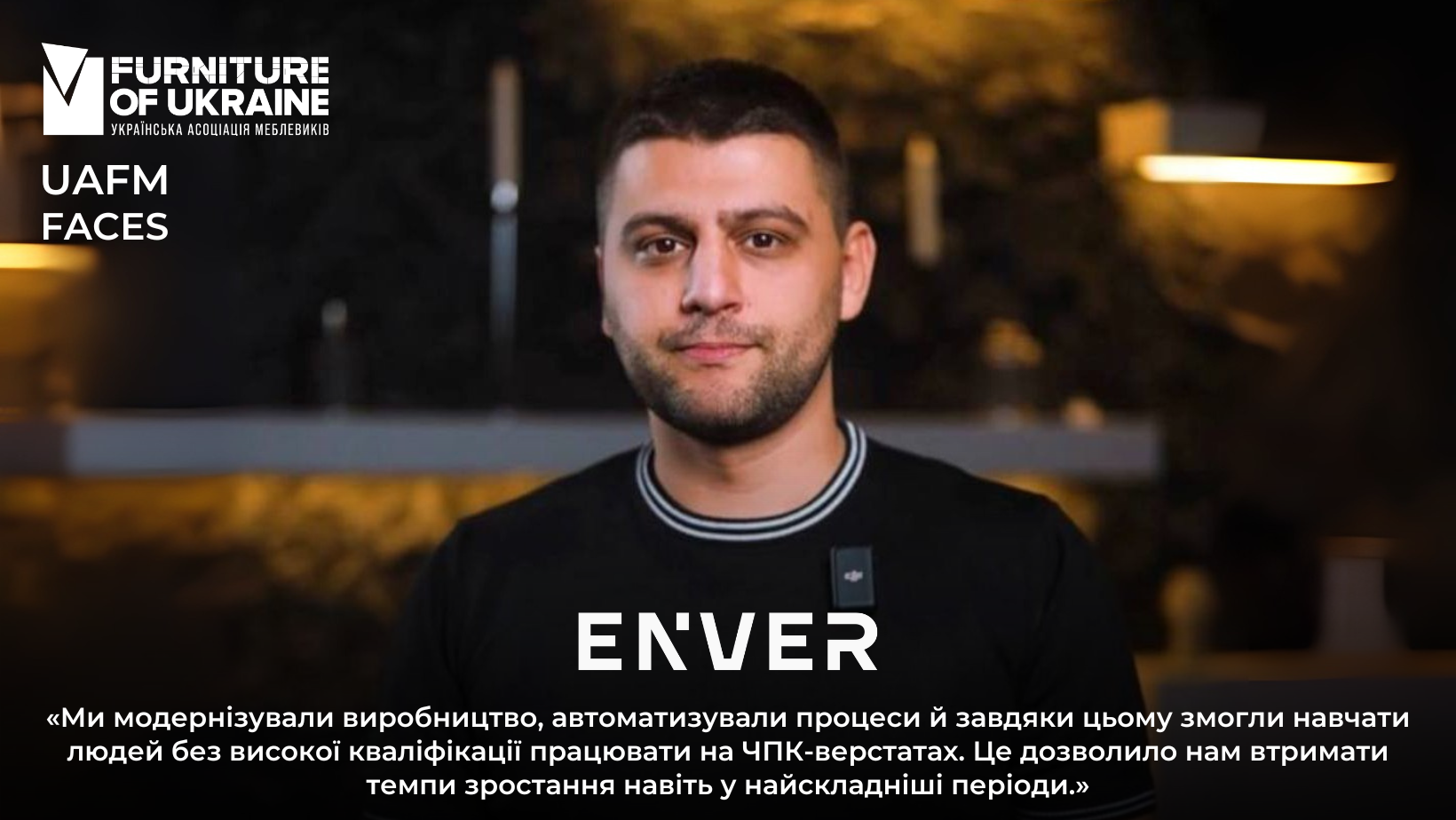
UAFM in faces: how Enver achieves annual growth — a story from its founder, Enver Mamedov.
Over the past year and a half, during conversations with furniture makers from our Association, we’ve been hearing fewer complaints about the economic and social challenges caused by the war — though these difficulties still persist for businesses. The most pressing issue remains the shortage of skilled labor. We can’t help but feel proud of the companies and leaders who, despite all obstacles, continue to demonstrate optimism grounded in real growth and profitability throughout nearly the entire wartime period. This story is about one of those companies — the company of Enver Mamedov.
– In the current conditions, our company feels confident primarily because we modernized our production by purchasing new equipment, which enabled significant automation of manufacturing processes. It was a strategic and forward-thinking move. When the labor market in the country became strained, we were able to hire people who, even without high qualifications, could work effectively on CNC machines after brief training. Additionally, fewer employees are now needed to maintain the production process.
Moreover, using modern tools and practices, we developed and implemented an effective quality control system and a set of standards for each employee to organize their workstations properly. This helped optimize both production and management processes and increased productivity. This internal organization also produced tangible results.
– For such a large-scale upgrade of your machine park, you probably didn’t rely solely on your own funds?
– Correct. We used credit. We were hoping for grant funding, but it didn’t work out. At the beginning of the war — during the chaos and disorientation business owners were experiencing — we couldn’t gather and prepare the necessary documentation for grants in time. However, the government simplified access to credit, and we took advantage of that.
– Has the company’s profitability grown only in the past year and a half, as the domestic market, economy, and society have adapted to martial law?
– Not really. Every year during the war, our production volumes have grown by 30–40%. Naturally, profitability has also increased. To be specific: last year we saw a 37% increase, and this year we aim to reach 42%.
– Has the product range changed?
– We exited the mass-market segment — we no longer produce economy-class furniture. Instead, we’ve established ourselves in the mid- to high-end price segment. Before the war, many clients sought the cheapest options and agreed to lower-quality fittings and materials. Today, staying in the mass market has become economically unviable. This shift has allowed us to work more with designers who incorporate our furniture into their interior projects, as well as with construction companies — rather than directly with end consumers.
– Many Ukrainian designers have moved abroad and are implementing interior projects there. Some companies have managed to enter foreign markets through cooperation with them.
– We’ve received such a request, but I’m not yet ready to accept it. For us, it’s important to maintain high quality at all stages of the project. I am confident in what we produce in-house, but due to obvious reasons, I can’t send our team abroad to take precise measurements or do the installation. Outsourcing these steps means I can’t be sure everything will be done precisely and correctly.
– So quality remains one of your key competitive advantages?
– I truly value the fact that in our company, we don’t leave even the smallest flaw unresolved if it bothers the designer. We finish projects to the point where the designer or client says: “super-super.”
Another key advantage: since the start of the war, we haven’t missed a single delivery deadline — and we’ve managed this without overexerting our team or resources. At times, we’ve taken on multiple large furnishing projects simultaneously. We’ve even completed work on sites a full month before the client was ready to use the space. Again, automation played a huge role in meeting and exceeding these deadlines.
– Let’s return to the issue of staffing shortages — a major challenge for furniture makers and most Ukrainian entrepreneurs. Practice shows that women can successfully operate automated woodworking machines. Have you considered this in your staffing strategy?
– We do employ women, particularly in the workshop, in roles that don’t require significant physical effort — for example, quality control, final preparation of products for delivery, and other key production stages. We highly value their professionalism and responsibility.
As for machine operation, we currently don’t have an urgent need to involve women. Not because of doubts about their capabilities, but rather due to the physical nature of the work. Personally, I follow a traditional approach here. That said, if the need arises or women themselves express interest in such roles, I’ll do everything possible to ensure safe, comfortable working conditions. It’s important to me that everyone in the team enjoys their work.
– What other innovations have you implemented recently?
– We’ve started organizing events, meetings, and consultations with designers to discuss pain points in cooperation with manufacturers. They share what challenges they face when working with furniture companies, and we, in turn, explain how we address similar issues. This has opened up a more active and productive dialogue.
Additionally, we’ve begun to work more deliberately and deeply on marketing, to better position ourselves. Over the past year, I’ve been fully immersed in this area.
We’ve also started inviting schools for tours of our facility — to show students what modern furniture production looks like. We want to demonstrate that it’s a complex but fascinating technological process, not just cutting boards and assembling them into furniture. These initiatives are part of our long-term strategy.
– There’s always room for improvement. What areas are you looking to improve next?
– We’re preparing to implement a management system based on artificial intelligence. It will process orders, organize and control product output, and help streamline and maintain a clear production workflow. We try to stay future-oriented and move in sync with digital Ukraine.
