

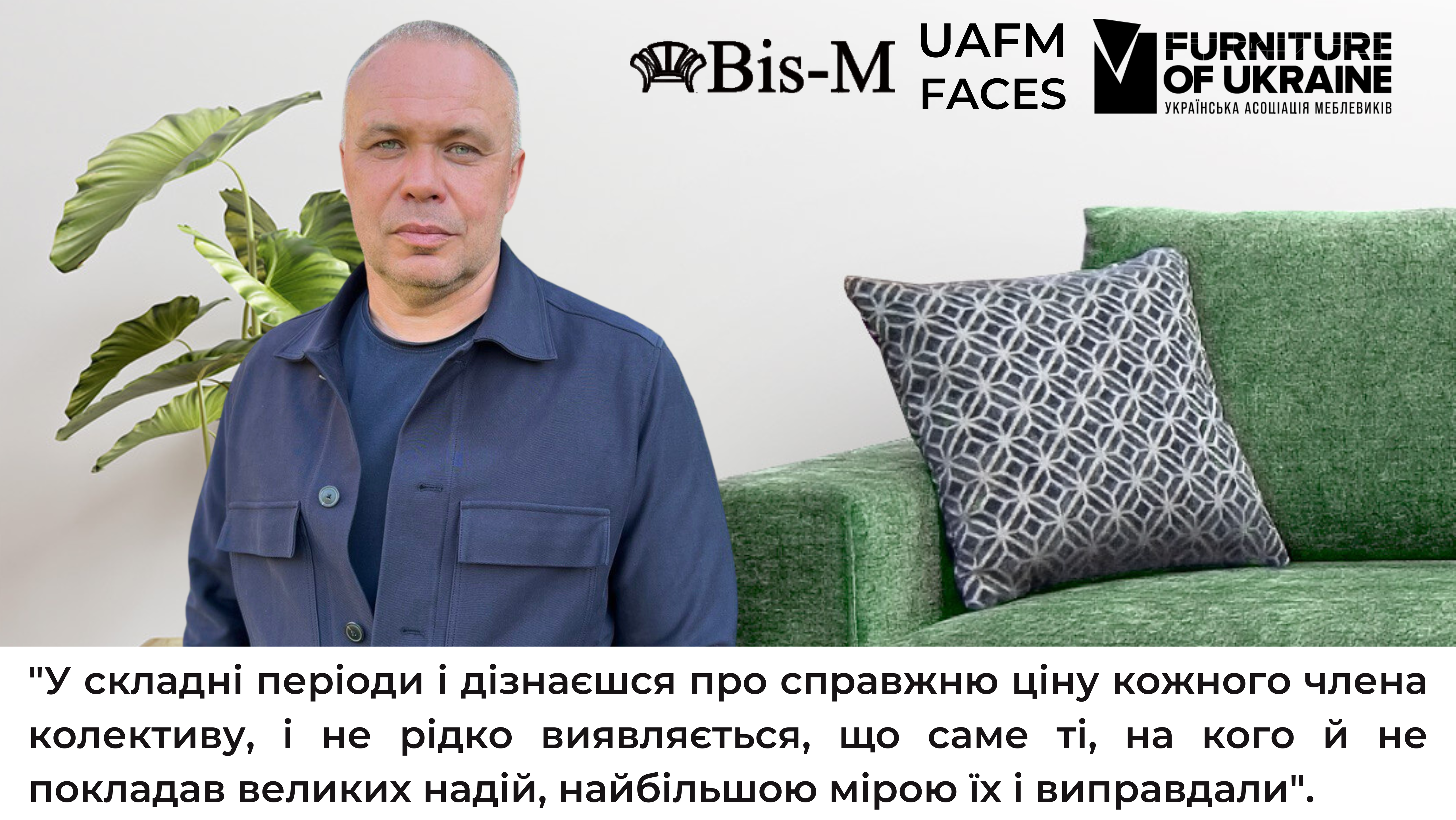
UAFM in Faces: “How to Furnish in Kharkiv Today, Which Remains Challenging for Business?” – Told by the Owner of “Bis-M” Company, Oleg Mazhnikov
Every time with anxiety – whether disaster has spared destruction? – we call someone from our Kharkiv colleagues, knowing that the city, due to its geographical proximity to hostile borders, remains one of the most vulnerable to russian shelling. With such apprehension, we prepared for a conversation with the owner of the “Bis-M” company, Oleg Manzhikov.
Thank God, our production remains intact and undamaged. It operates almost as usual. Gradually, it is picking up the pace to reach pre-war levels of soft furniture production, and the war, whose ominous shadow continues to loom over the city, has not hindered the renewal and expansion of the product range.
We were fortunate with the location of the factory, says Mr. Oleg. Industries located on the outskirts of the city, especially in the north, proved vulnerable to the enemy. However, “Bis-M” is situated in the central part, which is more secure, and therefore it escaped the sad fate of several Kharkiv furniture manufacturers that were affected by enemy shelling and ceased to function.
Manzhikov, whose company was more fortunate, came to the aid of his affected colleagues, showing both entrepreneurial and human solidarity. He provides them with his products, allowing them to sell them under their brands in the spaces they rent from him. This way, without producing their goods, furniture makers who have suffered misfortune managed to avoid disappearing from the furniture market until they can restore their production, which is important for their image and maintaining their market niche. Moreover, they earn some income through private label sales for their essential needs.
The catastrophic circumstances, which dealt a devastating blow to the furniture industry in the Kharkiv region, forced clients of those companies that were incapacitated by the enemy – including foreign clients – to redirect their import needs to functioning furniture manufacturers in the region. Former competitors, who are now like “subordinates,” as well as “Bis-M” gained new clients, for example, in the Baltic countries, as a kind of reward for their friendly assistance. Thus, they acquired new customers.
If we go back to April of last year (which we did in our conversation with Oleg Mazhnikov), when the “Bis-M” company started to restore the interrupted furniture production process after a one-month break, it was harder for them than for furniture manufacturers in regions that were not occupied. It wasn’t easy to gather those who could start working. Of course, this doesn’t refer to mobilized or even forced migrants who dared to return to a city methodically shelled by the enemy, but to employees who found themselves in the occupied territory of the region. Their escape from there was quite an epic, even in Mr. Oleg’s condensed narrative.
– We helped them in every possible way to get out of there. It was usually hazardous because they had to sneak through forests and fields. Upon arrival, we sheltered them at the factory. Where they worked, they also lived. In the workshops, in the warehouse. Some even in my office. The fate of temporary homeless people befell not only those who fled from the occupier but also the workers from the Saltivka area, which was constantly shelled, so people were afraid to return home after work.
I am among those Kharkiv residents who had to leave the city on its most critical days. During that period, I stayed with my children in the western part of the country. But I couldn’t stay there for long because I understood that this was not a case where you could remotely manage the process of restarting the factory. As it turned out, the physical presence of the factory owner was of great importance to the team, to the extent that if the owner was at work, we would work, but if he wasn’t, then we would go home. My presence as a calming factor, especially for the female seamstresses, was necessary, especially when we had to work under the thunderous explosions during the shelling of the city, which drowned out the noise of the equipment.
– Kharkiv remains problematic for business even now. How do you manage, in conditions of constant risk and a total shortage of labour resources – especially skilled labour, especially male labour – not only to provide a full-fledged production process but also to continue producing high-quality, highly competitive products, as you did in much better pre-war conditions?
– The current team is not the same as it was a year and a half ago, both in terms of personnel and functionality. To ensure a full-fledged operation of high-tech production with fewer workers, each employee had to take on several functional duties. This was done not out of coercion but out of a clear understanding of the absolute necessity of such a decision. In challenging times, you learn the true value of each team member, and it’s not uncommon to find that those on whom you didn’t place high hopes have proven to be the most valuable.
– War, as practice shows, tests the business and partnership reliability of foreign clients. And not all of them pass this test.
– Some of our clients fall into this category as well. They were hesitant to buy our furniture at the beginning of the war, but now they want to rekindle their former relationships. However, we are not interested in that anymore. We feel that the liberation of another settlement from the enemy adds strength to the domestic furniture market. People aspire to arrange their war-torn lives peacefully, and our furniture products are indispensable. Understanding this, we shape our business policy accordingly.
