

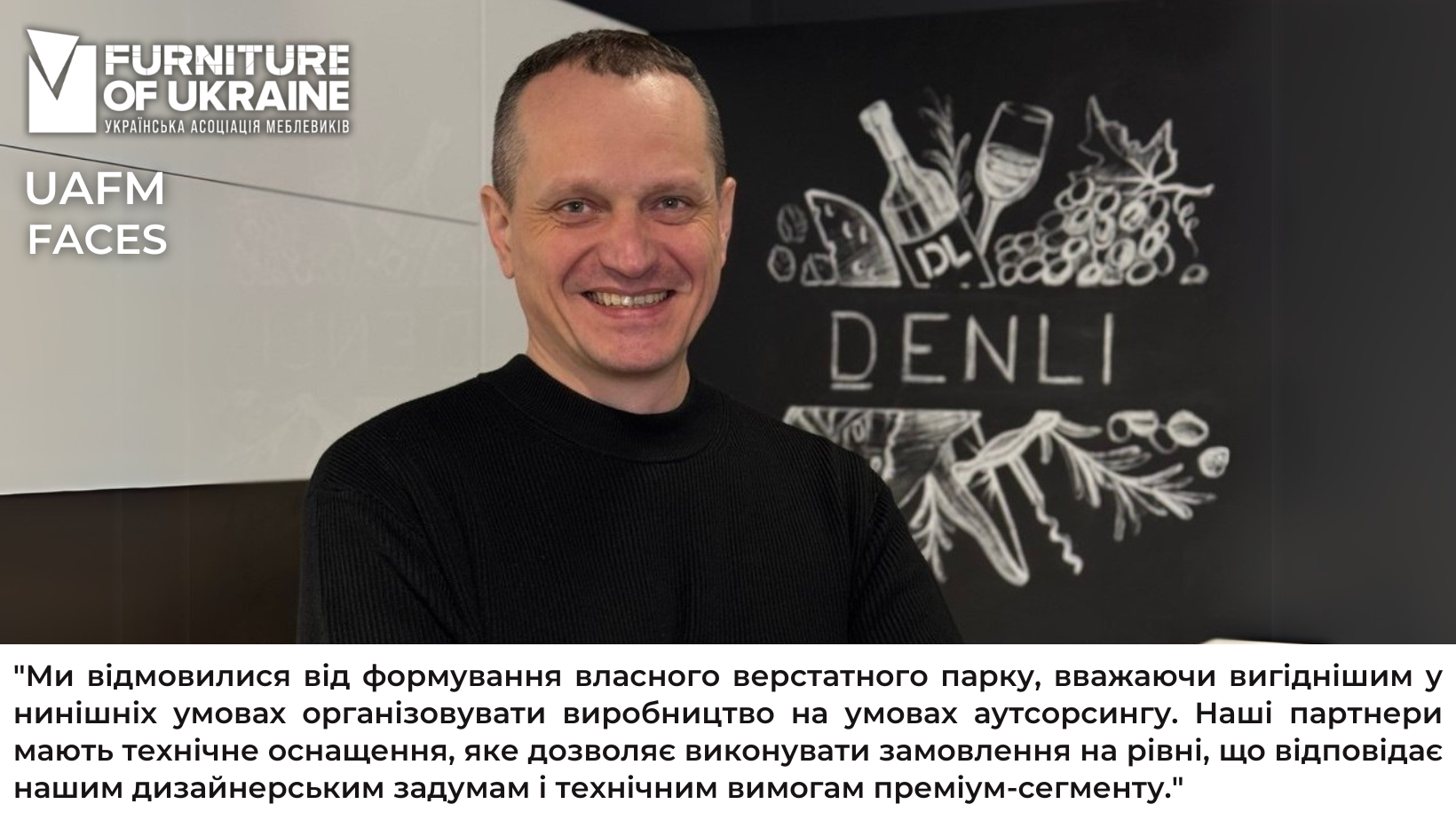
UAFM in Faces: The story of Stanislav Fedchun, Co-owner of DenLi
The Mykolaiv-based company DenLi has expanded its presence across the country — not only in terms of product sales (primarily kitchen sets), but also with a new production purpose. The company opened an additional production unit in Vinnytsia.
“Why did you choose to open a production facility in the center of the country, rather than in the west, like many other companies relocating to what they consider to be safer regions during the war?” — we asked Stanislav Fedchun, co-owner of DenLi. He explained the decision was driven by logistical convenience and available personnel. As for safety, he emphasized that currently the entire territory of Ukraine is exposed to enemy attacks, and no region is truly safe. That’s why the company decided not to relocate, maintaining its headquarters and production base in Mykolaiv and establishing only a supporting unit in Vinnytsia.
— What do you mean by logistical convenience?
— Before the war, we focused on serving the southern region of Ukraine, where we originally started. The war has reshaped the domestic market, and now we need to supply our products to Vinnytsia, the capital, the north, and the west of the country. Vinnytsia is geographically convenient for us to move in all directions.
— Is the Vinnytsia unit organized the same way as the one in Mykolaiv?
— We decided not to build our own machine park, finding it more efficient under current conditions to rely on outsourcing. We work with companies like Viyar, AGT Plus, Vibir, and Maximum Plus, whose technical capabilities allow them to fulfill our orders at a level of quality that matches our technical specifications and premium design standards. Our own installers then assemble and deliver the finished furniture to clients.
— So it’s possible to manage without having your own machinery?
— We still have some equipment, but it’s mostly used as auxiliary tools.
— Do you produce only kitchens?
— Mainly, yes. Since the beginning of the war, we’ve found it most reasonable to focus on kitchen furniture. However, we now mostly offer full-home furnishing solutions with custom cabinetry, delivered turnkey.
— Are these your in-house designs, or do you collaborate with external interior designers?
— Both. Even when we work with external designers, we handle all the technical documentation and design detailing — the designer provides only the overall project concept.
— Have you set export goals yet?
— Yes, but we haven’t fully explored that direction yet — it’s still at the stage of strong intention. This year, we’re going to tackle it. We’re considering two approaches: one is to work with our current models but establish representatives abroad who can take measurements and handle installation. That’s not an easy task, as you can imagine. The second direction is to develop a new original product. We already have some groundwork, though it’s too early to share details. We’re aiming for serial production, understanding that in this case, outsourcing alone won’t be sufficient — we’ll need to establish our own machine park. The new product will be intended both for domestic and export markets, though we’ll test it first in Ukraine.
— Many companies in the premium segment have struggled during the war. Yet yours has managed to stay afloat…
— I now consider it a stroke of luck that we succeeded in elevating our product to a premium level before the war. It’s now clear that the premium segment — surprisingly to some — has been the least affected under martial law. I mean, of course, the moderate premium segment, where a kitchen can cost tens of thousands of dollars.
— How was last year compared to the two previous ones? And apart from exploring export opportunities, what else do you plan for this year?
— Last year was definitely more favorable and productive — both in terms of production and sales volumes, and in staffing, since growing output requires more hands. As for plans, our priority is to determine our export strategy. It’s a complex task, so we prefer not to take on anything else major simultaneously, to avoid spreading ourselves too thin.
