

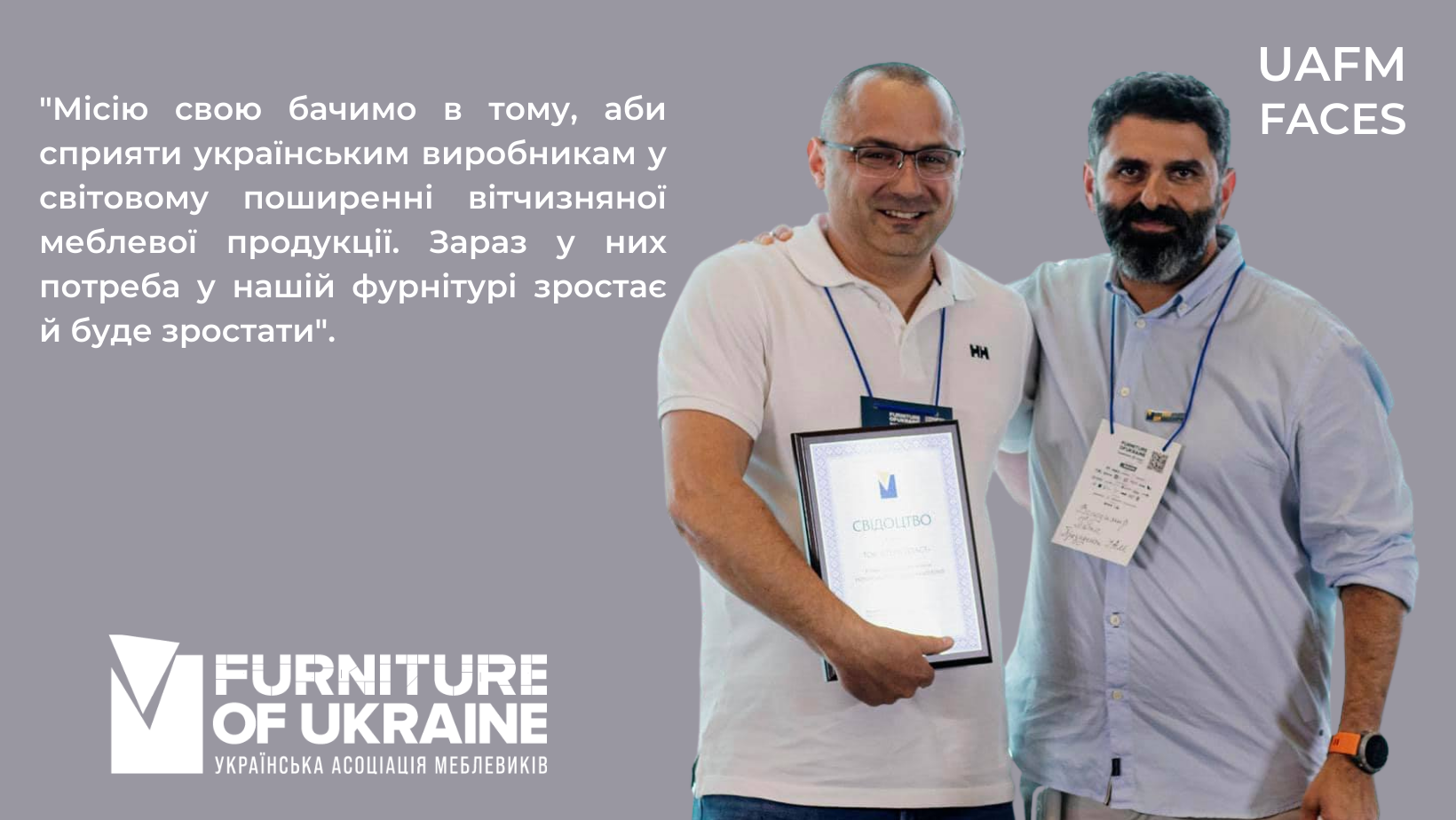
UAFM in the faces: in the growth of demand for furniture products of the “ETERA” furniture accessories factory, its co-founder, and CEO of the company Vitaliy Shmata sees encouraging evidence that domestic furniture is starting to return to pre-war positions
The war in one way or another negatively affected our entire industry, and all members of our Association. Unless someone to a greater extent, or someone to a lesser extent. It is clear that those companies that have not stopped their activities in Kharkiv or Mykolaiv feel more anxious, and exposed to greater risks of Russian destruction, than those that are registered in, say, the Ivano-Frankivsk region or Ternopil region. Actually, this publication will talk about the factory of furniture accessories from Ternopil Oblast.
“ETERA” furniture fittings factory is one of the members of UAFM that is not a furniture manufacturer – it produces components and fittings for furniture. It is needed by both cabinet and upholstered furniture manufacturers. And the fact that the factory already reached pre-war production volumes in August is encouraging not only for him – we are also happy for him because it is a testimony, an indicator that the Ukrainian furniture industry is straightening its shoulders, and is also striving to reach production indicators beginning of the year
– We have returned, – says the co-founder of the company Vitaliy Shmata, – and our pre-war traditional practice of regularly updating and expanding the range of products. For example, the production of metal lamella gratings, and transformation mechanisms for manufacturers of upholstered furniture and tables have already been established, and the assortment of decorative and fastening accessories has been expanded. This was prompted by the request of the domestic market in general and the need for them by our specific customers. They began to feel a certain shortage of some components due to the fact that fewer similar products began to enter our market under the conditions of the war.
The increase in production by our furniture customers has made it necessary for us to expand our production capacity as well. And very soon, the new production base with an area of 3,600 square meters will be operational and will produce the first batches of hardware products. The state helped in this matter by providing the company with a solid financial grant.
In the new difficult conditions of wartime, we strive to manage in a new way – more efficiently and economically, in particular by taking a course to establish complete, closed production cycles. And the first steps in this matter have already been taken. We have mastered and already started the production of our own pipes, which we use – for now partially – to create the already mentioned lamella gratings. In the new production areas, we will fully implement methods of lean, flow production, based on the principles of the well-known concept of lean production. We have been working on this topic for five years already.
– Those companies that lost part of their customers during the war, who either ended up in the occupied territories or ceased to function due to destruction, are trying to compensate for the decrease in the customer base by looking for customers abroad.
– Our export practice is insignificant – Moldova, Romania. And there was no urgent need to increase foreign sales. We are mostly indirect exporters – we export our products in the form of products of our customers. Actually, we also see our mission as helping Ukrainian manufacturers in the global distribution of domestic furniture products. Especially since now, as I said, their need for our accessories is growing and will continue to grow. Anticipating this, we are increasing production capacity.
– Virtually all of our wartime stories feature the volunteer aspect of the activities of our associated companies, because, apparently, not a single one in this difficult time of trials for our country was left out of the army’s assistance to the forced emigrants. How does your company help?
– Our workers are among the soldiers on the front line. We are constantly in touch with them and respond to all their needs. First of all, these are transport needs.
We periodically buy cars and send them to the front, because in the conditions in which the transport is operated there, it is not enough for a long time. The same applies to spare parts. Together with the fund that was created in the region, we have already sent more than 40 cars to the front line – mainly to soldiers from our region – not to mention the sets of smaller, but also necessary things there.
