

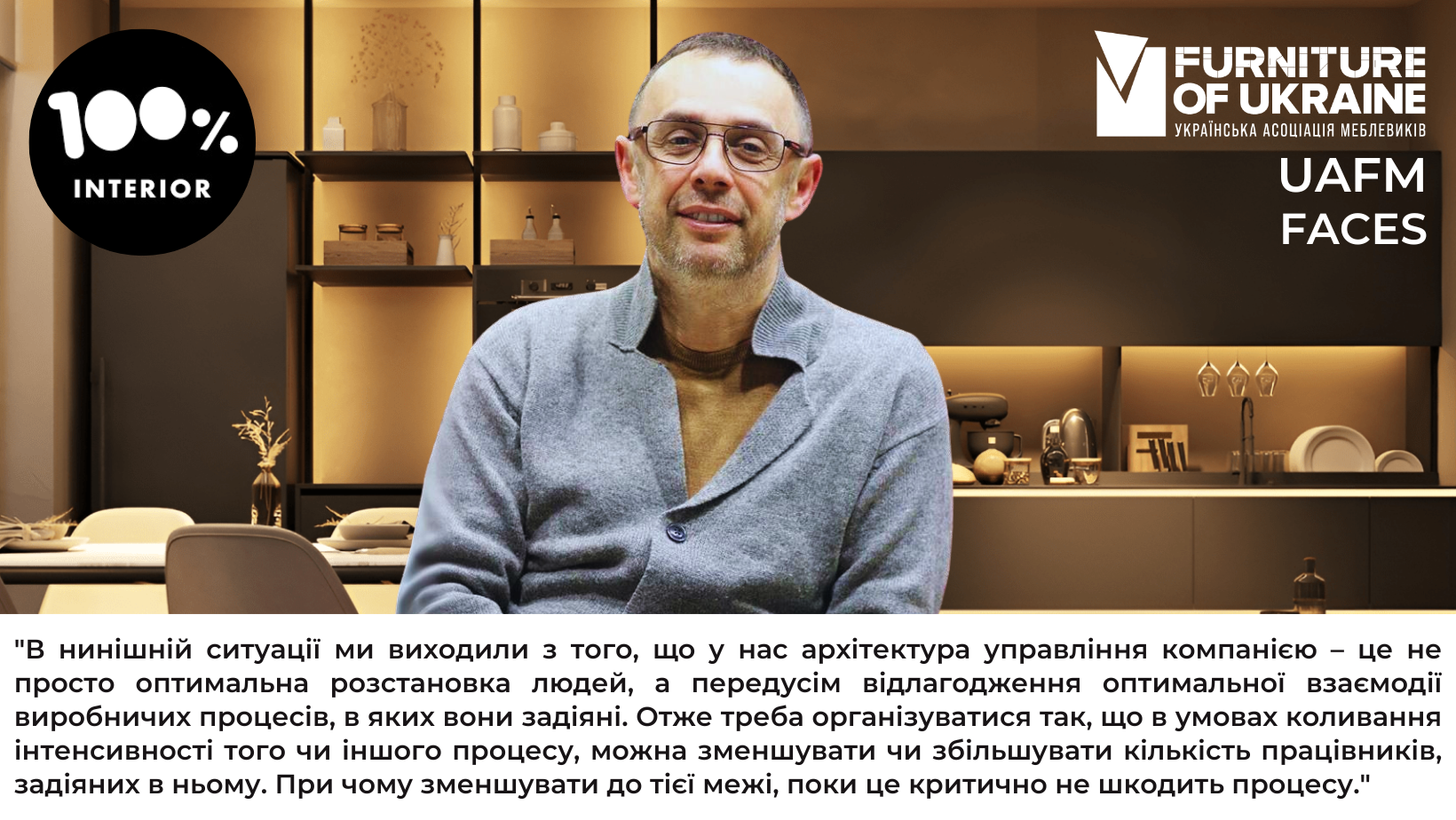
UAFM in faces: Vitaliy Ivakhov about current affairs in his company “100% interior”.
Vitaliy Ivakhov is not only well-known but, without exaggeration, popular in our industry. Of course, he’s also prominent in the Ukrainian Association of Furniture Manufacturers, having been repeatedly elected to its governing body and serving as a board member.
It’s both interesting and easy to communicate with him. Interesting because you’ll always hear a detailed expert opinion on the issue you’re addressing. This applies to design, where he’s an undisputed authority, and practical furniture making, as he owns a furniture production facility in Zaporizhzhia. And it’s easy because he formulates thoughts clearly, expresses them easily and comprehensibly – in a language understandable to all, having the experience of a TV host to boot.
– In whichever region or point of Ukraine a manufacturing company is located, no manager would say that the war hasn’t affected its activities. How has it changed yours?
– First of all, the war forced us to rethink everything that was usual for peacetime. To think deeply and creatively about how to work in the new, unfavorable conditions caused by it, so that production remains viable and business profitable. One of its main challenges was to prepare production for a situation where we’d have to manage with fewer workers. And such a reduction due to the mobilization needs of a country at war didn’t take long to come.
It should be noted that war is the biggest crisis situation that Ukraine, its economy and entrepreneurship are experiencing, but not the first. Recall the deep financial crisis of 2008. Then, too, we had to look for means to effectively counter it. Those who went through that crisis find it easier to counteract the current one, which is much more extensive and deeper.
As then, now perhaps the main challenge again is the aforementioned need to manage with fewer workers. Only then we were reducing them ourselves due to catastrophically low revenue inflows, and now the state is reducing them for us. Again, if then we were cutting non-critically important workers for production, now any specialist from the male part of the team can be pulled out at any moment.
In this situation, we proceeded from the fact that our company management architecture is not just an optimal arrangement of people, but primarily the adjustment of optimal interaction of production processes in which they are involved. So we need to organize ourselves so that in conditions of fluctuating intensity of one process or another, we can decrease or increase the number of employees involved in it. Moreover, to reduce to the limit where it doesn’t critically harm the process.
Another thing that has changed is the payment system. When there’s no stable flow of income, we’ve minimized the share of fixed salaries and increased the share of those calculated as percentages of profits received. What we earn, we distribute among everyone.
And one more financial aspect. We divide the received income into two parts. One is funds for company maintenance, the other is funds for purchasing necessary materials and components for the production of client furniture. This part has a clear purpose and is untouchable for other needs. This means that the company will certainly fulfill its obligations to customers, even if for some reason it owes salaries to employees, lacks rent payments, etc.
– But in current conditions, it may happen that even in that untouchable part there won’t be enough funds to purchase what’s necessary to fulfill received orders.
– That’s true, such misfortune does happen. Then suppliers come to the rescue. We have long-term partnerships with large supply companies that feel confident, have a reliable financial safety cushion, and in case of our hardship can defer payment for their products. I can name among such “Eskada-M”, “Thermopal”, “ADLER Ukraine”, “Kleiberit-Ukraine”. We know the capabilities of our suppliers because they are exclusively members of the Ukrainian Association of Furniture Manufacturers, where, needless to say, partner and corporate mutual assistance is one of the basic values.
– We can’t help but take advantage of your expert competence to learn about your vision of the current state of the domestic furniture industry.
– To answer, one could fit into the well-known saying “Everything that doesn’t destroy us makes us stronger.” But even furniture companies destroyed by war, defying it, rise from the ruins. Two and a half years of difficulties have added competencies to Ukrainian manufacturers that they would have acquired more slowly under “greenhouse” conditions. Their personnel competencies have grown: the ability to effectively manage personnel in conditions of “personnel hunger”, guided by the fact that the main task of the company is not profits, but survival in the long term. This is a sign of today’s furniture business. It has already gone through such trials, such hardening by adversities, that nothing will destroy it now.
– And what can you say about Ukrainian design?
– Along with high samples and innovative searches, our notorious folk-sharovar style is still present in it. But during the war period, this component shows a tendency to decrease. Thanks to the integration of Ukrainian design into global trends, which began even before the war, it is losing national characteristics in the context of globalization, like designs of other countries and peoples. Globalization levels them out, universalizes them.
The results of such integration are already noticeable. Works of Ukrainian designers have begun to appear on the covers of the most prestigious and authoritative profile publications, and over time there will undoubtedly be more of them. It’s not excluded that eventually a true design genius with a Ukrainian soul will crystallize. In the catalog of world design, Ukrainian will definitely not be on the last page. It’s already not there.
