

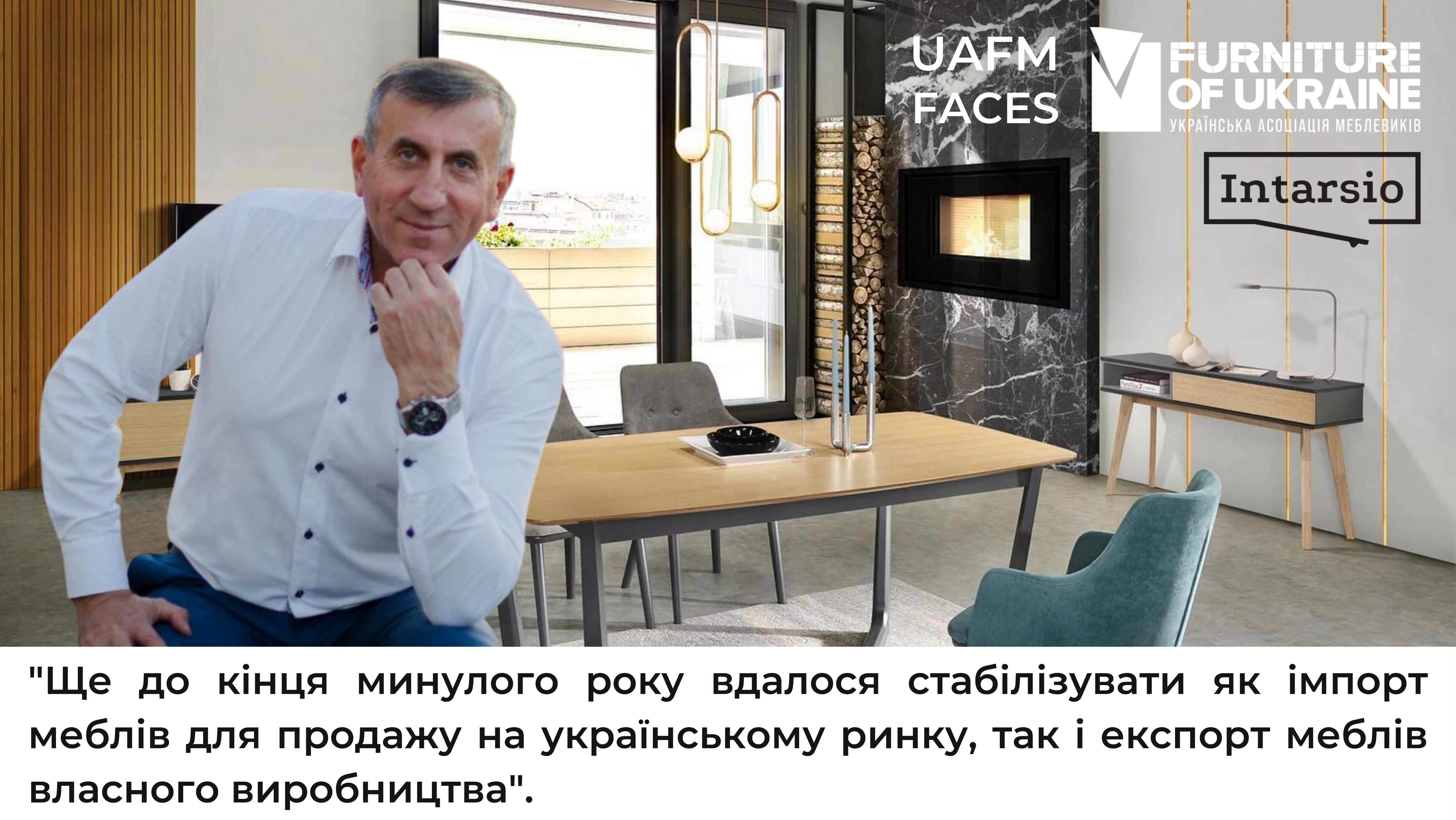
UAFM in the faces: even in the current conditions, the Intarsio company exceeded its pre-war indicators of furniture production and sales last year. About this in a conversation with its owner Igor Uznali.
“Stayed on our feet” and even increased production and export volumes compared to pre-war indicators” – this is how the current state of the Kovel company “Intarsio” was described by its owner Ihor Uznali. But we asked to tell about what preceded it if we take the beginning of the war as a starting point, which divided the life of the country and every Ukrainian into “before” and “after”.
– By the end of last year, we managed to stabilize both the import of furniture for sale on the Ukrainian market and the export of furniture of our own production.
– It is clear about export, but what about import?
– Our company is multidisciplinary: it not only produces and exports furniture for various purposes, but also sells furniture from foreign manufacturers in Ukraine, having long and closely cooperated with the Polish company “Signal”, which is a large furniture retailer. In other words, in relation to us – a sales agent who supplies us with furniture products of Polish and Chinese manufacture.
– Did you manage to avoid a stoppage of production last year?
– Unfortunately no. Like most Ukrainian furniture makers, apparently. But already at the beginning of April, I took samples of the new models to the Polish partner, which were approved, and their serial production began. Poles export furniture to us, and we, in turn, supply them with furniture of our production, which “Signal” not only sells in Poland but also exports under its own brand to other countries, however, keeping the “Made in Ukraine” label.
And the Polish retailer managed to increase the volume of deliveries largely due to the fact that it stopped buying similar furniture from Russian manufacturers.
– But your exports are not limited to the sales of the “Signal” company?
– We have an agreement with the Poles that we will not sell the models that we make to their order, the specified range, to anyone else. And we can sell other samples of products both in Ukraine and export, but at the moment, in the conditions of martial law, we have limited opportunities to look for customers in other foreign markets, in particular, due to participation in international exhibitions. This concerns the establishment of stable exports because we already had separate deliveries to Germany and the USA. Our production capabilities are several times greater than the volumes of products that we provide today. As well as the possibilities of developing and introducing new models into production.
– During the war, did prices for imported furniture increase significantly?
– Oh no. Furniture of direct Polish production increased by less than ten percent. The Chinese that the Poles supply to us has increased mainly due to an increase in logistics costs.
– Do you currently sell more Polish or Chinese furniture in Ukraine?
– Chinese. And it is much more – 90 percent of the volume of imports. Of course, this is economy-class furniture, the price of which corresponds to the current purchasing power of the majority of Ukrainians. Polish ones are 10-20 percent more expensive. However, on the domestic market, Ukrainian furniture makers are more competitive – often in terms of quality, and always in terms of price.
– Practically none of the members of the Association was left out of volunteering and other types of assistance to the army and displaced persons at a critical time for the country. What is in your asset?
– The local magazine “Flash” told about it in detail.
We found this article, which tells how at the beginning of the war, the company used its own transport to deliver humanitarian goods from Poland – from the “Wings of Hope” foundation there. The company’s employees got up at seven, led by its manager worked all day and only felt how tired they were in the evening. But the mood was raised by the feeling that they did not stand aside during a great test for the country.
There is also a mention of the fact that Ihor Uznali himself involved foreign acquaintances in helping Ukraine. In particular, a friend from the powerful German fund “FECG”, in turn, connected his acquaintances from different countries to volunteering, and as a result of such a formed volunteer chain, help came not only from Germany but also from the Baltic countries.
