

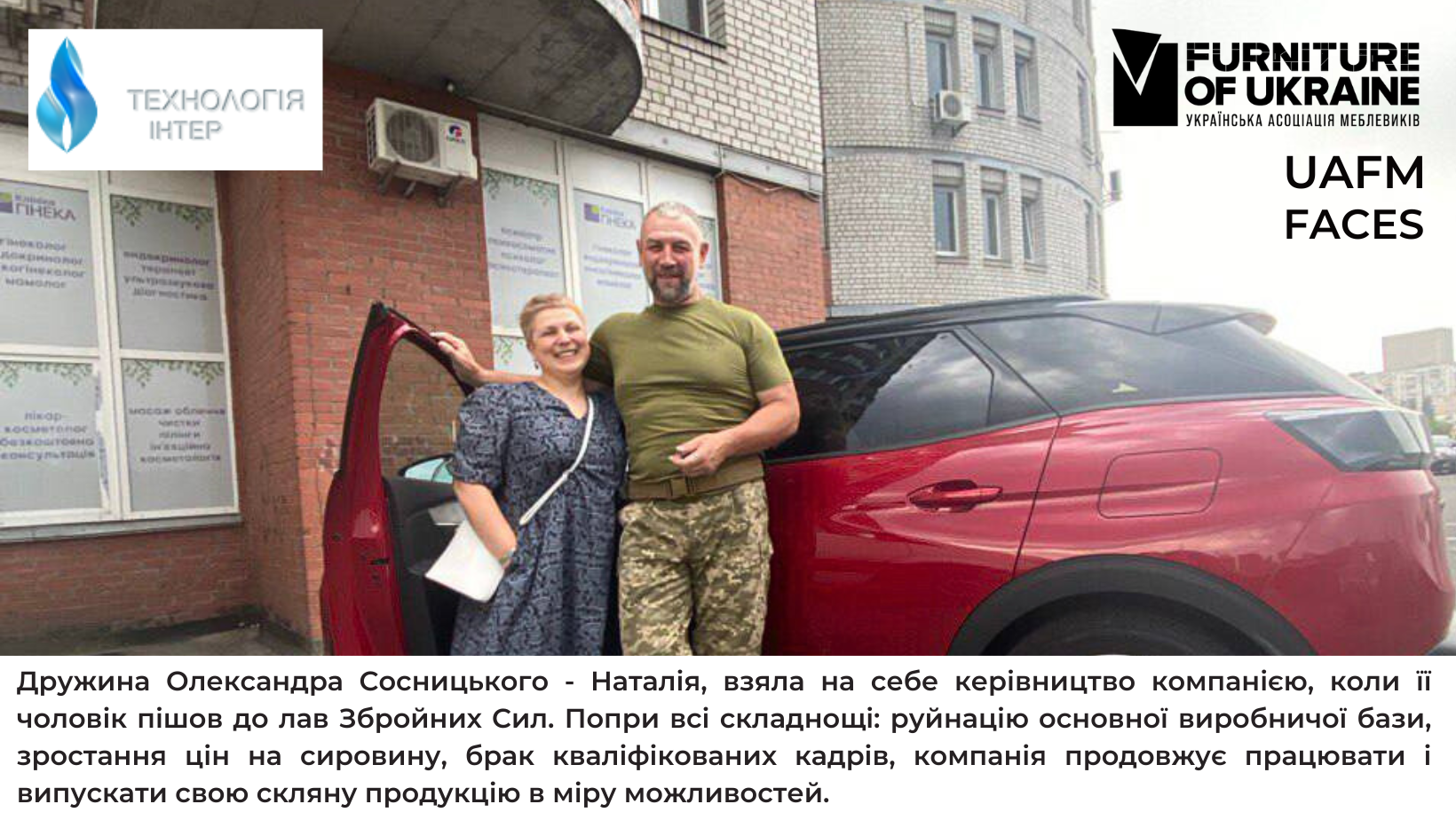
UAFM in faces: even while being in the army ranks, Oleksandr Sosnitsky, the owner of the “Technology – Inter” company, whose main production base was destroyed in Donbas, makes maximum efforts to keep the company an operating industrial unit.
Almost all members of our furniture Association are involved in resisting the enemy one way or another, who has not allowed us to live and work peacefully for over two years now. Some allocate funds or even purchase and deliver weapons, vehicles, ammunition, and food to combat units themselves; others charitably provide their products if needed; almost all furniture companies have become volunteer centers. But our special gratitude and respect goes to those furniture makers who have put on military uniforms and taken up arms. There are entrepreneurs among them – company managers and owners. Usually, they do not advertise this, so sometimes we accidentally find out that they have exchanged managerial duties in an office chair for hard and dangerous military service.
It was by chance, at the very end of our telephone conversation, that it turned out that the hero of our next story – the owner of the “Technology – Inter” company, Oleksandr Sosnitsky, is now a serviceman.
Since such people are reluctant to talk about their military affairs (understandably, also due to military secrecy), we focused on the company’s affairs, with which, of course, he has not lost touch for a single day.
But the situation with his business turned out to be rather disappointing. Mainly because the base production, which was located in Kostyantynivka, was destroyed. And the operating unit in the Kyiv region is neither technically nor technologically capable of producing the entire pre-war range of products.
It should be clarified that the products of “Technology – Inter” were specific – glass. From furniture – tables with glass tops, from furniture components – mirrors, stained glass facades, from interior accessories – kitchen splashbacks, shelves, aquariums. The range included commercial display cases, as well as products for keeping small animals – like terrariums. The company also provided subcontracting services for industrial glass processing (drilling, bending, sandblasting, and tempering).
The capabilities of its production base near Kyiv do not allow the manufacture of products that require special equipment for glass processing (tempering, bending) – precisely the necessary equipment for this was destroyed in the Donbas. So the assortment is now limited to interior items and aquariums, which can also be attributed to this product category. In fact, the fact that the company has significantly reduced its staff, impoverished its assortment, and allows operational management to be carried out by Alexander’s wife, Natalia, who took over her husband’s managerial chair when he put on his military uniform, and through her efforts the company remains an operating industrial unit in this difficult situation for it.
The destruction of the main production base is not the only significant blow that the war has dealt to the company. The price of glass, the main material for the products, has doubled, increasing its cost price and thus reducing its competitiveness. Another trouble is the lack of skilled workers.
Sosnitsky believes that the current shortage of personnel is also due to the fact that in better, peaceful times, the state and the furniture industry did not properly take care of training the necessary qualified workers, limiting themselves to the fact that companies mostly did it on their own. Something was being done in this regard in woodworking, but nothing in glassworking. If highly skilled glassmakers nurtured in the company had not been forced to leave production (some will never return because they were killed), then even with a lack of some technical equipment, it would have been possible to produce types of products that the company is not undertaking now due to this, the owner is convinced.
– And what about involving women in carrying out work? We can see such a personnel trend in our industry recently.
– Our company is also in this trend. But this does not fully solve the problem. Women were mostly hired for unskilled work and work not related to moving heavy parts – soldering, gluing, packaging. Glass is not a light material. Because of this, for example, we stopped producing glass tables, although technologically we can do it on the existing production base. And practice shows that in our field, where manual labor still prevails (not because we are backward – this is how it is all over the world), the productivity of women is lower in production processes. Automated to a greater extent in our field are mass productions of window and door glazing units, but we have nothing to do with that.
This is the difficult period in its history that the “Technology – Inter” company is going through now. But it is not going through it passively, not idly waiting for better times, but, to the extent of its current capabilities, continues to produce glassware – fortunately, the market, says Oleksandr Sosnitsky, is gradually increasing the demand for them.
