

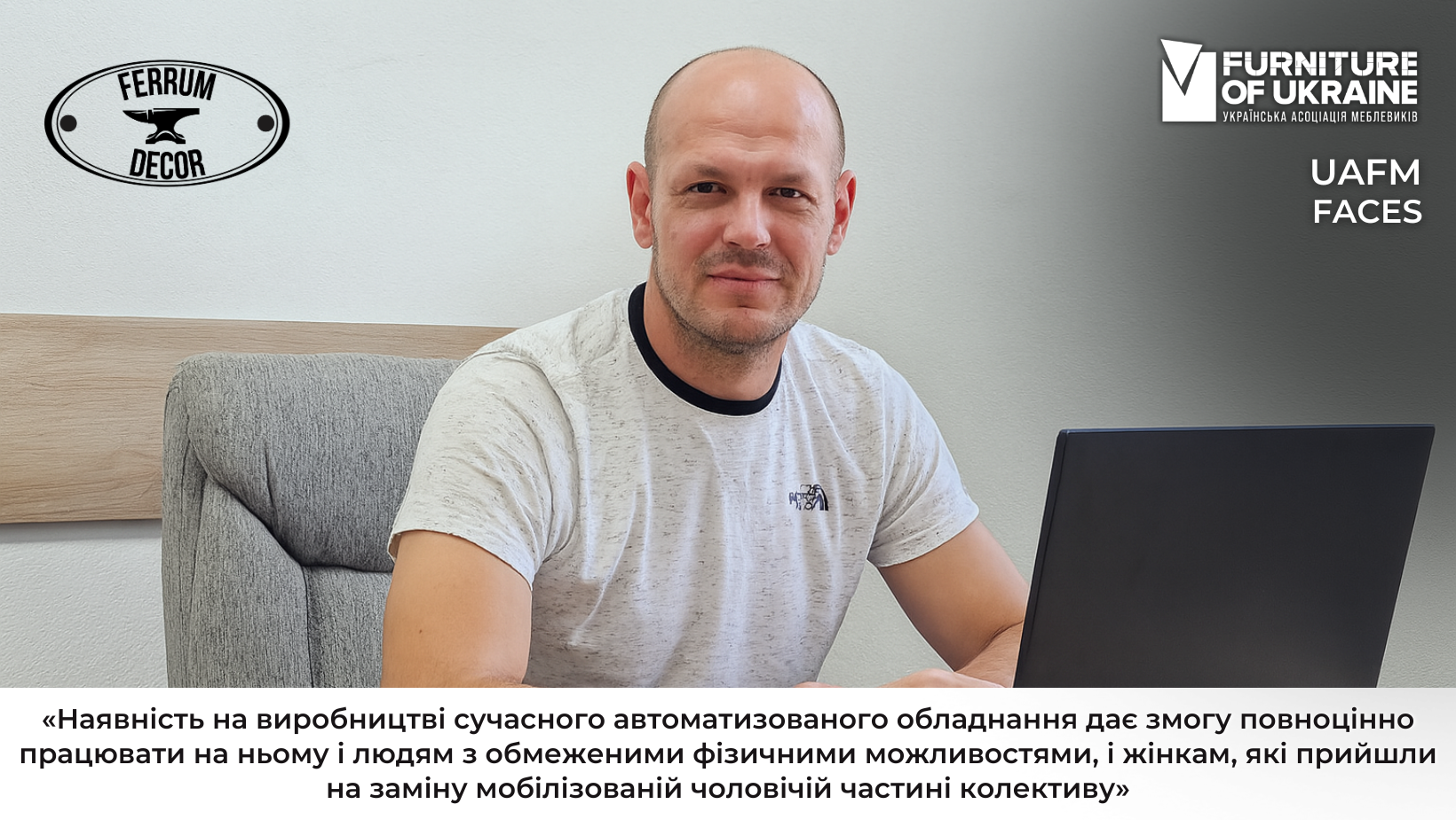
UAFM in Faces: Even though it was seriously “wounded” by the war, the Chernihiv-based company Ferrum-Decor managed to maintain its position on the market. How was this possible? Find out in the story shared by its co-owner, Kyrylo Doroshchuk
Due to the war and its economic aftermath, the vast majority of Ukrainian businesses have suffered — and furniture manufacturers, of course, are no exception. However, some members of the Ukrainian Association of Furniture Manufacturers (UAFM) have experienced particularly severe damage, including destruction of facilities. Among them is the Chernihiv-based company Ferrum-Decor, which is the focus of this story. One of its production workshops was completely destroyed along with all the equipment inside.
— Did this disaster significantly affect your production capabilities? we ask Kyrylo Doroshchuk, co-owner of Ferrum-Decor.
— The damage was substantial, but not critical to the company’s operations. The tasks previously handled by the destroyed workshop were redistributed between two remaining ones. We purchased replacement equipment, and the company is now operating stably. We can’t boast significant profit growth, but the three years of war haven’t been a failure for us either.
— So you didn’t immediately start rebuilding the damaged facility?
— Not yet. Other, more urgent needs required investment. We hoped for government support, but unfortunately, didn’t receive any. The destruction was so extensive that rebuilding would require substantial funding, which we currently do not have.
— What were those more urgent priorities?
— As the company name suggests, we specialize in producing decorative elements for both interiors and exteriors — for homes and gardens. These are primarily metal-based products.
One business line became economically unviable, so we decided to discontinue it and pivot in another direction. Previously, we produced plant stands for flowerpots and decorative indoor plants, which occupied an entire workshop. Now, we’ve transitioned to manufacturing plant supports. What’s the difference? The stands were bulky and expensive to ship. In contrast, the new supports are designed to be disassembled. They’re made from thick wire, which is currently in high demand. This change resulted in more compact packaging and significantly reduced logistics costs.
— Has your furniture production — which uses both metal and wood-based panels — undergone any changes?
— Yes. In the past, we produced metal furniture frames solely for our own needs. Now, we also sell them to other companies in the same sector. What’s more, we now have the equipment to form pipe cones for furniture legs — something we didn’t do before.
— Is your company fully self-sufficient in both metalwork and woodworking?
— Yes. We’re fully equipped to work with metal as well as particleboard and MDF. Soon, we’ll also launch vacuum film wrapping technology for panel furniture components, particularly tabletops. This will help us avoid the issues associated with edging, especially for round shapes. We’ll be using high-quality, durable film that’s resistant not just to moisture but also to UV exposure. In the future, we plan to apply this film finish to metal elements as well.
— Do you use domestic metal?
— Primarily. Although we have access to Turkish metal, which is sometimes cheaper, we prefer to support Ukrainian producers. We only use imported metal when there are local supply issues or when we need to manufacture parts with complex shapes. But even then, imported metal makes up no more than 10% of our output.
— And how about your workforce?
— The use of modern automated equipment allows people with physical disabilities and women — who’ve replaced mobilized male workers — to fully operate the machinery. Unfortunately, we haven’t yet been granted military deferments for key employees.
— We’ve improved our welding processes. Arc welding has been replaced by laser welding, which produces such high-quality seams that they no longer need to be ground down — something that was essential with arc welding. This innovation has freed up human resources and lowered production costs.
We’ve also taken steps toward energy independence by installing solar panels on-site. This has helped protect us from power outages and reduced the energy costs in our production. When industrial electricity prices soared in 2023, it became clear that energy autonomy was essential.
— Thank you for the insightful conversation.
