

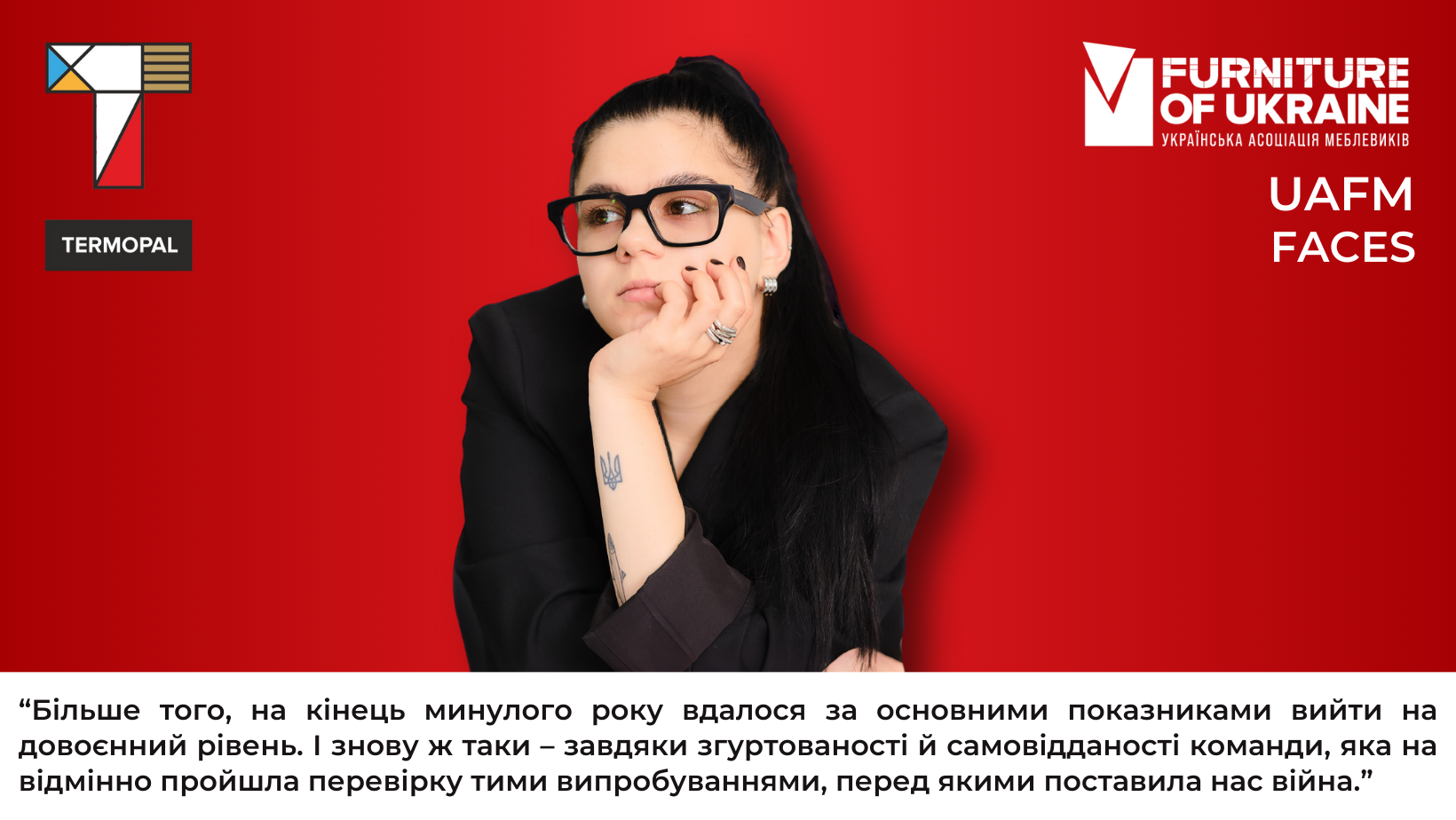
UAFM in Faces: the story of Yana Viknyanska, daughter and assistant of Mykola Viknyanskyi, owner of the company “Termopal”
The owner of the company “Termopal”, Mykola Viknyanskyi, dedicates a significant part of his time to volunteering and other public matters. However, this has not negatively affected the company’s performance, as shared by his daughter and assistant, Yana Viknyanska.
The Odesa-based supply and manufacturing company “Termopal” did not stop for a single day, even during the most critical days of the early stages of the war, although it was forced to pause its regular operations for over a month. The entire team immediately joined the volunteer movement, which actively unfolded in the city and region.
Odesa was one of the cities that experienced the largest influx of refugees from critical regions, with up to a thousand people arriving per day. The team at Termopal worked daily to provide shelter and other necessary assistance. Mykola Viknyanskyi, the owner of the company, together with a group of concerned citizens, organized a volunteer center that, among other things, took on the task of providing food for the newcomers. Termopal’s employees were directly involved in these efforts. The company also actively and effectively supports the military, as evidenced by a commendation from Commander-in-Chief Valerii Zaluzhnyi.
These memories from over two years ago marked the beginning of my conversation with another leader of the company, the owner’s daughter, Yana Viknyanska. However, most of our conversation focused on the present: what changes the company has undergone and how it is currently faring.
– It was our clients who brought us back to business. They started calling, asking: “How are you? Are you working? Can you still provide the services we used to receive from you?” And so we returned to our workplaces, but we never stopped our charitable activities, especially my father. He took on even more volunteer responsibilities when the city authorities asked him to become the coordinator of volunteer efforts in Odesa. He was also among those who prepared the city for receiving the status of a UNESCO World Heritage Site, which it eventually acquired. As a result, I also had to take on more responsibilities in the company than I had before the war.
Before, I mainly handled marketing matters, but since last year, I have also been entrusted with managing our production line — the factory that manufactures countertops. We provide turnkey stone products.
– And were you able to stabilize the company’s operations in these challenging conditions?
– Yes. Moreover, by the end of last year, we managed to reach pre-war levels in key metrics. Once again, this was thanks to the team’s cohesion and dedication, which passed the test of the challenges the war presented us.
I cannot say the same yet about the countertop factory. Before the war, it was growing so rapidly that it outpaced all other sales sectors. As a result, it is now taking longer to return to pre-war levels. However, since the countertop production provides additional rather than primary income for the company, it has not hindered Termopal’s recovery to pre-war levels.
– What is the current market situation in general regarding artificial stone products?
– The trend and demand for these materials in furniture making had already been noticeable before the war. However, the market previously had few brands offering such products, so stone items were considered premium and expensive. As the stone trend gained popularity worldwide, the number of brands and varieties of composites increased. This led to fierce competition, which resulted in lower prices for these materials. Now, they are accessible to more furniture manufacturers, and demand has grown. In some cases, these products may lack a brand-name element, but their quality, durability, and design will still be at a high level. Our factory has adapted well to this trend, and although it has not yet reached pre-war financial levels, it is maintaining a positive sales growth trend.
– In companies involved in trade, the current personnel shortage is felt less because women predominantly handle sales. Is this also the case at Termopal?
– I wouldn’t say that. The more active managers in the sales of furniture materials, which is the company’s main focus, are primarily men, while women typically serve as back-office managers, handling the paperwork for finalized deals. Therefore, the reduction in the male workforce has created personnel tension for us as well.
– Do you have any significant steps planned for the company’s development in the near future?
– To take such steps, we need to reach performance indicators that would justify growth. Our current goal is to reach pre-war levels and stabilize there.
