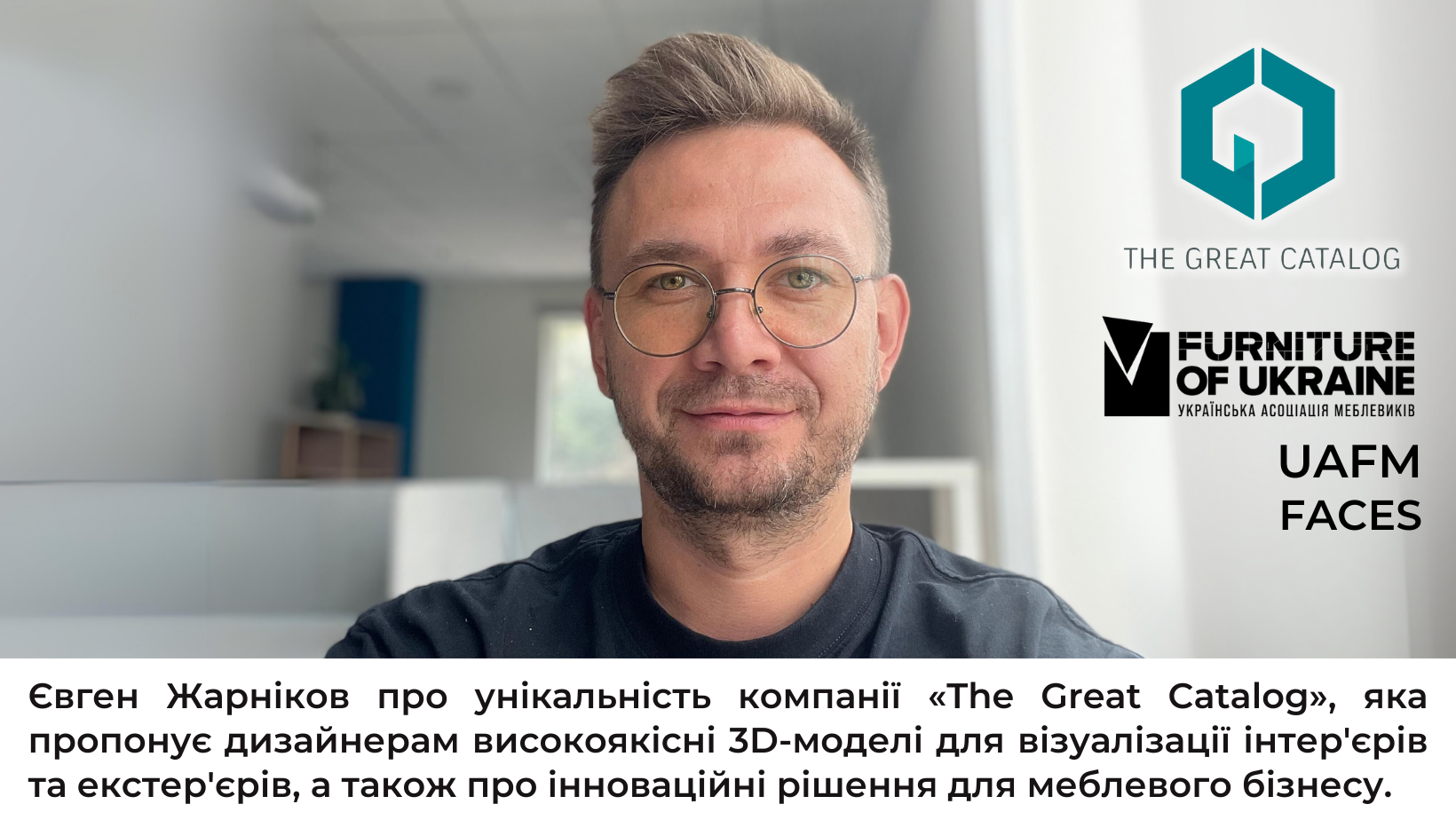
UAFM in Faces: A story by Yevhen Zharnikov, the owner of ‘The Great Catalog’.
The company “The Great Catalog” is the only one of its kind in our large community known as the Ukrainian Association of Furniture Makers, both in terms of its business nature and the content of the product it offers. Given this uniqueness, it makes sense to take a closer look at what makes it special and unlike other UAFM members.
At its core, it is truly a catalog, a library, a platform, a marketplace, a website — whichever term you prefer to use, all would be correct — featuring high-quality 3D-format items (objects) essential for designers and architects in their work on interior and exterior projects. Moreover, to take this work to the next level, each model can be supplemented with its BIM object, containing information about the manufacturer, the item’s dimensions, and more.
This catalog, and consequently the company, was created by Yevhen Zharnikov, who, drawing from his own design experience, knows how important it is for an interior designer to have a large and convenient catalog of 3D models of furniture, lighting, sanitary ware, materials, décor, and much more for efficient and quick project development. Thus, “The Great Catalog” offers “much more,” boasting nearly everything needed for the most detailed visualization of a project — from all types of furniture to a perfume bottle or a Mercedes — over 70,000 items and objects.
The company’s website clearly states that on the Great Catalog portal, users can upload, sell, and download 3D objects necessary for design purposes. Therefore, we conclude that the catalog effectively serves as a mediator between those who have 3D models of their products that they want to sell through the catalog, and those who want to use them with its help. Those who want to sell are manufacturers of furniture, home appliances, lighting, materials, and other products offered in a 3D format, as well as designers who, in turn, offer manufacturers 3D models of the items (objects) they create. And those who want to use the 3D models offered by the catalog are interior, exterior, and landscape designers who need these manufacturers’ products, represented as 3D models in the catalog, for their project implementation, or graphic models during the project visualization stage, in order to present it to clients.
Thanks to the explanations provided on the company’s website, we’ve understood the functioning of the Great Catalog, and we reached out to Yevhen Zharnikov to clarify the business aspect of such exchanges. For example, why are some 3D models available for free from the catalog, while others require payment, even though both types are high quality?
– Those who upload their 3D models on our platform decide for themselves whether the models will be available for free or for a fee. In practice, free models are downloaded ten times more often than paid ones, so the rights holders often transfer models from the paid category to the free one.
– And do manufacturers pay you for placing their 3D models on your platform, thus helping them promote their products?
– No, this opportunity is free for them. Only those who download 3D models from the catalog pay, and only for the ones listed in the paid category, as mentioned earlier. These are mostly models of interior accessories and décor items. If a designer who frequently uses our catalog subscribes to a monthly plan, they can download ten models at a reduced fixed price during the month, which would otherwise cost more if downloaded individually.
– In the product categories presented in your catalog in 3D format, there are vehicles, clothing, and sports equipment. What are they for?
– These models are offered because we provide 3D models not only for interior but also for exterior and landscape projects. If a designer is generating a visual of a sports hall for a project they are working on, they need to include the items typically found in such a space. Any object, for detailed visualization, requires relevant contextual items.
And when it comes to the needs of furniture manufacturers, they often require a visual representation of an interior item for better promotion. In traditional practices, this is a tedious task: you need to assemble various physical items in a studio to create the desired interior and then photograph it. With the help of artificial intelligence, we can bypass all of this by using 3D models of the items instead of real objects, allowing us to quickly create an even better and more expressive interior image. By the way, we will soon be offering this service to furniture makers, our colleagues at UAFM.
– On your website, you promote the GC Merger program. What is the advantage of using it?
– It is not a purchased script program but one of our own development. With its help, catalog users can, with one click, download the 3D model they need, fully ready for use — no need to unzip files or go through other time-consuming preparation steps.
– What are your future plans for developing the catalog’s features?
– With the introduction of the GC Merger script, we have nearly completed the implementation of tools that provide users with a convenient catalog experience. Next year, we will focus on improving collaboration with manufacturers who are interested in Great Catalog as a sales platform for their products.
We are generating not only object design models but have also started collecting samples of various ready-made interiors offered by interior designers. We will continue to move in this direction. Moreover, we aim to explore the compatibility of interiors with the geographical location of the objects for which the interior is being created. For instance, for greater convenience, we will be able to recommend 3D models of items that can be purchased in Odessa if the designer is working on a project in that city. To develop in these new directions, we cannot do without artificial intelligence, whose capabilities we are already using in some cases.
But these are not our only plans for the near future. We want our platform to become multimedia in terms of offering various formats for our models and integration with different programs, including free ones like Blender. Since the DWG and 3DS formats are outdated, Great Catalog uses photorealistic models in MAX, OBJ, FBX, and GLB formats for Unreal Engine and SketchUp, with all the shaders and textures of modern rendering systems like V-ray and Corona.
– We wish you success in implementing these plans.
And here’s an interesting example of what the company is currently doing for some furniture makers: