

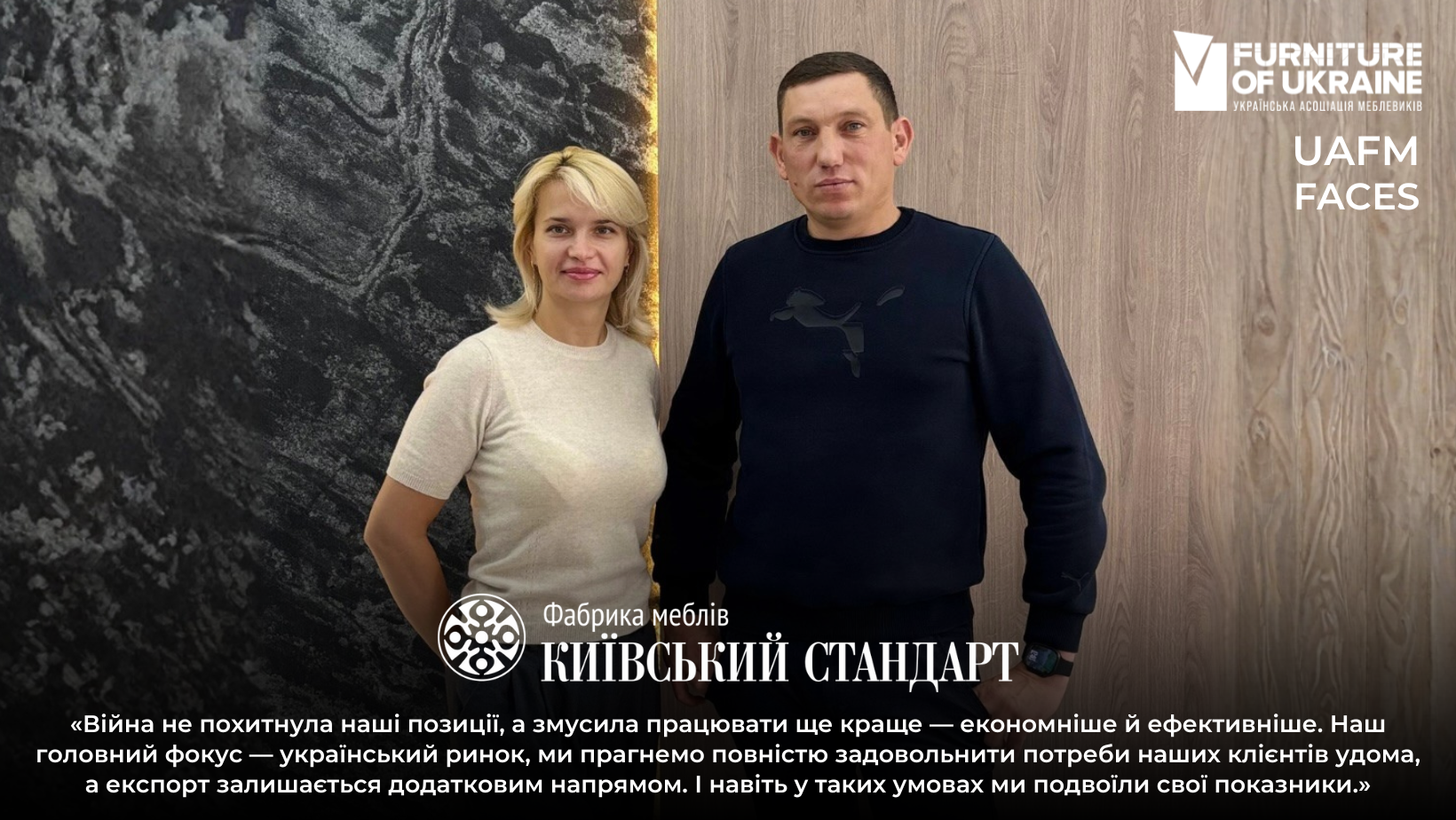
UAFM in Faces: a story by Anatolii Manakonov, Director of the company “Kyivskyi Standart”
One might think that the Bila Tserkva-based company Kyivskyi Standart, positioning itself as one of the leaders of Ukraine’s furniture industry, is exaggerating — that it’s just a metaphor for image-building. But after speaking with its owner, Anatolii Manakonov, we learned that even in wartime conditions, the company managed to double its performance indicators — primarily in the domestic market. This can easily be verified by the volumes of board materials the company purchases for the production of case furniture of various types — for both residential and office spaces.
— The war not only failed to shake our position but actually pushed us to work much better — more efficiently and economically. Hence the results.
Traditionally, our top priority has been the domestic market. We strive to meet the furniture needs of Ukrainians as fully as possible, while exports take place, one might say, on a residual basis. Still, we have managed to grow those as well, though not to the same extent as in the domestic market.
— Yet, given the war and uncertain prospects, people’s purchasing activity has significantly declined, wouldn’t you agree?
– I’d say it has become more emotional and unpredictable — it fluctuates sharply, again because of the war.When the situation on the frontline worsens and there are heavy enemy attacks, the furniture market freezes, and our sales drop. When Ukraine receives F-16s or achieves success on the battlefield, public sentiment improves — and sales rise. Of course, such instability — this fall-and-surge dynamic — makes our work much more difficult, especially since it’s also hard to find staff. Sometimes we work at half capacity, sometimes in overdrive.
— It’s easier for companies producing serial furniture — they always have warehouse stock…
— True, but we manufacture products to specific orders. This market “turbulence” made us consider launching a warehouse program, which we plan to implement next year.
— “Kyivskyi Standart” celebrated its 18th anniversary in early September, congratulations on that! That’s adulthood by human standards. How did you mark the occasion?
— Well, celebrations are not really the thing these days. We marked it modestly, without a loud corporate party. Still, this date gives us the right to confidently say that over these years, we’ve grown from a small dream into a brand trusted by thousands of families across Ukraine. We may be “of age,” but we still consider this path only the beginning.
— From the very start, your company has focused on a wide product range — case and upholstered furniture, tables; and within the case furniture segment, a broad array of functional designs. Doesn’t that complicate production?
— Not really. We started quite modestly and gradually increased both our production volumes and product assortment. In today’s conditions, such diversification does present some challenges, but we’ve adapted to work this way — with a broad product range — and we have no intention of giving up what we’ve achieved.
— Such production versatility only makes sense if the factory is self-sufficient, capable of processing all furniture materials and performing all operations. Is your factory like that?
— Almost. The only thing we don’t process ourselves is stone. We even produce one of the key furniture components — facades — for our own needs. While it’s quite common in Ukraine’s furniture industry to use purchased facades available on the market or order them exclusively from specialized facade manufacturers, we follow a strict rule: we sell only what we can make ourselves. It guarantees quality and strengthens our reputation.
— The fact that “Kyivskyi Standart” keeps up with the times is also evident in how your managers work with clients using a 3D visualizer. Is it truly helpful, or more of an image-building tool?
— It’s very helpful. Not only for clients, who can better visualize the furniture they’re ordering, but also for production. Once the design and construction are approved by the client, all parameters go directly to the workshop, where work on the specific order can begin immediately.
— From what you’ve said, it’s clear that your main goal for next year is launching a warehouse program. What steps are you already taking toward this?
— First of all, we need a warehouse — and it will be a large one, about ten thousand square meters. We’re developing new models, which will also be reflected in the updated product catalog.
— Thank you for the conversation. Once again, congratulations on your company’s coming of age!
