

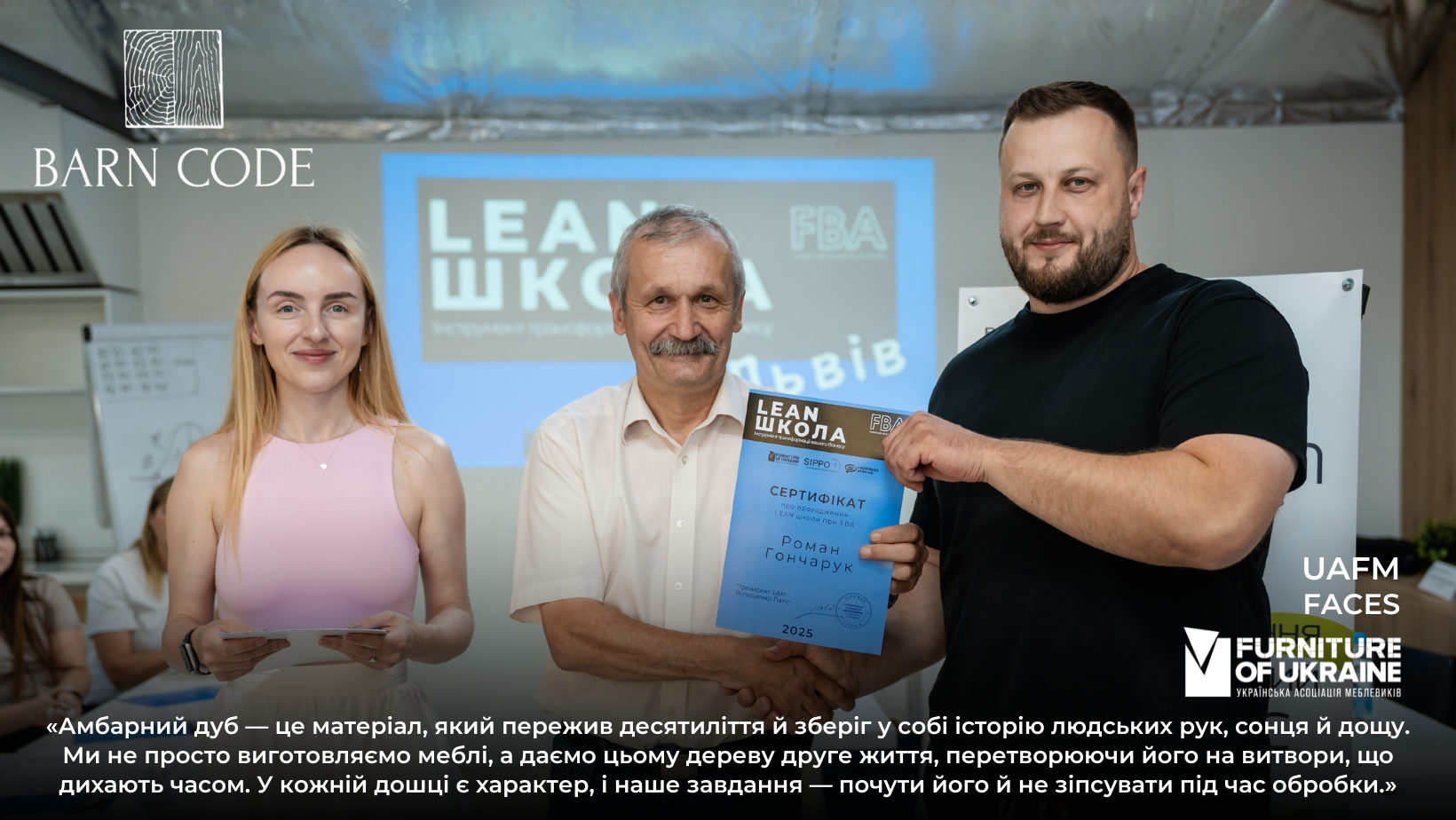
UAFM in Faces: a story by Roman Honcharuk, owner of “BARN CODE”
Let’s start with a mysteriously paradoxical statement: the company is young, yet it works with something old. And so you don’t puzzle over this for too long, here’s the explanation right away. It’s about the Rivne-based furniture company BARN CODE, which is unique in that it is perhaps the only member of the Ukrainian Association of Furniture Manufacturers that gives new life to old — sometimes even century-old — wood, creating unique pieces that literally breathe history.
The craftsmen of this company, when creating each new masterpiece, listen to the whisper of time — the stories of oak that for decades supported peasant barns and houses, licked by rain, scorched by the sun, and tempered by everyday life. Yet, despite its venerable age, this oak, trusting modern technologies, continues to serve, turning in the hands of today’s masters into true works of furniture art.
We spoke with the founder and owner of the company, Roman Honcharuk, about the peculiarities of this kind of furniture making.
— The material you use for furniture is called differently: old, reclaimed, restored, retro, even antique…
— Yes, but the most common term we use is “barn wood” or “barn oak,” because oak is the only wood we work with. Although, personally, I don’t really like the term “barn.”
— But could other naturally aged types of wood also be used for such purposes?
— You can also use naturally aged spruce or larch. With modern restoration, they can look beautiful too, but we work exclusively with oak.
— Is it hard to find such material?
— Actually, we don’t find it — we buy it. Maybe in the past furniture makers of this kind had to travel around villages searching for it, but now a market for reclaimed wood has formed in Ukraine. There are people who collect it across the country and sell it to us.
However, nowadays it has become more difficult not so much to buy as to transport purchased materials, usually from northern regions where barn oak is most commonly harvested. Since old wood is a unique material and its market supply is smaller than that of regular timber, it has always been more expensive. And during the war, considering that most of the harvesting takes place in the shelling-prone border regions with Russia, prices have risen even more.
— Obviously, restoring such wood must be more troublesome than working with new timber…
— Much more. Removing rot — including through washing — and extracting old nails are complex and labor-intensive processes. They can’t be automated, so there’s a lot of manual work involved.
Even though we use advanced metal detectors to find metal fragments, there’s always a risk that something remains, which can damage cutting tools. Moreover, the tools wear out much faster when working with wood compacted by time.
There’s another difficulty: to chisel out a leftover nail from a hardened beam, you have to damage part of it, which increases waste of such costly material.
— Given all these complexities and the uniqueness of barn wood, you probably don’t have many competitors.
— And yet, competition is growing. At the beginning of the war, I knew only three similar companies; now there are at least ten.
— From your social media, we learned that you recently furnished a restaurant in London with barn oak products. How did you find such a client?
— Actually, it’s a Ukrainian client — a nationwide restaurant chain for which we’ve already completed several projects in different cities of Ukraine. The restaurant in London is also theirs. That’s how we practically entered the export market. Just recently, another of their restaurants opened in Dnipro, for which we also made furniture.
— You’d probably agree that this kind of furniture making doesn’t have a long-term future, since the number of old buildings — the source of barn oak — will gradually decrease. Have you thought about that?
— Yes. Diversification of risks is necessary in our case. That’s why we are already setting up parallel production using regular oak for manufacturing tabletops.
