

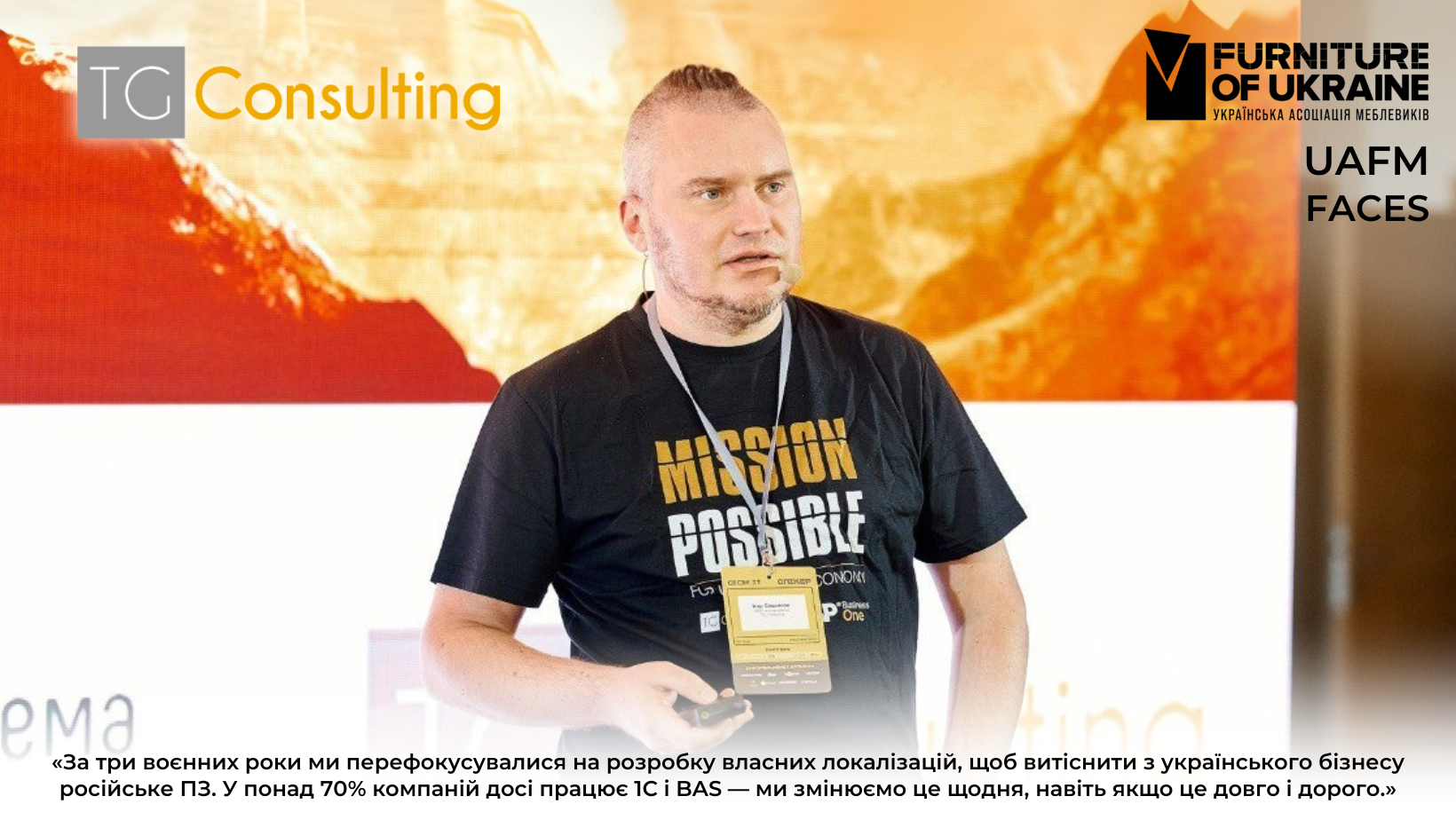
UAFM in Faces: a story by Ihor Soshnikov, head of TG Consulting
Ukrainian furniture manufacturing is increasingly entering the world of digital technologies. What was used sporadically just a decade ago — accounting automation, electronic production planning, supply chain management — has now become a necessity for almost all manufacturers. However, the unfortunate reality is that most Ukrainian businesses still rely on russian-made software products. At the same time, the call to switch to domestic software is growing louder on social media.
Furniture makers don’t have to look far for alternatives: among the members of the Ukrainian Association of Furniture Manufacturers is TG Consulting, a company that even before the war began helping, including furniture producers, transition to digitalized production and management processes through the implementation of useful IT solutions. Now, as the trend of phasing out Russian software from Ukrainian businesses accelerates, this transition is gaining momentum — as confirmed in our conversation with the company’s director, Ihor Soshnikov.
– Over the three years of war, we have refocused on developing our own localized solutions to replace, including with our own products, widely used Russian software in Ukrainian manufacturing businesses — especially 1C and BAS, which are still in operation at over 70 percent of companies. That’s why we’re investing significant time and resources into localizing our software specifically for Ukraine.
In addition to developing new products, we also held a webinar with UAFM, guiding furniture business owners on what alternatives they can use instead of Russian-made 1C and other business software.
– When it comes to the nationwide localization effort, what portion of that is attributable to your company?
– We haven’t calculated an exact share, but I know for sure that we’re not yet a dominant player in the IT services market. However, there’s still a huge effort ahead to replace Russian software because businesses, unfortunately, remain slow and reluctant to act. The main reason is the financial cost involved. And such a replacement doesn’t happen overnight, which also holds back entrepreneurs. We also understand that many small companies are currently focused on survival in this difficult wartime economy, not on upgrades or development.
But since the state has taken a firm stance on this issue, eventually not only state-owned companies but also private ones will have to make the switch. Some will even be required to do so by law. That’s why we’re investing — to expand our capabilities and, therefore, our role in this process.
– It’s important to understand that efforts are needed in two directions. First: to ramp up and scale within the current Ukrainian localization — as we’ve discussed. Second: to develop entirely new software products or modernize existing ones by integrating artificial intelligence.
– Yes, we are currently working on integrating AI to reduce the manual workload in manufacturing and to manage some production, commercial, and administrative processes with fewer employees — a very relevant issue for nearly all manufacturers today.
– Speaking of workforce — in your sector, is the shortage of skilled personnel as acute as it is for your clients, such as furniture manufacturers?
– Not really, because our company experienced its staffing crisis five to seven years ago. To mitigate risks, we created our own academy. We train staff not only for our company but also for our clients who use our software. Additionally, we cooperate with 20 Ukrainian universities — helping train not only students but also instructors. The quality of our educational system is proven by the fact that our subjects have already been included in the Ministry of Education’s curriculum for bachelor’s degrees. We’re now scaling this practice nationwide.
– Are your business programs universal — meaning suitable for furniture makers, food producers, and metallurgists alike — or are they industry-specific?
– They are built on basic modules that cover classical business processes. But through additional extension modules, we can tailor them more closely to specific industries. For furniture manufacturers, we currently offer more universalized programs — covering processes common to most production facilities.
– From our conversation, one could conclude that your company feels confident even in the current challenging economic climate…
– And that’s true. At the very least, we’ve exceeded our pre-war revenue. Our team has grown both in size and expertise. We’re planning for further growth this year — despite remaining dependent on Ukraine’s political situation, internal and external economic factors, and the mood of potential clients who are still waiting for signs of economic recovery.
