

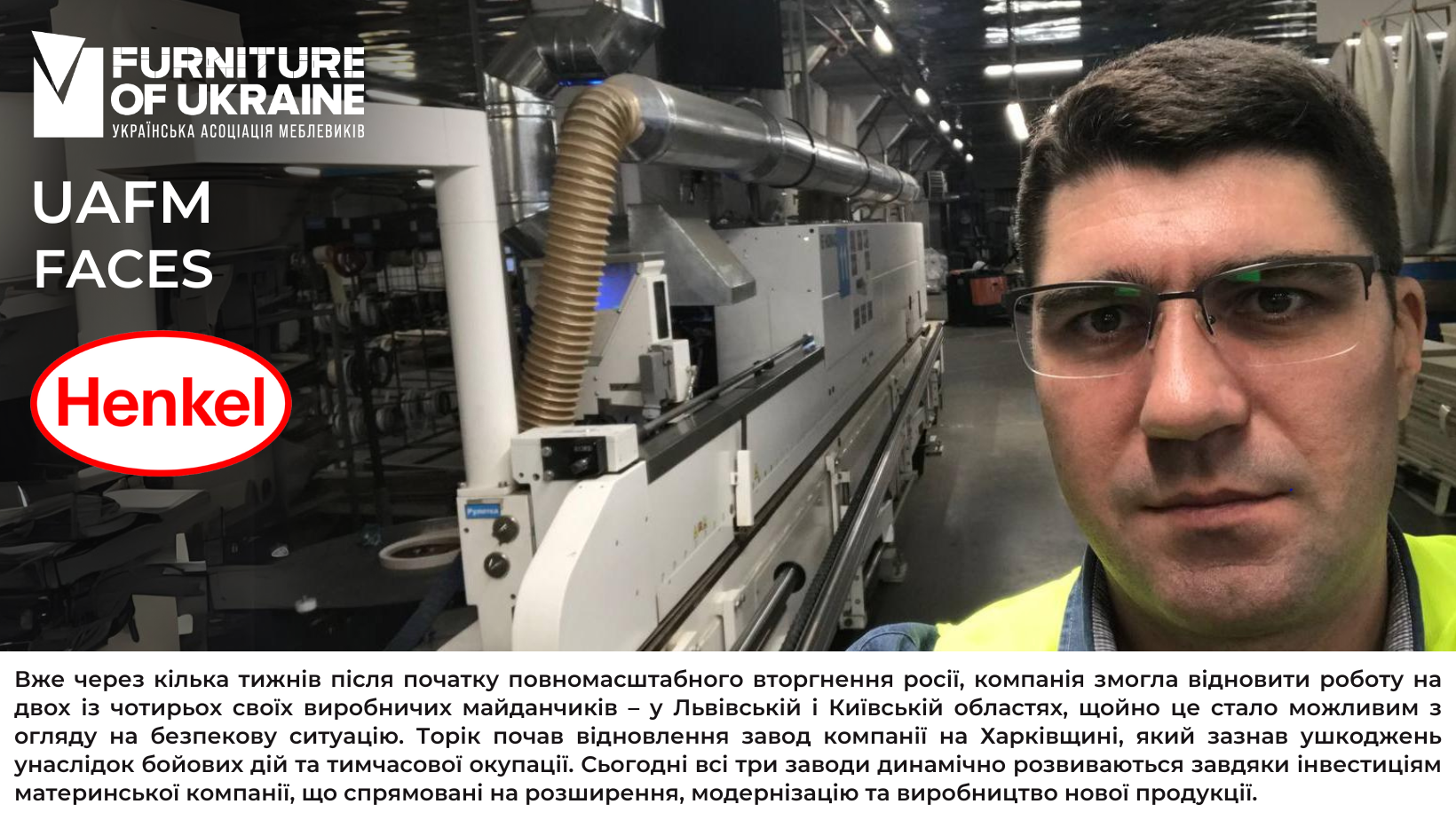
UAFM in faces: a story by Oleksiy Belomestnov, head of the “Woodworking” division at Henkel Ukraine.
Before discussing Henkel Ukraine specifically, it’s worth noting that the parent company Henkel Bautechnik (a powerful German manufacturer of chemical products, including high-quality woodworking products) ceased operations in the Russian market in the spring of last year, becoming one of the first international companies to sacrifice the benefits of the large Russian market for the sake of justice and humanism. Moreover, from the first weeks of the war, this German company actively joined charitable initiatives to support the Ukrainian economy and Ukrainian citizens who desperately needed such support. In particular, it directed its household products for humanitarian purposes, transferred funds to charitable foundations and volunteer movements, provided financial assistance to its Ukrainian employees, and actively invested and continues to invest in the development of Ukrainian business. In total, it used six million euros for all this.
Henkel Ukraine, as reported by Oleksiy Belomestnov, head of the “Woodworking” division, was able to resume operations at two of its four production sites – in Lviv and Kyiv regions – just a few weeks after the start of Russia’s full-scale invasion, as soon as it became possible given the security situation. Last year, the company’s plant in the Kharkiv region, which was damaged due to hostilities and temporary occupation, began recovery. Today, all three plants are developing dynamically thanks to investments from the parent company, aimed at expansion, modernization, and production of new products. Since 2022, Henkel Bautechnik has invested approximately 1.5 million euros in Ukrainian business. The same amount is planned to be directed to investment projects during this year. The German company will continue to invest in the development of Ukrainian business, create jobs, pay salaries, and pay taxes in Ukraine, fulfilling its obligations to Ukraine.
– Has work with Ukrainian clients changed under war conditions?
– It would be strange if it hadn’t.
For example, our employees used to often visit client companies that use our adhesives. To familiarize themselves on-site with the specifics of production and select those adhesive systems that would most accurately correspond to it, to train the client’s employees on how to properly use our adhesives, and so on. Now, due to various reasons caused by the war, we have switched to remote communication with clients and their employees who are directly related to working with our products. For this purpose, all our employees are equipped with tablets and online cameras, which provide remote business and production contacts. Digitalization in action, so to speak. A trend of primary necessity in the current situation.
It should be noted that we started practicing such remote contact with clients during the exacerbation of the coronavirus pandemic. During the war, it has become more widespread and deepened. The experience gained earlier allowed us to quickly and productively transfer the company to online work when the war again put us before such a necessity.
The product range has also undergone significant changes during the war. As sales volumes decreased and orders from furniture makers became unstable, we were forced to reduce the pre-war assortment, leaving only the most popular, most in-demand adhesives, sealants, and functional coatings in the price lists.
– It has already been mentioned that the parent company, even during the war, which is felt abroad as well, continues to invest in creating new types of products, new generation adhesives. Can you introduce us to a few of them?
– Yes. I will tell you more about two of the most advanced novelties.
The first is a new generation adhesive with minimal – almost zero – content of harmful isocyanate. It is beneficial primarily for Ukrainian exporting companies because when using it in furniture, there is no need to undergo periodic training and confirm relevant certificates, which the European Union requires from companies that use ordinary adhesives with isocyanate.
Another interesting adhesive line in the category of new generation products is eco-adhesives, which are produced using renewable energy sources, which is an increasingly widespread global trend developed by eco-focused giants such as IKEA, JUST, involving their suppliers.
Before the war, we actively and successfully promoted these new products in the Ukrainian market, but now the demand for them, it must be admitted, is insignificant: they are noticeably more expensive than traditional adhesives, and in the conditions of economic hardship that Ukrainian furniture manufacturers have been driven into by the war, such products have become “unaffordable” for many.
– Your company – as one that has foreign investments – should be subject to the conditions of employee reservation that the state has agreed to.
– Yes. We are allowed to reserve half of our employees. This mobilization concession does not completely solve the personnel problem, but it makes the shortage of workers non-critical for the company. Of course, this is a plus for both us and our clients, who need our products and our employees who help them use it effectively.
