

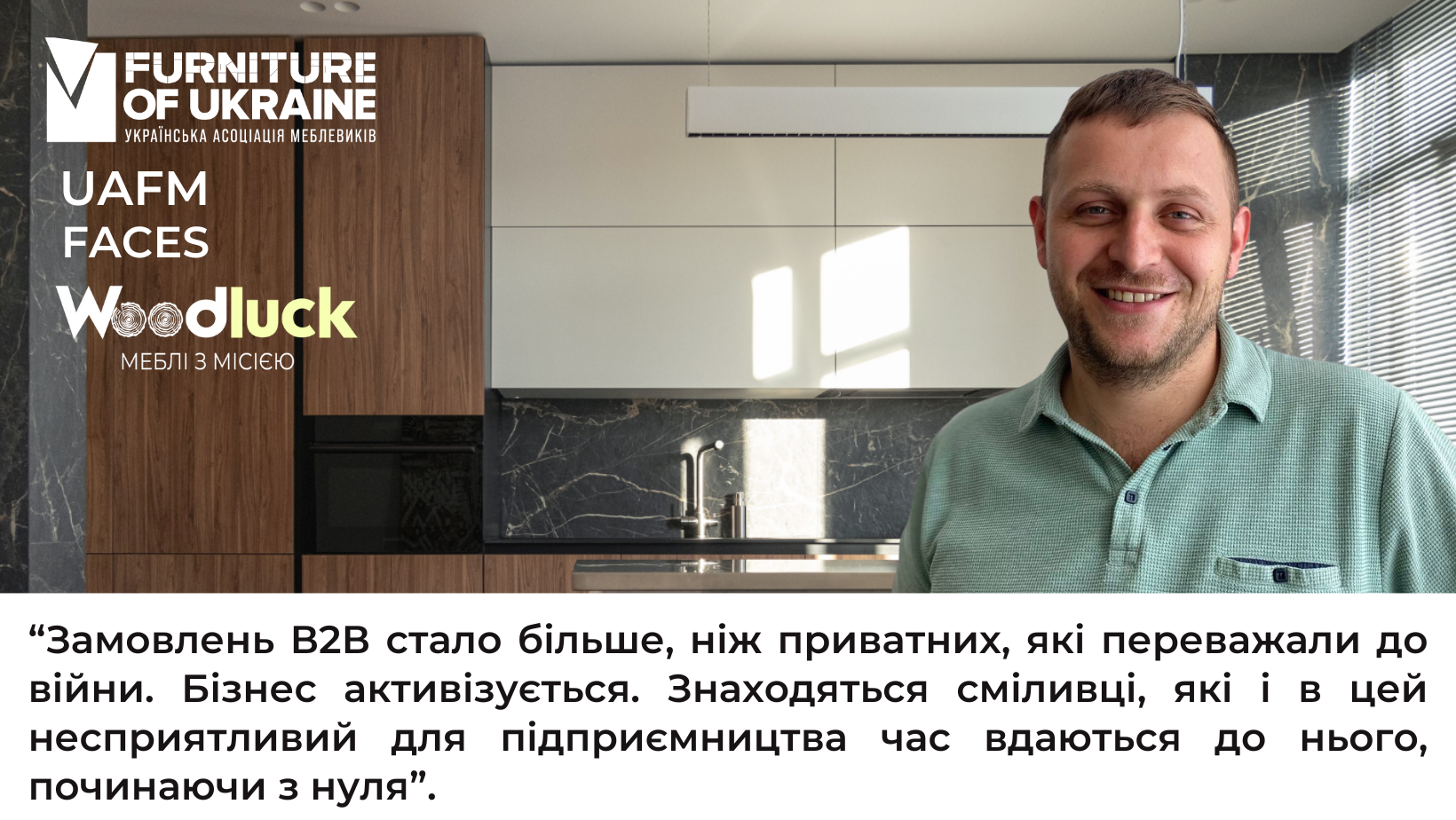
UAFM in the faces: the furniture company “Woodluck” also took up the production of drones, but this is not the only thing that distinguishes it from other furniture makers. About other features in the story of its co-owner Taras Levytskyi
Furniture companies are similar in their production activities. With the beginning of the war, almost all of them acquired another similarity – volunteering, participating in the national assistance of the army, helping thousands of refugees. The Woodluck company is the same in these characteristics, but at the same time it is special. It has another feature: it has been implementing another social project for more than a year. Our conversation with one of the managers – Taras Levytskyi (he and his brother are co-owners of a furniture business) started from a conversation about him.
– This is brother Andrii’s idea, – clarifies Mr. Taras, – to hire and employ men who have undergone rehabilitation in centers for drug and alcohol addicts. In addition to occupational therapy, an important aspect is the process of re-socialization, that is, the adaptation of such a person to new living conditions, to a new community. In addition to rehabilitated guys, we also employ veterans. Now we have one veteran who has been working since the beginning of the workshop, but before the full-scale invasion of the Russians, we had much more of them working for us. Surviving the war has a negative effect on the psychological and emotional states of a person, so, unfortunately, before adapting to society normally, some veterans end up in the same rehabilitation centers.
– By starting this good work, you must be taking some risks, because such a contingent (former alcoholics, drug addicts, gambling addicts) is an unreliable public?
– We employ people who have undergone rehabilitation, which means that a person has worked on himself for six to nine months with the help of psychologists. In addition, frankly, it is very noticeable whether a person has the motivation to permanently break with his former life or not. That is why we practically do not make mistakes in the people we hire from rehabilitation centers.
World statistics show that only ten percent of such people avoid repeated breakdowns after rehabilitation, our statistics are different: only ten percent of such people, working in our team, take on the old.
They adapt quickly and confidently in the work environment, persistent in acquiring professional skills. They do not create staff turnover, they have been working for us for years. We started this business back in 2016.
– Does such adaptation not require professional psychological support?
– There is no need for a special psychological service. For this, we have a so-called mentoring program, the functions of which are broader. This is not only a certain psychological support for newcomers, but also professional mentoring. In this mentoring role, we have experienced – not only professionally, but in the sense of life experience – foremen, shift leaders, who at one time started working for us also after rehabilitation and have already made a certain career in the company. There is even a man who has already obtained the relevant education – both a psychologist and a woodworker.
– Can we say that the realization of the national disaster brought to the country by the ferocious northern neighbor took place in the company as a well-coordinated and well-coordinated team – without panic or other manifestations of disorganization?
– So. From the very first days of the war, they became involved in volunteering and charity, which further united the team. They provided their warehouses for the assembled “humanitarians”, took them to the east with their own transport, and drove the necessary military transport there. We fulfilled furniture orders received from charitable organizations, which compensated us only for the cost of materials. In particular, in such a synergy, about four thousand beds were made for the needs of people from the affected communities, and shelters were also equipped in the Lviv, Ivano-Frankivsk and Zakarpattia regions. Moreover, they even started making drones before more competent manufacturers started making them.
– Has the domestic market – and the company works defiantly for it – already started to show signs of stability, a return to its pre-war potential?
– There is still a lack of stability – there are still periods of failure caused, of course, primarily by the war. As for building up its potential, positive dynamics are observed here. We manufacture furniture both for private customers and for the HoReCa sector. Both there and there, such dynamics are observed.
As for the private sector, it is due to the intensification of construction, in particular, housing destroyed by the enemy. And according to state assistance programs. And yet, at least as far as our company is concerned, there have been more B2B orders than private ones that prevailed before the war. Business is becoming more active. There are brave people who, even in this unfavorable time for entrepreneurship, resort to it, starting from scratch.There are also indications of relocation processes: people from the affected regions have to make a living in new places.
Since the number of active furniture companies decreased during the war, the load on the existing ones increases, which gives an increase in production and sales.
Having started a conversation with Taras Levytskyi about the peculiarity of the Woodluck company, which distinguishes it from others, the same topic was continued. Because this company has one more feature: our interlocutor heads the Lviv furniture cluster.
– The initiators of its creation, – Mr. Taras easily switches to another topic, – were 15 creative furniture companies from Lviv and the region, for whom not only their own benefits are important, but also the development of the furniture industry of the Lviv region, as well as to contribute in general by their example and activity domestic furniture industry. The most important area of activity of the cluster is communicative.With the aim of establishing partnership, cooperation, mutual benefit, exchange of experience among its members. In particular, export.
The cluster established productive relations with specialized educational institutions of the region – colleges and forestry university. We are implementing with several schools, after receiving a targeted grant, quite powerful for the region, the “School of furniture maker” project. These are accelerated – ten-day – courses on primary, initial training of personnel (primarily designers) for the needs of the furniture industry of the region.
– Our Association works – but on the scale of the entire country – in particular, in the same directions as your cluster. Such communication as cooperation with UAM, as well as with the same Rivne profile cluster, would not be superfluous.
