

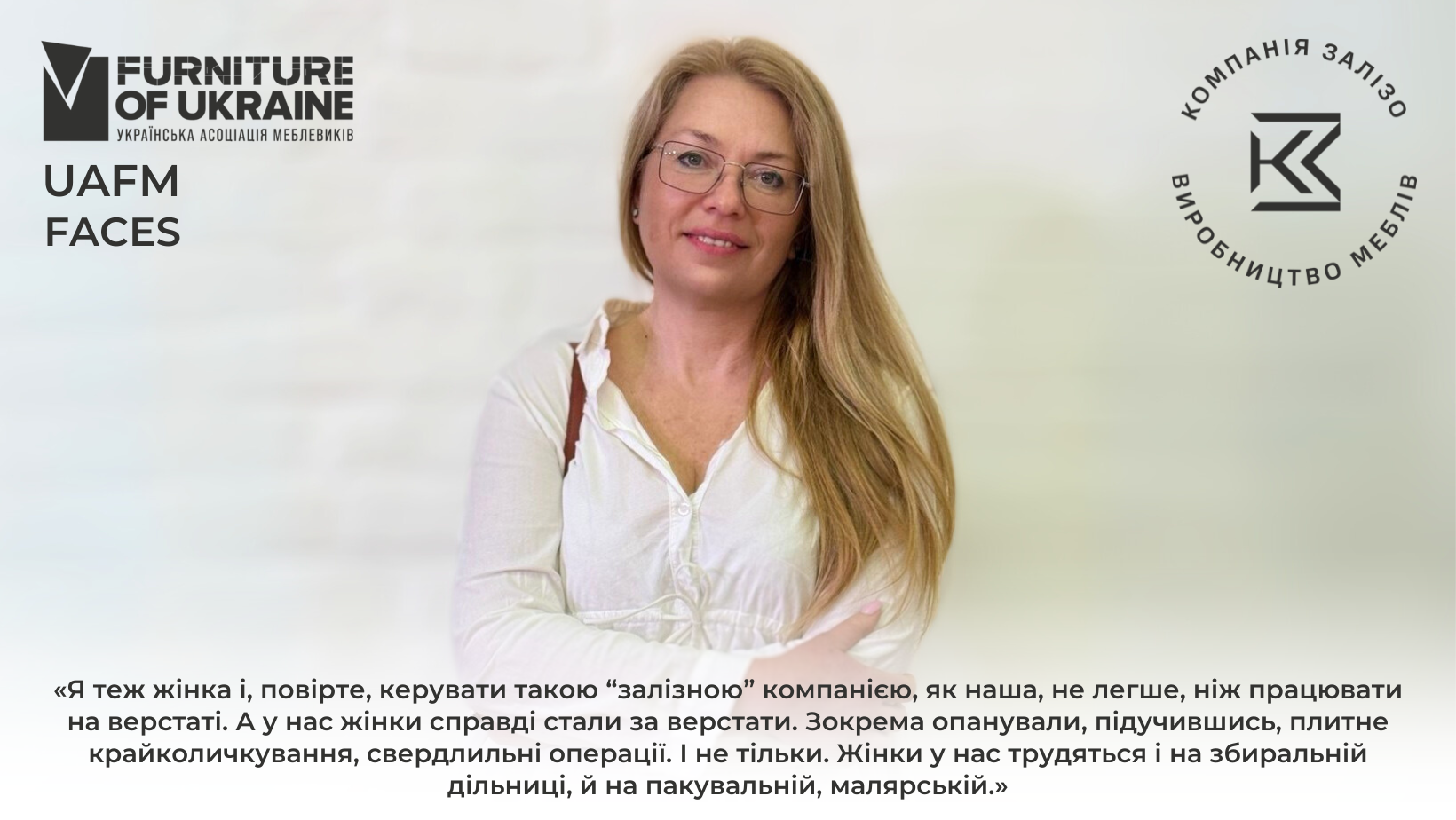
UAFM in Faces: The Story of Nataliia Nikolenko, Head of the Manufacturing Company “Zalizo”
For those unfamiliar with modern furniture manufacturing, it might seem strange that a full-fledged member of the Association of Furniture Manufacturers — traditionally dealing with wood and wood-based materials — is a company with the telling name “Zalizo”. But modern furniture production has long since moved beyond the traditional, and today, a furniture workshop can include those who work exclusively with glass or only with metal. Most often, modern furniture production combines different materials in furniture items: wood, metal, glass, plastics, stone.
The Mykolaiv-based LLC “Zalizo” is exactly one of those “combiners”: their furniture is based on metal combined with wood elements — for example, if it’s a table, the base is metal, and the tabletop is made of chipboard.
The company’s director, Nataliia Nikolenko, shared the changes the company has undergone over the past three years — years of loss, resilience, and faith.
– Although Mykolaiv is one of the cities that has been under constant enemy fire since the first days of the war, our “Zalizo” has demonstrated iron endurance, even though, like all domestic manufacturing enterprises, we have suffered losses and changes. Not deadly losses, but still tangible ones: production and sales volumes decreased, and our previously mostly male team has become mostly female.
– The word “iron” is immediately associated with something heavy and far from the traditional female labor sphere. Yes, in today’s conditions, there is a growing trend of involving women in jobs traditionally held by men, but even “non-iron” productions do this cautiously, selectively, and hesitantly. However, in your company, as we understand, such substitutions are not rare.
– Yes. I’m a woman too, and believe me, managing such an “iron” company like ours is no easier than working at a machine. And our women really did take up the machines. In particular, they learned, after some training, edge banding and drilling operations. And not only that. Women in our company work at the assembly section, packaging section, and painting section. Of course, we must make their work easier by equipping workstations with assistive tools — hoists, manipulators, in-factory transport, etc. But welding still remains the prerogative of men, although it is becoming increasingly difficult to find and retain qualified welders.
– Can we say that the company not only stabilized its operations fairly quickly, but also made some steps in development?
– We can. And I’ll name the main ones now.
First of all, it must be said that the company stopped being purely a metalworking enterprise. After setting up woodworking and acquiring the necessary equipment, we became fully self-sufficient in furniture production. That is, we no longer need to outsource services like board cutting, edge banding, or drilling. We do all this ourselves now. This means the production process has not only accelerated but also improved in quality, because we can now control all operations at every stage of woodworking.
– Which, of course, increased the competitiveness of your products and opened up export prospects.
– Exactly. And that’s the second area where we’ve made progress. We were already actively competing for public and private orders within the “Prozorro” or DZOs platforms, but we wanted to go beyond that. We managed — not without difficulties, but still — to obtain the status of an official UN supplier, meaning we became a UNGM registered vendor. This gives us the opportunity to compete in international tenders within Ukraine. And that will also significantly help us enter international markets and participate in foreign tenders.
A major achievement of recent years has been establishing a partnership with the Epicentr supermarket chain, which now sells our mass-produced products — mostly dining tables.
In addition, the self-sufficiency in furniture production we gained in recent years allows us not only to focus on serial production of relatively simple furniture — like school furniture, for example — but also to take on complex furnishing projects. Mostly commercial ones. These include offices, dental clinics, beauty salons, shops, etc. These projects are fully ours — from developing technical documentation to delivering a turnkey project.
In this regard, we are open to collaboration with other furniture manufacturers, which would allow us to take on projects that go beyond our typical loft-style metal-heavy aesthetics, which our serial production is geared toward.
We are also ready to expand traditional cooperation with furniture industry colleagues — manufacturing metal furniture components like legs, frames, and other custom parts. This direction, as before the war, remains a leading one for our company. However, our metalworking capabilities have improved and expanded. In recent years, we acquired a pipe bender and a plasma cutting machine, which significantly improved our capabilities. We also maintain our “Mykolaiv-style” affordable pricing, which is favorable for furniture makers.
– Can this year be called a year of further development for the company?
– Yes, because there is not only a need for this but also the capacity to do it. We plan to expand our production facilities and capacity, as sales volumes through the Epicentr chain are steadily increasing. This compels us to consider ramping up production and increasing warehouse stocks.
We will continue modernizing workplaces, adapting them to meet the needs of female production workers.
