

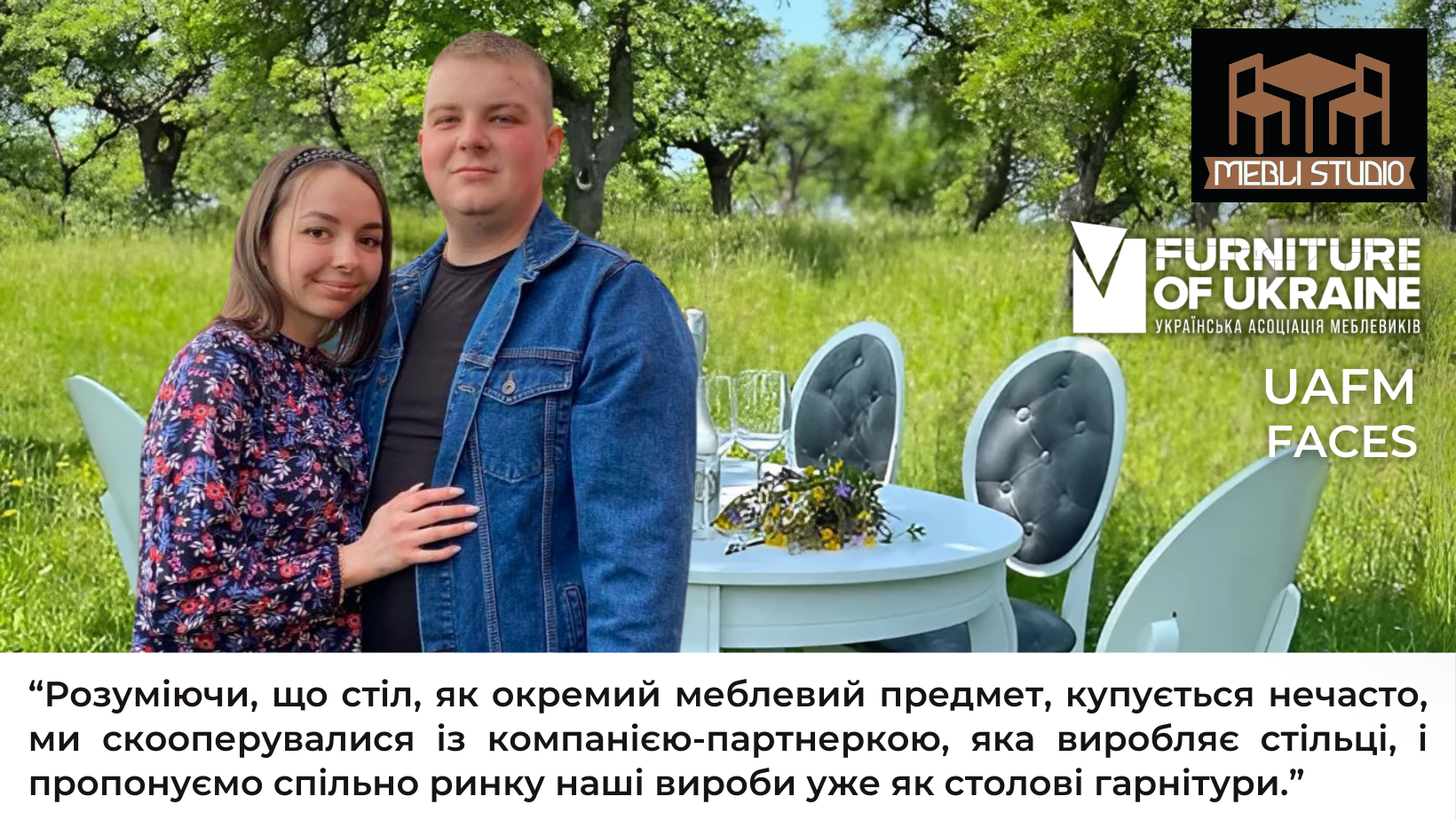
UAFM in Faces: the story of Roman Shelever, оwner of “Mebli Studio”.
Furniture-making for the Shelever family from Bedevlya, Zakarpattia, is a family business. Roman began his working life as a machinist in his father’s furniture company. When he reached the point where he felt capable not only of making furniture but also of designing it in his mind and on paper, he decided to start his own company. Now, he and his father work side by side in a truly family-like setting: his father and his team work in one shop, while Roman and his team work in another. Roman’s team includes his wife, Natalia, with the traditional division of responsibilities: production is handled by the husband, and management by the wife.
Of course, the furniture produced by the two family companies is different: Roman’s ‘Mebli Studio’ specializes in manufacturing tables made of solid beech wood.
The company places great emphasis on the quality of its products, ‘because furniture should not only be aesthetically pleasing but also safe for health and the environment.’ Therefore, the ecological aspect of the products is a priority. All stages of production—from woodworking to packaging the finished product—are carried out in compliance with international standards, which are carefully monitored by highly qualified employees. All technological operations are performed using powerful, high-precision equipment from global manufacturers.
The war did not cause the company as much damage as, for example, their colleagues from the occupied or frontline areas, who were forced to relocate to safer regions to save their businesses, but it also did not spare ‘Mebli Studio.’
– It reduced the potential of the domestic furniture market, – explains Roman Shelever, – and limited the purchasing power of the population, which means we sell fewer pieces of furniture and make less profit.
– Our industry is more affected not by the decline in profitability but by the staffing issue, which really puts some companies on the brink of survival.
– Our company has not been immune to it. We are one of those companies where it has hit very hard. Before the war, our staff numbered up to thirty workers, but now it’s three times less—we don’t even have ten people. Most of those who left the company went abroad. Replacing them is also problematic: men are afraid of the risk of mobilization, which is higher for those officially employed. So, I often have to operate the machines myself—luckily, I have long-standing experience—and also perform other furniture-making tasks when needed. Similarly, my wife now has to take on more than just management; she also, for example, helps with packaging the finished products.
– The most common attempts to improve the crisis caused by the war in the domestic furniture market are searching for foreign sales markets (particularly through participation in overseas exhibitions), reducing the cost of production, expanding the product range, and cooperating with industry colleagues.
– ‘Mebli Studio’ is an export-oriented company. But not enough, as until recently we only exported tables to Romania, and now we also sell to Moldova.
Thanks to the Ukrainian Association of Furniture Manufacturers, our tables were showcased at a prestigious exhibition in Poland this year. Recently, we received several interested foreign contacts from the UAM management. We are preparing our proposals.
I am personally responsible for the development of new models in the company. And I don’t sit idly by in this matter. I have developed three new table models, which are already in the process of being mass-produced. Without boasting, I’ll say that there’s nothing like them on the market yet. I personally crafted the decorative legs for them—putting both creative and physical effort into the new models—so I’m counting on their market success.
Understanding that a table, as a standalone furniture item, is not purchased frequently, we have partnered with a company that produces chairs and are now offering our products as dining sets.
– What does the company need for further development?
– To maximize the automation and robotization of production processes through the purchase of appropriate equipment. This is both a general requirement of the times, if we focus on global furniture-making trends; a reliable way to reduce production costs to remain competitive; and a forward-thinking step to better cope with the staffing shortages, which will likely become more acute.
We have these needs, but we do not yet have the financial resources to implement them. And once again, we turn to exports, without the growth and expansion of which the development of the company will remain just a good intention. That is why we are currently focusing our efforts in this direction.
