

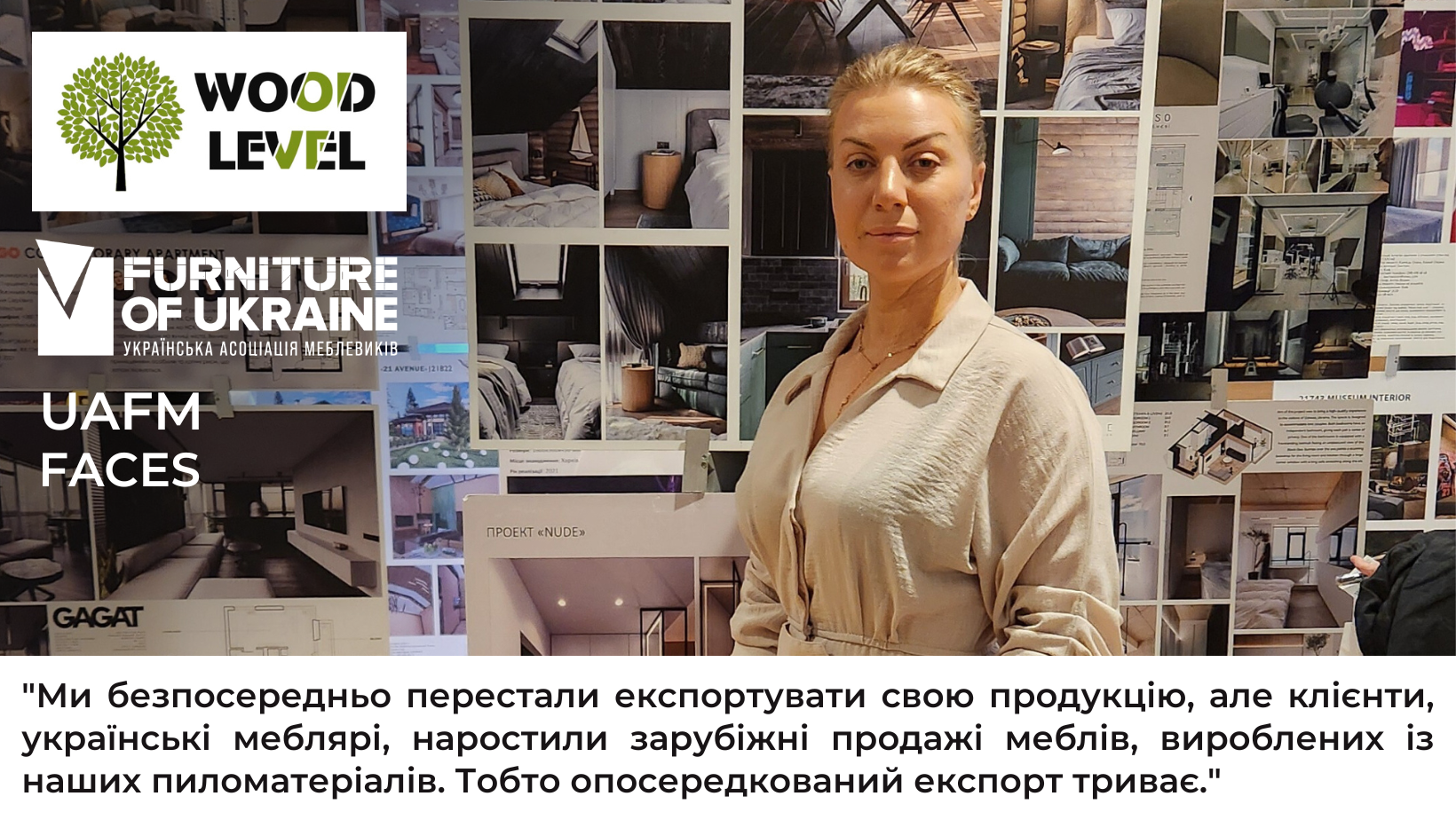
UAFM in Faces: a story from the owner of “WOOD LEVEL” – Anna Bukata.
We present to the industry community a new member of the Ukrainian Association of Furniture Manufacturers (UAM) — the lumber supplier “WOOD LEVEL” (LLC “GROVS WOOD”) from Sumy.
“Joining the Association is an important step for us, as it offers not only the opportunity to grow our business but also to contribute to the development of the entire Ukrainian furniture industry. We believe that, together with other members of the Association, we can create new opportunities for partnership and growth, as well as improve the quality of Ukrainian wood products on the international level,” the company said in response to its UAM membership.
It must be acknowledged that the company has strong arguments for claiming that it can “contribute to the development of the entire Ukrainian furniture industry,” as it offers high-quality lumber of its own production. The company’s clients can purchase boards from hardwoods such as oak and ash and receive their orders in the shortest possible time. Delivery is available to any location in Ukraine, making the products accessible to a wide range of customers. The company’s warehouse always has ready-made products available for inspection to ensure quality and grade.
Anna Bukata, the owner of “WOOD LEVEL”, gave us more details about the company’s partnership opportunities and how it is currently operating just ten kilometers from the russian border.
– Oak and ash, the two types of wood you work with, are key materials, particularly in the furniture industry, which uses solid wood in its production. These types of wood and the products made from them have always been more expensive than other domestic industrial species. As we know, the war has driven all prices up, and the increase for these materials has been quite significant?
– An almost forty percent price increase can be considered substantial.
– In the furniture industry, this price factor has become a hindrance for many companies, as it has reduced both domestic and export sales. Has this negative trend affected your company?
– Let’s start with export sales. With the onset of the war, they stopped, and we no longer supply products outside of Ukraine. Before the war, we exported our lumber exclusively abroad — to Belarus, the Baltic States, and other European countries. The Belarusian market is closed, for obvious reasons, and it has become economically unfeasible to ship products to the Baltics due to the disproportionately high logistics costs (from €1,500 to €5,000 per shipment).
However, we haven’t cut off trade with all foreign clients. Lithuanian customers bought a factory in western Ukraine, and we now supply materials to them there. There is enough oak in the Carpathians, of course, but they still purchase lumber from Sumy out of habit. We offer a competitive price, favorable payment terms, and they have long known our company as a reliable partner.
A curious trend has emerged in wartime exports. While we have stopped directly exporting our products, our Ukrainian furniture clients have increased their foreign sales of furniture made from our lumber. So, in a way, indirect exports continue. The fact that our Ukrainian clients have increased their exports means they are buying more of our lumber, which compensates for our loss of foreign markets. In fact, we have even seen growth compared to pre-war times.
Another wartime trend is that some Ukrainian manufacturers now sell furniture abroad to Ukrainian buyers — our compatriots who are setting up their lives abroad. These are mostly buyers of high-end furniture, for which our lumber is perfectly suited.
– Now about the lumber. You sell both edged and unedged boards of various grades. Why do clients buy unedged boards, even though they will have to cut them themselves? Is it just because they’re cheaper?
– It’s not only about the price. Some customers need the cut-off pieces for heating purposes.
– The war hasn’t deterred you from continuing to participate in exhibitions. In the follow-up to your participation in a recent capital investment exhibition, your Facebook page mentioned that the event allowed you to track current trends in the domestic woodworking industry. So, as an expert, what are those trends?
– There is a global trend of diminishing natural wood resources of high quality, and even despite the war, industrial wood will continue to rise in price. This makes the issue of reducing the cost of wood-containing products more pressing by transitioning to composite materials. For the furniture industry, these are solid-lamella and glued boards.
In this context, there is also the creation of composite materials from so-called wood flour, which is produced by grinding wood into fine particles and then pressing it. The idea is to make high-quality wood materials even from low-quality raw materials.
