

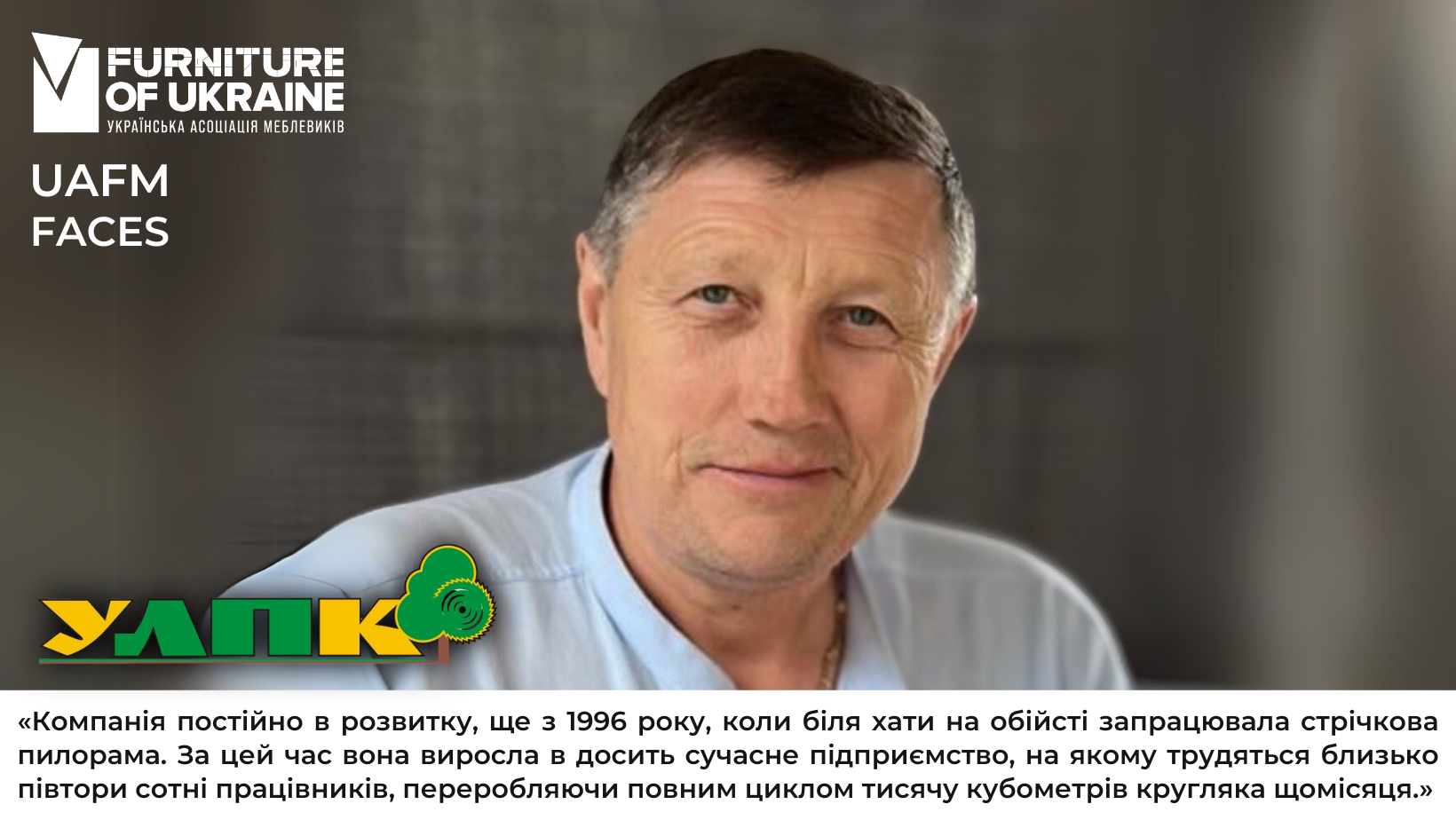
UAFM in Faces: the story of Viktor Okhremchuk, owner of the Ukrainian Wood Processing Company.
The Ukrainian Wood Processing Company from Rivne region can be called one of the few in our Association that, according to its owner Viktor Okhremchuk, has been “working as we did before.” That is, like before the war. However, this is more likely due to the fact that the company’s leadership turned out to be more skillful and creative in their actions.
This means that UWPC still specializes in the production of high-quality lumber, furniture blanks, glued panels, and industrial parquet. All waste is processed into firewood for fireplaces, kindling wood, Pini-kay briquettes, and also into charcoal.
— Your words radiate optimism. But still, hasn’t the second and third years of war — when our industry began to “groan” from the lack of skilled male workers due to mobilization — shaken your company in any way?
— You know, I’ve been in the wood processing business for thirty years, which means it’s hard to surprise me with anything. I’m used to the fact that crisis situations in our country arise regularly — be it financial, COVID-related, or now, war-related. I also know they can and must be overcome. And we are overcoming this one as well, without stopping our usual operations. I’ll say more: it’s during times of crisis that we get better results than when things are calm.
— But still, you’d agree that this crisis is unique…
— For our company, it’s unique because Europe, frightened by the war in Ukraine, began buying up everything we produce at an accelerated pace.
— So, you’re experienced exporters?
— Since 1999. Mostly to European markets. There’s also interest from Chinese buyers, but we can’t agree on price — they want our products almost for free.
— Do you have any European clients who’ve worked with you for over a decade?
— I remember a French client who bought from us for fifteen years. If not for him, I’m not sure we would’ve survived the financial crisis of 2008. And although they no longer buy from us, we still maintain contact.
Some companies have bought from us since our foundation. Others work with us steadily for a few years, then disappear, only to return and renew contracts later.
— Which of your products sells the most, especially abroad?
— It’s hard to say offhand. There’s a certain cycle: at times parquet is in high demand, at others — glued panels. The strongest sales fluctuations usually relate to secondary products like firewood, fuel briquettes, and charcoal. Of course, there’s also a seasonal factor here.
We adjust our production accordingly — if demand for one product drops, we increase output of another. Last autumn, for example, parquet demand dropped sharply, but this year the situation improved. Sometimes it’s more profitable to sell furniture blanks than finished panels.
— Judging by the range of your products, your company processes wood with virtually zero waste.
— Yes, we’ve established a full-cycle roundwood processing system. Of course, there are some production scraps, but we turn even those into products.
— Many wood processing companies don’t bother with waste recycling — they simply burn it for heat.
— Everyone does their own math and chooses what’s more profitable. Some companies grind large wood scraps, like slabs, into chips to press into pellets or briquettes. We calculated that it’s cheaper — and thus more profitable — to turn these pieces into charcoal without the cost of grinding, glue, or pressing.
We found the right technology, purchased special hydrolysis kilns, and added another product to our line. What’s more, we get a double benefit: during the eight hours while the charcoal is forming, we also get heat as a bonus. Now we’re working on how to use that heat more efficiently.
— Even companies in worse shape than yours still create development plans. No doubt you have plans as well.
— The company has been growing continuously since 1996, when a band sawmill started working in our backyard. Since then, it has grown into a modern enterprise with around 150 employees, processing a thousand cubic meters of roundwood monthly in a full cycle.
As they say, every cloud has a silver lining. In our case, the war brought access to favorable loans and available grants, which we used for further development. Our latest investment was aimed at stabilizing electricity supply — we installed solar panels at our facility.
