

UAFM in faces: Ternopil company “RONEL” engaged in optimization of production and sales in order to significantly exceed its pre-war performance already this year.
Two years of war are behind us, two years of the country’s economy, entrepreneurship, domestic market being in harsh conditions of restrictions, inflation, decline in production and sales. The furniture industry has been fully affected by all these economic troubles, but nevertheless survived the most difficult period of the war, did not succumb to the difficulties that still do not let go, and even often shows development trends in some companies. But the fact that the conditions of wartime have affected the practice of their management is undeniable for all furniture manufacturers. Of course, each in its own way, to a greater or lesser extent.
– And what did the two years of war change in your company? – Yaroslav Vakolchuk, co-owner of the Ternopil company “RONEL”, was asked.
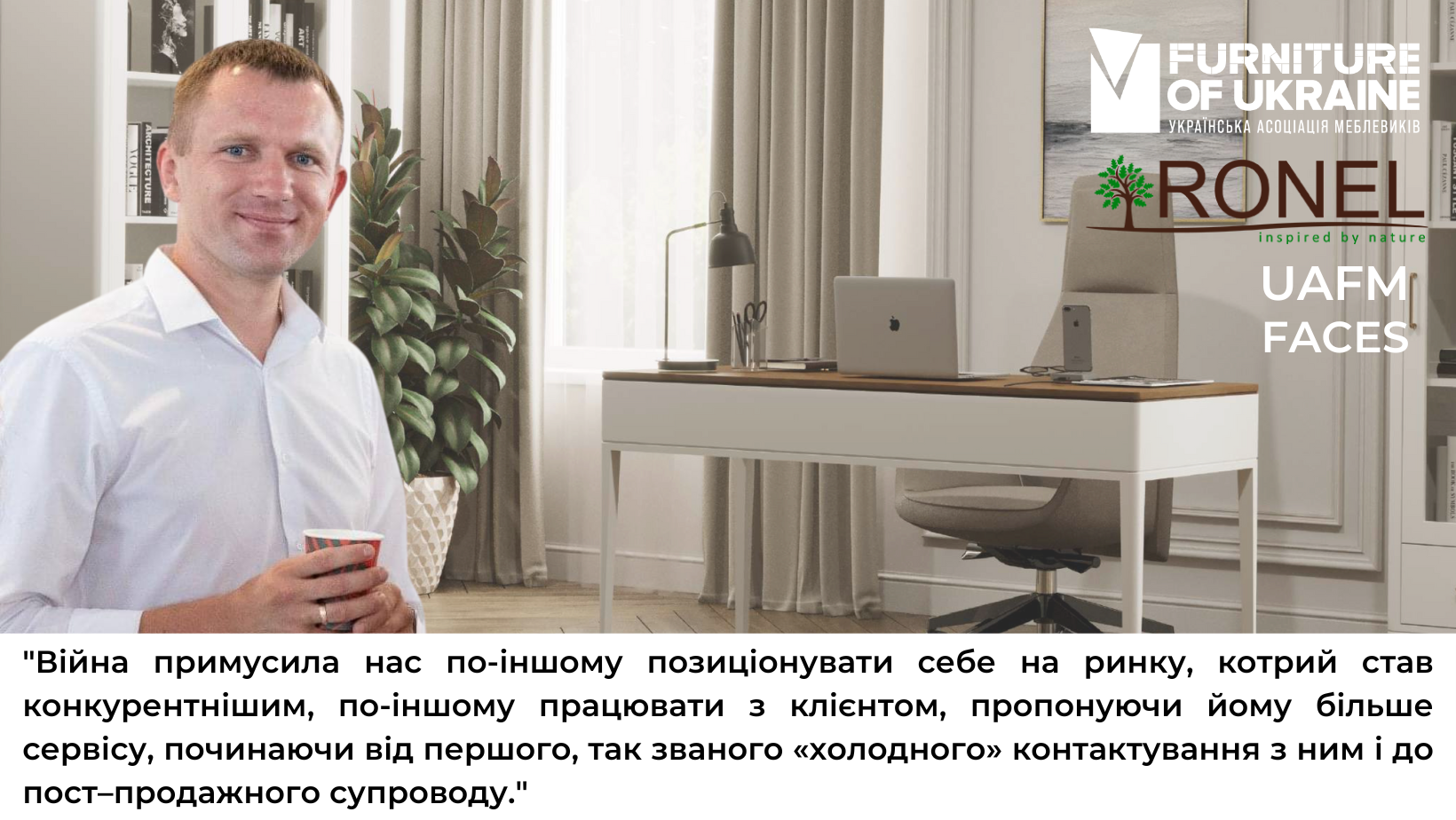
– The war forced us to reposition ourselves in the market, which has become more competitive, to work differently with the client, offering him more service, from the first, so-called “cold” contacting him to after-sales support.
– Despite the difficulties of this time mentioned above, some furniture manufacturers also talk about certain positives that have manifested themselves and are favorable for their companies…
– I would include in the positive that I noticed in the practice of our company the tendency that customers began to make more complex furniture purchases more often than before. For example, in our segment – bedroom furniture – usually bought a bed, two nightstands, a dresser. Now the number of purchase checks has decreased, but they have almost doubled in value, the amount of purchase.
– Furniture production has become more costly due to rising prices for materials, components, logistics…
– Yes, but in the two years of war, domestic furniture has risen in price by about 15%, not by half. Another factor made the purchase check more “solid”: intra-migration processes. A significant number of Ukrainians are forced to change their places of residence. To settle in, and hence furnish a new home, they buy not individual items, as it used to be – in order to update something, but immediately completely furnish themselves. Of course, we are talking about people who can afford it. And there are still plenty of those in Ukraine, if not more.
I will also say this: there has been a noticeable polarization of potential buyers. The average price segment seems to have disappeared: some Ukrainians have slipped into the mass market due to their purchasing power, while others have risen above.
– Can we say that the furniture market of the wartime has become less demanding? According to the proverb “Not to the fat…”
– No. “RONEL” traditionally made furniture in the classics, and now we are cramped within its framework. We are receiving requests for stylistic diversification. In the latest series launched into production already in wartime, we have not yet radically departed from the classics, but have come closer to modernity.
The plans for this year are to increase sales by launching new, even more advanced series towards modernity into production. These will be furniture for both the bedroom and the living room and office.
– During the war, many UAM members, introducing new models into production, set export objectives in the first place, so they seek to promote new models primarily at international exhibitions, in which the Association provides them with significant assistance…
– We have not yet exhausted the potential of the domestic market. Moreover, it is no longer what it was in the spring of 22. And convincing evidence of this is the fact that the company has been able to maintain pre-war production volumes for two years of war. And if now we aim to increase sales, it is not to reach pre-war levels, which most colleagues in the industry strive for, but to provide our products to meet the needs of the domestic market.
As for exports, it is still not completely uninteresting for us. We look closely, compare prices, even from time to time contact potential buyers, but we have not yet reached an agreement on cooperation. To form an export strategy, we are gradually studying the market and determining who our client is.
– What will be the main driver for the planned increase in production and sales?
– Deep optimization and systematization of production processes and management. We realized that it was unlikely that we could achieve the necessary depth in this matter on our own, so we involved an appropriate specialist. The optimization process has been going on for two months now. This is not the end yet, but its positives are already obvious: in these two months, the indicators that interest us first of all have grown by forty percent in relation to those that we had two months ago. In particular, just the other day we were able to inform potential customers that the company is reducing the order execution time by half – to one month. And this is without reducing production and sales.
– The company works more with solid wood, and exclusively with ash. Why such a limitation?
– I do not consider this a disadvantage, because ash is among the most popular wood species in the furniture industry. In addition, we have long-standing, well-coordinated and cost-effective supply of this wood.
Oak is always more expensive. Its use would hardly have allowed us to keep furniture products in the price category in which the company operates. In addition, the average buyer usually knows little about the textural differences between wood species. Nevertheless, the texture of oak can be found in our products: we finish some furniture elements with sheet materials covered with oak veneer.
