

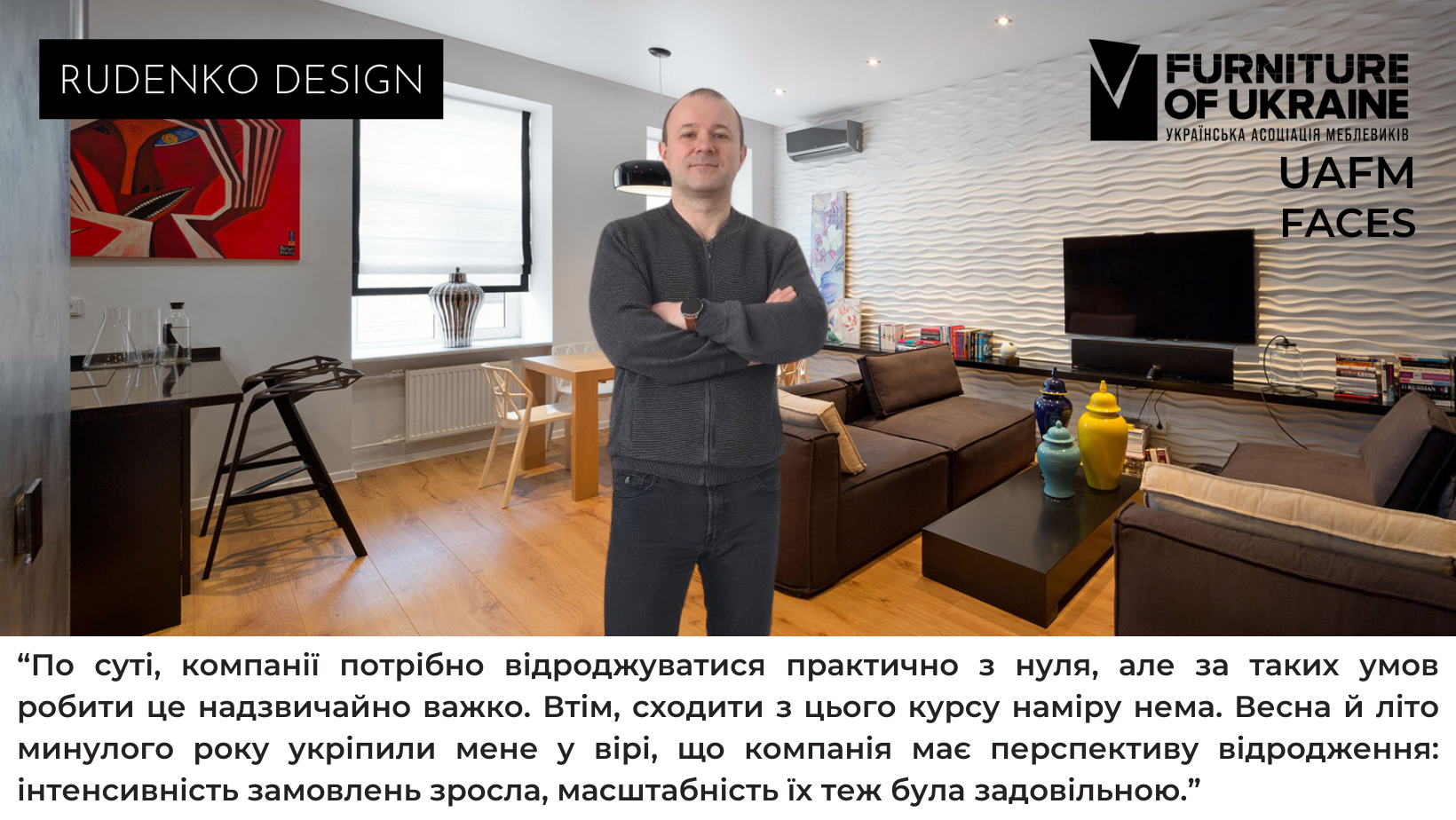
UAFM in Faces: The war has brought Ruslan Rudenko’s company to the brink of existence. The conversation with the Kiev-based furniture entrepreneur is about the difficult steps to get out of this dangerous zone.
When we ask members of our Association about what has changed in their companies over the two years of war, almost everyone gives the same answer: “we have downsized”. In 2022, it was about a decrease in the number of orders, sales, and consequently, a reduction in production volumes. Since last year, production downsizing has been compounded by staff reductions, which has now grown into a severe industry-wide problem.
Ruslan Rudenko’s company Rudenko-Design has also “downsized in terms of space” almost fourfold – from 300 square meters of rented space to 80. Clearly, such a reduction was interdependent with the other two reductions. Moreover, the landlord acted like a glutton, demanding payment for those initial weeks of the war when Rudenko’s company was forced not to operate, like thousands of other manufacturers in the capital. With no new orders, the company faced a dilemma: either to completely stop furniture production or to look for another, smaller rental space. Rudenko chose the second option, hoping that the decline of the domestic furniture market, which reacted so strongly to the war, would be temporary. And so it happened. After the army achieved its first significant victories over the enemy, the market began to revive.
– But it’s impossible to fit everything that was in three hundred square meters into eighty…
– Yes. That’s why the company did not avoid a fourth type of downsizing – its production base. A significant part of the equipment had to be sold for a pittance. It was a forced but logical step given the circumstances: they had to make do with less production space, and product output had virtually stopped due to the lack of orders at the beginning of the war.
– Under such circumstances, any entrepreneur could fall into despair.
– But I didn’t fall. As soon as the first orders started coming in under the wartime conditions, the company was still able to fulfill them. They are still periodic, so there is no point in keeping a permanent staff of production workers. Moreover, this is currently problematic for another well-known reason. Therefore, we temporarily form a team for each new order received. But even this is becoming increasingly difficult due to stringent mobilization measures. In addition, each time there is a need to train newly hired workers before allowing them to use the machines.
Essentially, the company needs to be revived virtually from scratch, but it is extremely difficult to do so under such conditions. However, there is no intention to deviate from this course. Spring and summer of last year strengthened my belief that the company has a prospect for revival: the intensity of orders increased, their scale was also satisfactory. This means that the industry, the market, and the country’s economy, despite being in such a difficult state, still have a need for such a furniture manufacturer. But this need – taking into account our needs – is insufficient for us. Its instability does not allow for clear planning for at least a year, and without this, it is impossible to expect development. Therefore, we are now actively seeking access to foreign markets to acquire new clients and stabilize the company’s operations.
This need is also driven by the fact that many designers, whose projects we previously participated in quite often, have now left the Ukrainian market and are working abroad.
In conversations with colleagues who have already established foreign sales, I know that foreigners are very satisfied with both the quality and prices of furniture made in Ukraine. Especially furniture in the segment we operate in. If others are selling, why shouldn’t we?
– The UAM can be helpful in this regard. Primarily, in finding foreign clients through discounted participation in furniture exhibitions, which has become a regular practice of the Association. Many of your colleagues have already taken advantage of this opportunity. In addition, training courses, seminars, and workshops on export topics are organized. Primarily for those who have just decided to embark on this path.
– We also received such an offer from the directorate. But such an event is still financially unaffordable for us, despite the fact that it provides certain discounts for participants. Therefore, we are forced to blaze our own trails abroad. And we already have some encouraging initial results.
On the occasion of such a conversation, I would like to once again touch upon the painful issue regarding the company’s membership in the UAM, which I have repeatedly raised at corporate gatherings and which many colleagues agree with.
At one time, the association was created by large manufacturers of mass-produced furniture and was built around their needs. Over the years, as it grew, it was joined by smaller companies and those of a different specialization – the implementation of individual custom projects. Such companies now may even predominate in the association, but are forced to “be members” on the basis of rules created for large “mass producers”. I’m not suggesting that those rules be adjusted to the somewhat specific interests of the “individual manufacturers”; rather, I propose separating them into a separate division so that in supporting them, a different approach is taken than the one originally designed for the furniture “heavyweights”, so to speak.
