

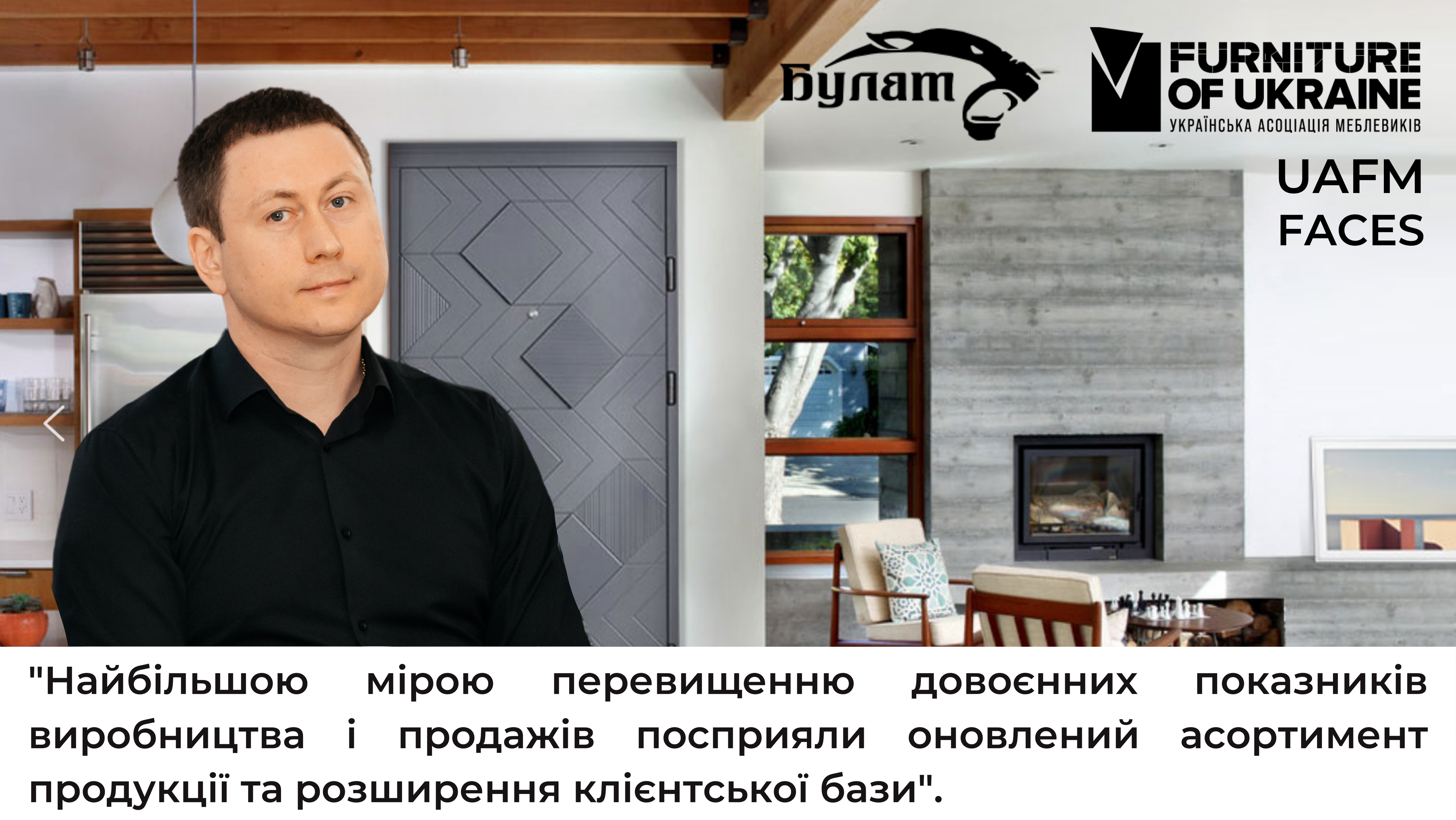
UAFM in the faces: Victor Atroshchenko, the owner of the “Bulat Doors” company, shared why the company surpassed pre-war production and sales volumes of entrance doors.
While gathering information about member companies of our Association, which, despite the war and the difficulties it imposes on businesses, continue to produce and deliver their products, we learned about a pleasant paradox: despite the significant decline in the domestic market, especially in the first year of the war, the company started producing and selling more products than in pre-war times. The fortunate company turned out to be the Chernihiv-based “Bulat Doors” factory, a renowned Ukrainian manufacturer of entrance doors, which three years ago joined forces with the Ukrainian Association of Furniture Manufacturers.
However, luck is capricious. It manifests in some aspects but lacks in others. If we talk about the “Bulat Doors” company in this sense, as its co-owner Victor Atroshchenko explained, luck turned away from it in the early weeks of the war when the enemy occupied the Chernihiv region and regularly shelled the regional centre. The factory’s production facilities were also not spared by enemy shells, with four direct hits causing nearly a million in losses for the company. Therefore, before resuming door production, the company’s employees had to heal the wounds inflicted upon it in April of last year. All those who remained in the team at that time worked united and diligently to restore the company’s operations, and by May, the factory was able to deliver products of all its brands: “BULAT,” “CITADEL,” each offering a combination of quality, design, and price. Furthermore, last year the company managed to expand its range of doors with another brand called “REVOLUT DOORS,” preceded by a comprehensive analysis of entrance door assortment, which was successfully conducted before the war. The new brand, like the well-known “CITADEL” on the market, is a series offering quality products at an affordable price.
– Perhaps it was not only the expansion of the company’s product range that allowed it to surpass pre-war production and sales figures last year.
– To a great extent, this was mainly due to the updated product assortment and an expanded customer base, as well as the absence of a strong Russian competitor in the domestic market, which covered a significant portion before the war. Although the domestic door market as a whole contracted by more than twofold, replacing the market share previously occupied by Russians allowed us not only to compensate for the market decline but also to increase sales. Belarusian doors also stopped selling in the country. This circumstance enabled us to increase export shipments because trade with Russia and Belarus has also ceased in Europe. Competition among domestic manufacturers has weakened as well since those located in partially occupied territories, such as Zaporizhia and Kherson regions, ceased their operations.
– Where in Europe do you sell your doors?
– Before the war and even now, our doors are mainly sold in the Baltic countries. We expanded our customer base and increased sales there during the war. In Ukraine, the largest share of our doors is sold through the “Epicenter” hypermarket chain, but its share in the overall sales does not exceed 25%.
– The expansion of production and sales volumes, which you can rightfully boast about, doesn’t it urge you to expand your export horizons?
– It is more challenging for door manufacturers to sell their products there – there are different requirements, different standards. To produce doors that could be sold in the United States, a different type of product is needed – different designs, different standards, different equipment, and tools. It is unlikely that any domestic door company can afford to create another parallel production without knowing how their products will be sold there, and without having reliable channels for their distribution. And to establish new production relying solely on luck, who would take such a risk?
– Currently, in Ukraine, almost all production teams have experienced forced downsizing, especially the male workforce, due to well-known circumstances. In companies that have reduced production, this loss of personnel has not significantly affected their operations, but in your case, production volumes have increased despite these staffing circumstances.
– Mobilization reduced the workforce by about twenty percent. Of course, it presented us with challenges. It forced us to find replacements for those who are on the front lines. But it doesn’t mean that these employees are lost to us. After returning to civilian life, there will always be a place for them in our team.
– Your company has always had a strong competitive position, particularly due to the regular updating of your door assortment. Has the war affected this regularity?
– Yes, the development and implementation of new door models in our production have always been ongoing, so to speak. As production resumed in May last year, the work of designers and engineers on updating and expanding the model lineup also resumed. Traditionally, we change up to 20 percent of our assortment each year. Last year’s creation of a new brand is a convincing confirmation of that.
