

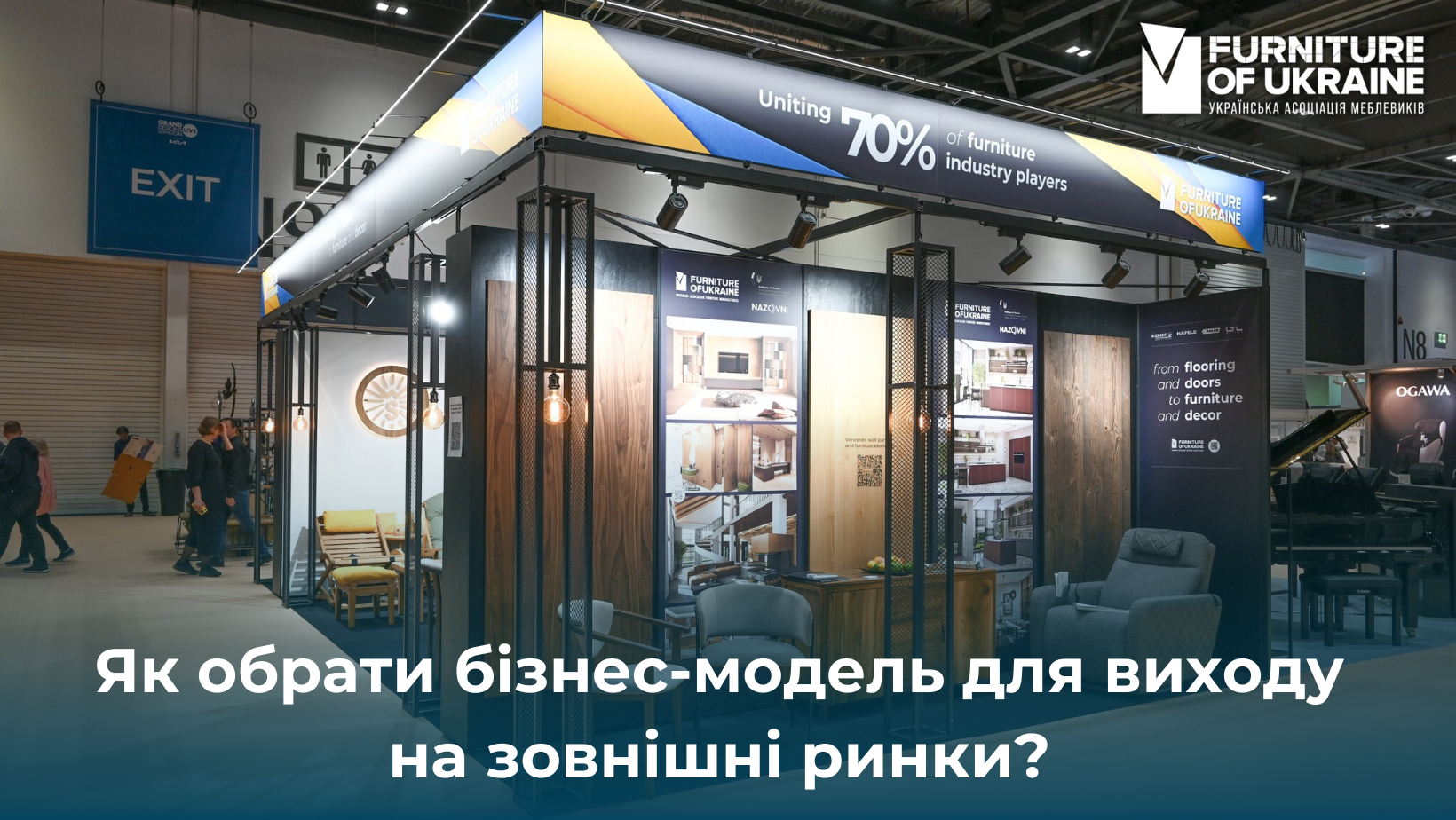
How to Choose a Business Model for Entering Foreign Markets
Recently, the UAFM team completed training as part of the second module of the Export Alliance Mastery program by Vision Institute. One of the key topics of the module was developing an effective strategy for Ukrainian manufacturers to enter foreign markets. We offer practical recommendations for companies building their export strategy.
Choosing the Right Market Entry Business Model
After analyzing and selecting a target market, it is essential for businesses to determine the business model that best aligns with their capabilities and goals. Below, we explore the main options:
- B2B (Business-to-Business): Through Partners or Distributors
The B2B model involves selling products to wholesale buyers, distributors, or local agents. This option is suitable for companies looking to quickly enter a new market with minimal marketing expenses.
Advantages:
- Rapid market entry through established partner channels.
- Lower operational costs for servicing end customers.
- Ability to focus on production and product quality.
Risks: - Dependence on partners and their marketing strategy.
- Lower margins due to intermediaries.
- B2G (Business-to-Government): Public Procurement via Tender Platforms
For furniture manufacturers, participating in tenders through specialized electronic platforms provides opportunities to secure government contracts. This can be particularly beneficial for companies with certified products that can meet high quality standards consistently.
Advantages:
- Access to large volumes of government orders.
- Guaranteed payments and stable demand.
- Positioning the company as a reliable supplier.
Risks: - Competition with large suppliers.
- Complex tender procedures requiring specialized legal support.
- B2B (Business-to-Business): Through Interior Designers and Architects
For custom furniture manufacturers, it is important to consider a B2B model where clients include not only wholesalers and distributors but also interior designers and architects. They require high-quality products that align with their creative concepts.
Advantages:
- Direct access to skilled professionals who can become long-term clients.
- Opportunity to create tailored solutions for projects, increasing product value.
- Direct control over branding, including unique designs and color solutions.
Risks: - High demands for quality and product uniqueness.
- Lack of guaranteed large-scale orders.
- B2C (Business-to-Consumer): Direct Sales to End Consumers
In this model, the company sells its products directly to consumers by opening a company representative office, showroom, or online store. This approach allows full control over branding, pricing, and customer communication.
Advantages:
- Maximum control over branding, pricing, and communication.
- Higher margins due to the absence of intermediaries.
- Ability to collect data on customer preferences.
Risks: - High marketing, logistics, and customer service costs.
- Need for infrastructure to manage online sales (website, technical support, delivery).
- E-commerce via Marketplaces
E-commerce is a component of the B2C model but is categorized separately here. Ukrainian manufacturers can sell products through popular platforms like Amazon, eBay, Wayfair, or local European marketplaces.
Advantages:
- Access to a large customer base across various countries.
- Relatively low market entry costs compared to creating a standalone online store.
Risks: - Intense competition and the need for investment in product promotion on the platform.
- Commissions and restrictions imposed by marketplaces.
- Franchising
Franchising is a model where a company grants the right to use its brand, technology, or established business processes to another enterprise in a new market.
Advantages:
- Rapid business scaling with minimal investments.
- Involvement of a local partner with experience and market understanding.
Risks: - Partial loss of control over service quality and product consistency.
- Difficulty in finding a reliable partner.
- Private Label Manufacturing
Ukrainian companies can collaborate with foreign retailers or brands to produce goods under their trademarks.
Advantages:
- Stable order volumes and predictable revenue.
- Minimal marketing costs.
Risks: - Complete loss of the company’s brand presence in the target market.
- Dependence on large clients and their terms of cooperation.
Conclusions
Choosing the right business model depends on the company’s capabilities, target market characteristics, and strategic priorities. For many Ukrainian manufacturers, the most effective approach involves combining B2B partnerships at initial stages with gradual expansion into B2C and e-commerce. Developing a financial plan and taking a consistent approach minimizes risks and enables stable growth in international markets.
The UAFM team continues to support Ukrainian manufacturers on their path to success, providing expertise, tools, and training to boost export development.
Author: Oksana Donska
