

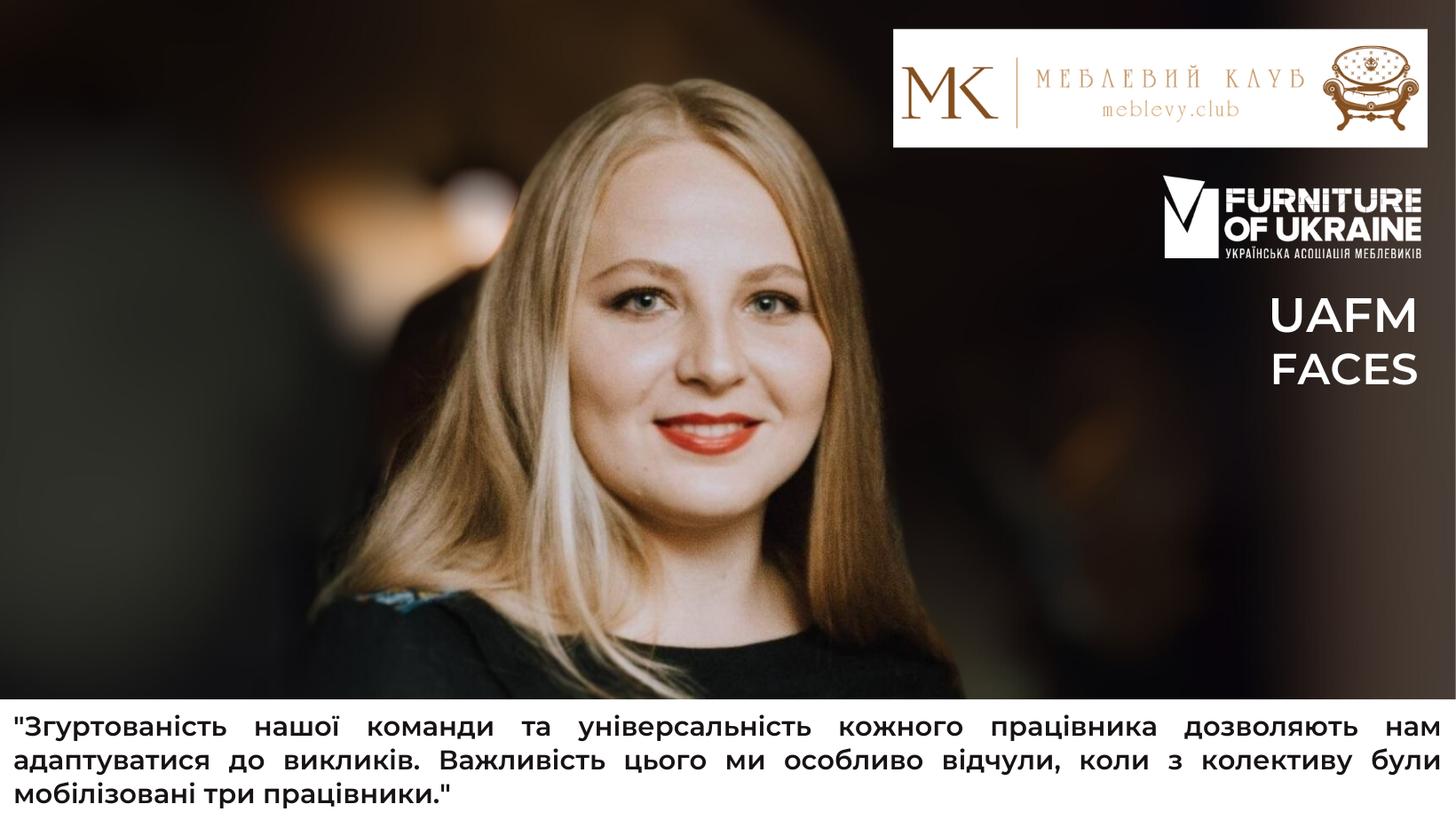
UAFM in Faces: the story of Kateryna Hlavatska, who took over the operational management of the company “Meblevyi Klub”
The war complicates the work of domestic furniture manufacturers in various ways. The most painful challenge now is that, due to the mobilization needs of a country at war, labor collectives sometimes lose critically necessary employees. This outflow of personnel is especially threatening for small companies, where every worker, as they say, is worth their weight in gold. And what about those companies where the main manager is among those leaving? Our story today is about one such furniture company.
Ihor Abramov, the owner and director of the Kyiv-based company “Meblevyi Klub”, was mobilized into military service a year and a half ago. The operational management of the company—an already difficult task, especially under current conditions—eventually passed to project manager Kateryna Hlavatska, who now also serves as the acting director.
Why her? The situation caused by the manager’s mobilization required it. However, the main argument in her favor was her deep understanding of furniture manufacturing. What she still had to additionally master was financial reporting and adapting the company’s workflow to new regulations and circumstances.
– What has been the most helpful for you in this situation?
– The cohesion of our small team, as well as the versatility of almost every employee, which allows for mutual substitution and the ability of one worker to competently perform multiple technological operations. We particularly felt the importance of this when three employees from our team were mobilized.
There are force majeure situations when I have to work in the workshop myself because I know how to sew, foam, and upholster soft furniture—the specialization of our company. If I didn’t know how to do this, could I properly control the quality of these tasks performed by others? However, this does not mean that women can fully replace men in our industry. Furniture is large and heavy; it needs to be moved and rotated, so male strength is still indispensable.
– Even if a company mainly produces custom-made furniture, like yours, having a brand store is still important—not only for retail sales but also to showcase its capabilities in an exhibition-salon format.
– And we do showcase our furniture offline, where customers can see the quality and experience the comfort firsthand. Our store cannot be called a branded one in the full sense of the term because it belongs to a colleague, but our products are well represented there.
– Furniture manufacturers now face challenges—staff shortages and energy supply issues—that make it difficult to produce, deliver, and install furniture within the same timeframes as before.
– That’s true. Therefore, when signing contracts with clients, we specify the possibility of force majeure circumstances. Usually, this does not cause problems, and clients are understanding.
– Do you work with international clients?
– Yes, we fulfill orders from abroad. I can recall projects in Poland, Germany, France, Cyprus, and the United Kingdom. We receive foreign orders thanks to our partners in these countries, for whom doing business with our company is beneficial. In turn, working with them is also advantageous for us. Finding such partners is a great success because, without their mediation, entering and securing a foothold in foreign markets is incredibly difficult.
Among these partners are designers who have started working abroad. Naturally, our furniture is featured in their interior projects. It’s easier for us to attract international clients because we had experience working with foreign orders even before the war. This gives us an advantage over colleagues who had to start building export relationships from scratch under wartime conditions.
– What aspects of the company’s operations need improvement?
– We need to use social media more actively and extensively to introduce as many potential customers as possible to our products and manufacturing capabilities. Plans for the year also include upgrading the workshop to improve working conditions and developing a warehouse program for materials and components.
