

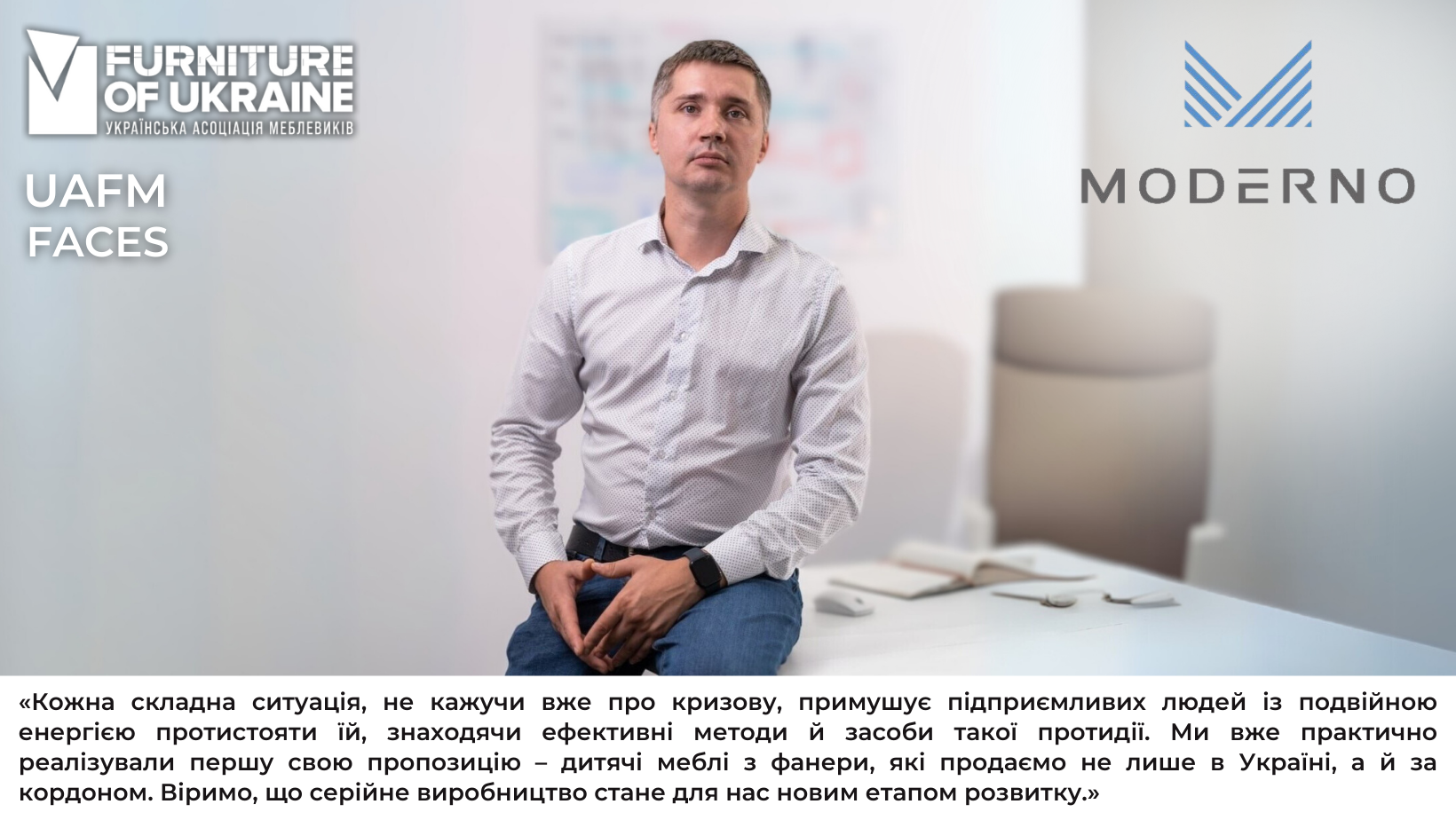
UAFM in Faces: the story of Anton Yushyn, owner of the company “MODERNO”
Many furniture makers with whom we spoke while preparing publications for this section find the behavior of the domestic furniture market quite paradoxical. A few months after the war began, once the initial shock had subsided, the market—previously at a standstill—began actively regaining its footing. While it has not fully recovered, signs of promising revival became evident. However, now, approaching the third year of the war, when businesses have somewhat adapted to its challenges, the market is again showing signs of stagnation: orders and sales volumes are noticeably declining.
Anton Yushyn, the owner of “MODERNO”, has also pointed out this troubling trend. He has witnessed various market conditions, having been in the furniture industry since his school years when he worked at a furniture manufacturing facility during the summer. This experience, reminiscent of Soviet-era career pathways, paved the way for his journey into the furniture business. However, the current situation is unprecedented for him.
– Every difficult situation, not to mention a crisis, forces enterprising individuals to fight back with doubled energy, finding effective ways to counteract the challenges. You haven’t just given up, have you? The very fact that your company remains operational and hasn’t dropped out of the race—unlike some of your colleagues—proves that you’re actively pushing forward.
– Like many small Kyiv-based furniture companies producing custom case furniture for private clients, we used to primarily assemble furniture rather than manufacture it. Companies like ‘ViYar’ performed the cutting, drilling, and milling operations for us, as offering such services is part of their business model. Not because it was more profitable, but simply because we didn’t own the necessary equipment. However, in 2022, we decided to eliminate this dependency and acquired several essential machines, taking advantage of a government grant. We purchased used machines to stretch the grant funds for critical equipment, and later, with our own resources, we bought another machine—this time, almost new.
– Having even a limited but personal fleet of machines means you can proactively offer products to the market rather than just waiting for incoming orders…
– Exactly. We have already launched our first in-house product—children’s furniture. Moreover, we’re targeting not just the domestic market but also international customers. That’s why these will be serial production models, made from plywood. Initially, we plan to sell them on a popular online marketplace, where plywood furniture enjoys high demand. Once we build a customer base, we’ll start selling directly, without intermediaries. In fact, we’ve already sold a few pieces and realized we need to expand the product line by adding more items and offering a wider variety of colors.
-Are the designs for this children’s furniture original, or did you collaborate with external designers?
– Everything is done in-house. We have a skilled constructor, and I personally handle the design. That applies to our new product line. As for our traditional case furniture, we usually execute pre-designed projects that clients bring to us. Nearly half of our clients are interior designers.
– Some say that smaller companies have an advantage in tough market conditions because they are more agile and adaptable…
– That may be true, but small-scale operations also come with significant drawbacks. One major challenge for us is large orders. In theory, securing a big order is considered a stroke of luck. However, for a small company, it’s also a serious test. Fulfilling such an order can take six months or more, yet employees need to be paid every month. At the same time, handling smaller orders becomes difficult because it diverts limited resources away from the large project, risking delays. This is a real issue for us, especially now when we’re receiving fewer orders, and the clients we do get have become more demanding. It’s not uncommon for us to turn down additional orders when we’re already committed to a major project.
– Have you considered participating in exhibitions to attract new clients?
– I assume you mean international exhibitions, which UAFM helps companies join. Not yet. We would love to, but financial constraints prevent us. However, we do have our eye on a local exhibition in spring—a trade fair for children’s products in Kyiv, which is a perfect fit for our new children’s furniture line.
– Finally, what are your goals for this year?
– We aim to establish ourselves in serial production, which would significantly ease our operations. Expanding international sales is also a priority. Additionally, we plan to acquire another machine—a sanding machine for processing plywood edges, as edge finishing greatly impacts the overall quality of the final product.
Due to financial difficulties, “MODERNO” has temporarily suspended its membership in the Ukrainian Association of Furniture Manufacturers. However, the company intends to rejoin the community once its situation stabilizes.
We wish “MODERNO” success in launching new projects and achieving continued growth!
