

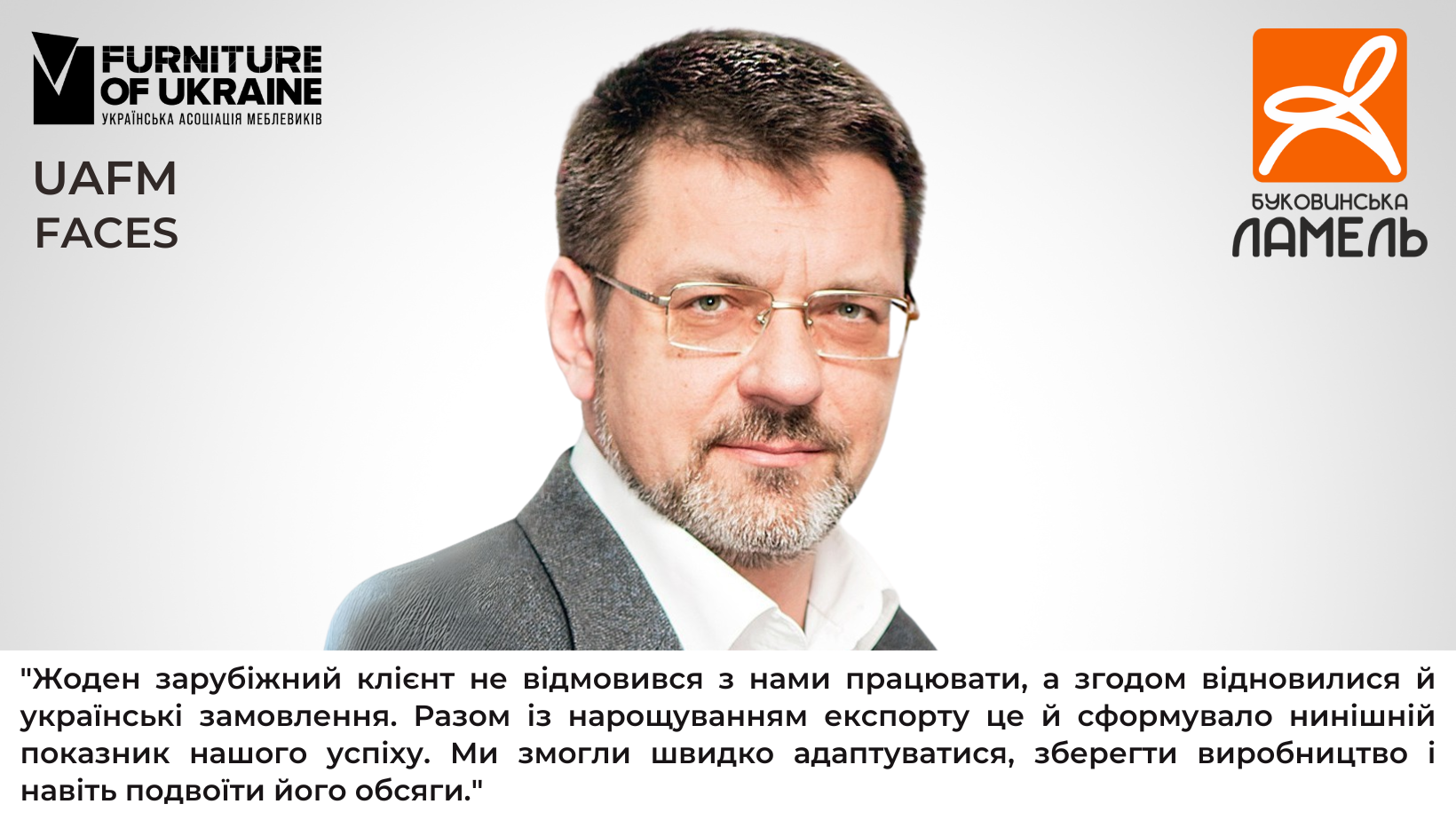
UAFM in Faces: The story of Serhii Odarych, co-owner of the Bukovyna bentwood parts factory “Lamel”
A pleasant and encouraging trend has begun to emerge: more and more UAFM member companies are reporting, according to their executives, that they not only feel confident in the current challenging economic realities of our war-torn country but have also significantly increased their production and sales volumes, thereby advancing in their development.
Among them is the Bukovyna bentwood parts factory “LAMEL”. Its co-owner, Serhii Odarych, shared that over the past three years, the factory’s production figures have doubled. Naturally, we were curious about what contributed to such a remarkable achievement in these times.
– After the full-scale Russian invasion began, we focused as much as possible on finding new clients in Europe and overseas, and we succeeded. Currently, we export our products to Germany, France, Italy, Austria, the Czech Republic, and other countries. Even in the first months of the war, when the domestic market came to a halt, we operated exclusively for export. By March, we had fully restored our order portfolio, and by April, the factory was operating at full capacity. Not a single foreign client refused to work with us under the current circumstances. Eventually, Ukrainian furniture manufacturers—our clients—resumed operations as well. Over the following year or two, they also started showing growth, which increased the demand for our bentwood components used in their products. This, along with expanding our exports, has shaped our current success.
However, there are other factors behind this success. The Bukovyna Bentwood Parts Factory “LAMEL” continues the region’s centuries-old tradition of processing beech wood—an exceptionally unique and challenging material to work with. The factory collaborates exclusively with legal raw material suppliers and holds an FSC certification to confirm this. It produces high-quality veneer in-house, ensuring uniform color, moisture content, and thickness, while maintaining full control over the production process—from wood procurement to packaging of finished products. Special programs regulate the heating modes of the wood, and quality control systems monitor the peeling and drying of the veneer. Thanks to a modern edge-gluing machine, the surfaces of the parts are free from glue seams, gaps, or stains. Upon request, parts can be coated not only with veneer but also with plastic.
The company has its own design bureau, which develops all engineering documentation, processing programs, and manufacturing fixtures. Clients only need to provide a sample of the product or a 3D model, and the ordered item will be ready within three weeks. Additionally, the factory has more than 150 ready-made press molds, which enable the production of over 650 different bentwood product models.
– I would also highlight one of our competitive advantages: when accepting a client’s order, we do not operate with the concept of a “minimum order quantity.” Any order size is acceptable and profitable for us because our production process is highly flexible. For example, in pressing operations, we can switch from one product to another within 5–10 minutes. In some milling operations, the equipment and program reconfiguration time is reduced to just two seconds.
– What are the company’s goals for this year?
– Our performance could have been twice as good already if we had been able to increase our workforce to match our technical capacity. However, under current conditions, the issue of sufficient staffing remains a challenge for us. Nevertheless, we have set a very ambitious goal: to double our current production volumes by the end of the year. This will be achieved partly through our core product—bentwood parts—and partly through new product lines.
Starting in the second half of the year, we will begin selling peeled veneer, which we have previously used only for our own needs. Additionally, we will launch a production line for fuel pellets. After modernizing our thermal facilities and optimizing heat consumption, we now use only about 15% of our wood waste for the factory’s heating needs. The remaining waste will be repurposed for pellet production.
– One final personal question: In the past, Serhii Odarych was widely known as a successful politician, and now you are an equally successful entrepreneur in the woodworking industry. When and how did this shift in life priorities occur?
– For others, it may have seemed unexpected, but not for me. Back in the ninth grade, while attending a vocational training program, I was drawn to working with wood. So when the opportunity arose to start a business, my partner and I purchased a woodworking plant in Cherkasy. We revived it, pulling it out of bankruptcy, and then continued developing in the same field. Today, that plant operates as “VENETO,” a company specializing in bedroom furniture. However, in the past, we lacked our own beech lamellas for a fully self-sufficient production process. In Bukovyna, we found a company that manufactured them, acquired it, and later carried out a radical modernization and expanded its product range. That company is now the Bentwood Parts Factory “LAMEL.” Although it no longer primarily produces lamellas, it mainly focuses on bentwood blanks for chairs.
