

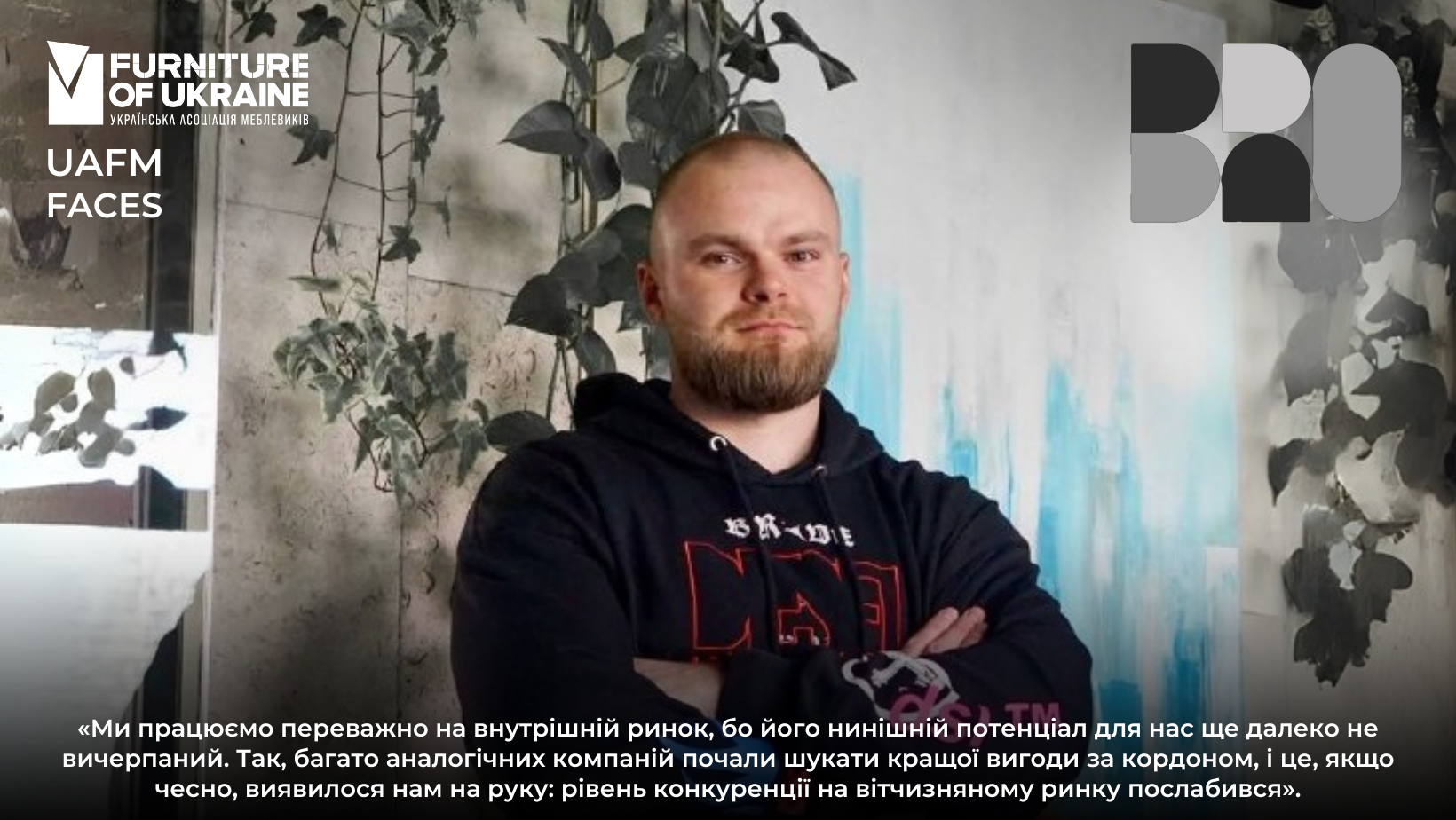
UAFM in faces: a conversation with Dmytro Yushchenko, owner of BRO Group
When a company owner or manager remains optimistic even in these challenging times, it usually means that the company demonstrates steady growth and stable profitability. Some might say: it’s just luck. Perhaps this factor plays a role in such cases, but Dmytro Yushchenko, owner of BRO Group, offers a different explanation:
— No, it didn’t happen on its own. We had to make an effort: change our approach to clients to more effective ones, actively look for new customers, and open up new opportunities in the market under its current conditions.
— Were you looking for new clients abroad?
— In Ukraine. We work mainly on the domestic market because its potential for us is far from exhausted. Yes, many similar companies have started seeking better conditions abroad, and honestly, that has even helped us: the level of competition in the domestic market has weakened.
— But it’s been said more than once by entrepreneurs that Ukrainians’ incomes have decreased, and therefore so has purchasing power.
— That’s probably true. But our company focuses on B2B clients. And they have become significantly more active over the last two years; investment money has started flowing back into Ukraine.
BRO Group is a furniture company with its own production facilities in Kyiv, with experience in implementing over 100 projects and more than five years in the market. The company develops design projects and manufactures furniture, offering individual solutions, unique décor, decorative wall cladding, and the option to order even a single piece of furniture. It not only designs and produces furniture for businesses but also equips facilities within client-friendly timeframes and with high quality. This is largely thanks to its own architectural bureau and a skilled team. Implemented projects cover a wide range: offices, restaurants, cafés, retail spaces, private schools and kindergartens, clinics, and more.
— And hasn’t the domestic market’s shrinkage due to the occupation of significant territories by the enemy and proximity to the combat zone undermined the company’s stability?
— The first year of the war was indeed tense, but the following year, the process of business relocation partially compensated for that market shrinkage. In the new locations where companies were forced to move, offices, catering establishments, and other facilities were also needed. You could say that this even increased our number of orders.
— Can you name any significant projects completed recently?
— That’s difficult right now. In the past, we could easily photograph completed work for our portfolio since it also served as a marketing tool. But now, many clients do not allow us to showcase their facilities either on social media or on our company website, and they even object to us talking about them. Perhaps they do not wish to reveal their investment capabilities.
— At present, the biggest threat to the stability of even the most resilient manufacturing companies is staffing. How do you address this challenge?
— Since the start of the war, half of our male staff have been drafted into the army compared to our pre-war team. The highest percentage of mobilization occurred this year. We work closely with specialized educational institutions, inviting students for internships and hiring graduates. Attracting young people to manufacturing is no easy task, but we work on it by offering both material and social incentives. For now, most of these recruits are pre-conscription age, but we understand that their time will come too. Therefore, we have made the preparation of this group for practical work in our workshops a permanent process.
— What are your plans for this year?
— First, further stabilization of the team. Second, improving working conditions by increasing comfort and workplace safety. This need became even more urgent after we suffered damage from enemy attacks. We have already fully repaired the damage, and no one was injured, but this incident has made us even more responsible for ensuring our employees’ safety. We also plan to secure our energy independence — possibly through alternative sources of electricity.
